
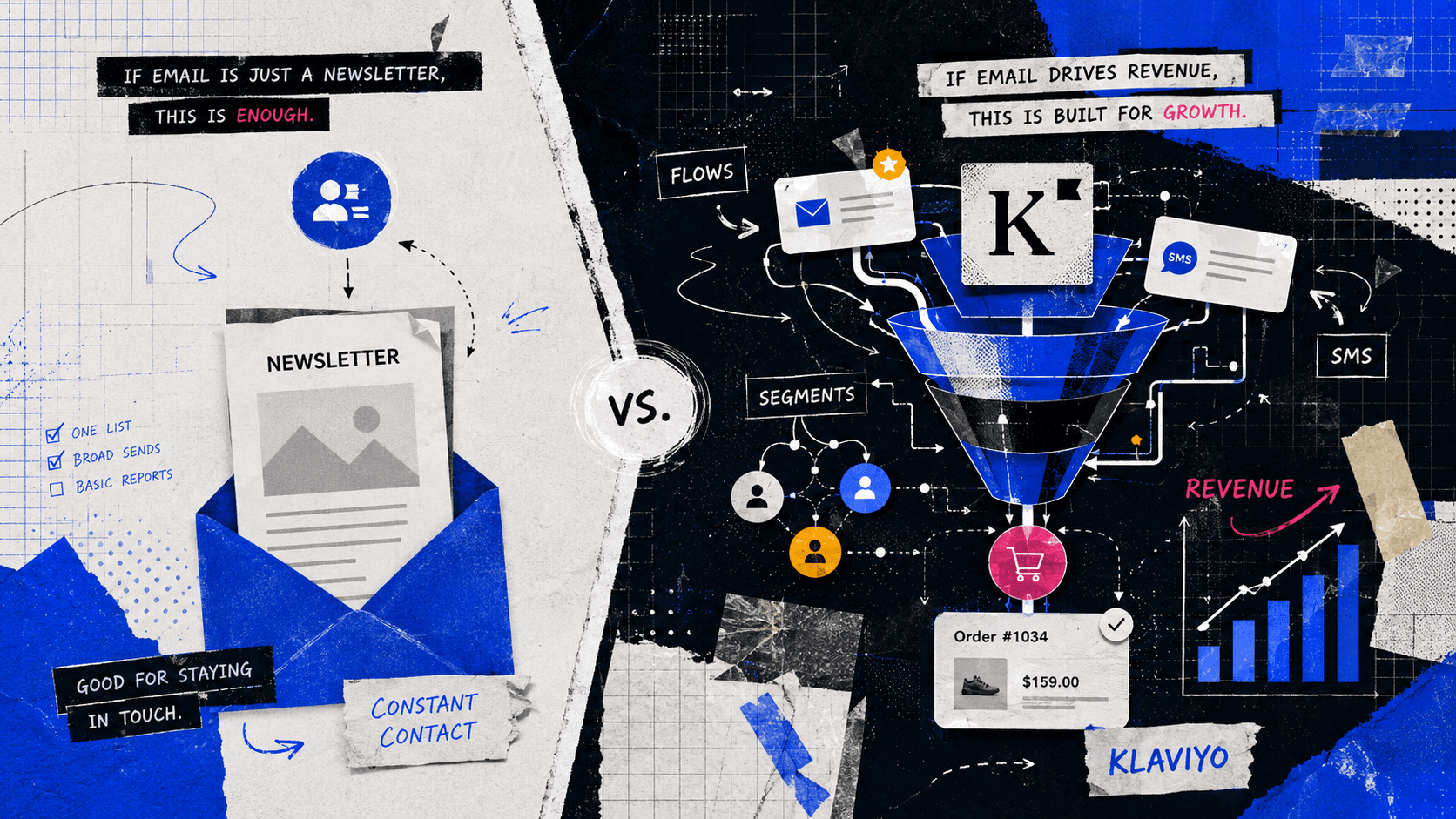
Pick Klaviyo if email is a revenue channel for your store. In our flow benchmarks, cart abandonment earns $1.50 per recipient and welcome flows $1.01, revenue that comes from behavior-triggered flows. Pick Constant Contact if you mainly send a newsletter and want the cheapest, simplest tool.
This verdict is based on running both platforms for DTC brands, migrating brands off Constant Contact onto Klaviyo, and checking our results against G2 and Capterra review data. Here is the honest comparison, including where Constant Contact is the smarter pick.
The Verdict: Klaviyo for Ecommerce, Constant Contact for Newsletters
For ecommerce, Klaviyo is the better platform. Its behavior-based flows, ecommerce segmentation, and native Shopify integration are built for stores where email and SMS drive revenue.
Constant Contact is the better choice for straightforward newsletters, non-ecommerce businesses, or teams that value ease of use over automation depth. If you are weighing Mailchimp instead, the trade-off turns on billing, which we cover in Klaviyo vs Mailchimp.
Core Comparison Matrix
| Decision Criteria | Klaviyo | Constant Contact |
|---|---|---|
| Ideal for | Ecommerce and DTC brands | Small business, newsletters, non-ecommerce |
| Primary strength | Behavior-based ecommerce automation | Simplicity and responsive support |
| Ecommerce automation | Best-in-class flows | Basic, calendar and action triggers |
| Segmentation | Behavioral and predictive | List and tag based |
| Ease of use | Steeper learning curve | Very easy |
| Free plan | Up to 250 contacts, full flows | Free trial only |
| Price starting at | ~$20/mo at 500 contacts | ~$12/mo |
| G2 rating | 4.6/5 | 4.0/5 |
| Overall for ecommerce | 4.5/5 | 3/5 |
How Do Klaviyo and Constant Contact Compare on Ecommerce Automation?
Klaviyo wins clearly. It triggers flows on product views, purchase history, and cart activity, the behavioral signals that actually drive store revenue. Constant Contact automates simpler sequences built on calendar dates and basic contact actions.
Klaviyo's flows are purpose-built for ecommerce: welcome, cart, browse abandonment, post-purchase, and win-back, plus predictive features like lifetime-value and churn scoring. This is why we go deep on Klaviyo flows, from the welcome flow through win-back, as the core of any store's email revenue.
Our flow benchmarks put numbers on the gap. Welcome flows earn $1.01 per recipient and winback $0.32, and both run on purchase and browse data that Constant Contact's simpler automation doesn't use.
Constant Contact does include automation, but it stays at the level of welcome notes and simple reminders. That is fine for a newsletter and thin for a store that needs to recover carts and reactivate lapsed buyers.
The Winner: Klaviyo. Score: Klaviyo 9/10, Constant Contact 5/10.
Which Is Cheaper, Klaviyo or Constant Contact?
Constant Contact is cheaper at the entry level, starting around $12 a month. Klaviyo starts near $20 a month at 500 contacts and scales with list size, to about $100 at 5,000 and $150 at 10,000, with SMS billed separately.
Klaviyo's free plan covers up to 250 contacts with full access to flows and segmentation, so a new store can build and test its entire automation engine before paying anything. See Klaviyo's pricing for the current bands.
Constant Contact's lower entry price is real, but its ecommerce features are thinner, so the cost per dollar of revenue can end up higher for a store. Cheaper software that recovers fewer carts is not actually cheaper.
The Winner: Constant Contact on raw price, Klaviyo on cost per revenue. Score: Klaviyo 7/10, Constant Contact 8/10.
How Do They Compare on Ease of Use?
Constant Contact wins. It is simpler to learn, faster from setup to first send, and its support is rated more responsive by users. Klaviyo is more powerful, and that power comes with a steeper learning curve.
For a small team sending occasional campaigns, Constant Contact gets you live quickly. For a store, Klaviyo's depth is worth the ramp, and the curve is exactly what a Klaviyo agency exists to flatten.
The Winner: Constant Contact. Score: Klaviyo 6/10, Constant Contact 8/10.
The Agency View: What We See After Migrations
We migrate brands off Constant Contact and similar tools onto Klaviyo often, and the lesson is always the same. The platform switch alone does not add revenue. Building the behavioral flows and using store data does.
The brands that see a step-change after moving are the ones that stop sending the same email to everyone and start personalizing off purchase and browse data, which is exactly what a general email tool cannot do. Our BFCM case study shows what that rebuild is worth once the flows and campaigns work together.
“Personalization at scale, using zero-party data to change the content of the email, consistently outperforms generic segmented lists.”
What Third-Party Reviews Say
The review data lines up with what we see in accounts. On G2, Klaviyo sits around 4.6 out of 5 while Constant Contact sits around 4.0, and the Capterra gap is narrower at 4.6 versus 4.3.
Klaviyo reviewers consistently praise its segmentation depth and ecommerce automation. Constant Contact reviewers just as consistently praise its ease of use and support responsiveness. Neither pattern is a surprise: they are strong at different jobs, for different buyers.
Final Comparison: Klaviyo vs Constant Contact
Klaviyo is the better platform for ecommerce. Its trade-offs are a steeper learning curve and pricing that climbs with list size.
Klaviyo strengths:
- Behavior-based flows triggered on product views, cart activity, and purchase history
- Predictive segmentation including lifetime value and churn scoring
- Native Shopify integration, with SMS on the same customer profile as email
- A genuine free plan up to 250 contacts with full access to flows
- Best-in-class abandoned-cart and post-purchase automation
Constant Contact is the better platform for simple, low-volume, non-ecommerce sending. Its trade-offs are limited automation and list-based segmentation that a growing store outgrows.
Constant Contact strengths:
- Easy to learn, with a fast path from setup to first send
- Support responsiveness rated highly by reviewers
- Cheaper at the entry level, starting around $12 a month
- Well suited to newsletters and low-volume, non-ecommerce sending
Overall for ecommerce: Klaviyo 4.5/5. Constant Contact 3/5.
FAQs
1. Is Constant Contact Good for DTC Brands?
For early or very simple DTC, it can work. For most growing brands it falls short, because its automation and segmentation are not built for cart recovery, browse abandonment, or behavior-based flows. Most DTC brands that start on Constant Contact outgrow it once email becomes a real revenue line.
2. When Should You Switch From Constant Contact to Klaviyo?
Switch when email becomes a revenue channel rather than a newsletter: when you need behavioral flows, want segmentation off purchase and browse data, are scaling on Shopify, or are leaving cart and post-purchase revenue on the table. If email is still occasional and simple, staying put is reasonable.