
The Results
Top Year-Over-Year Performers:
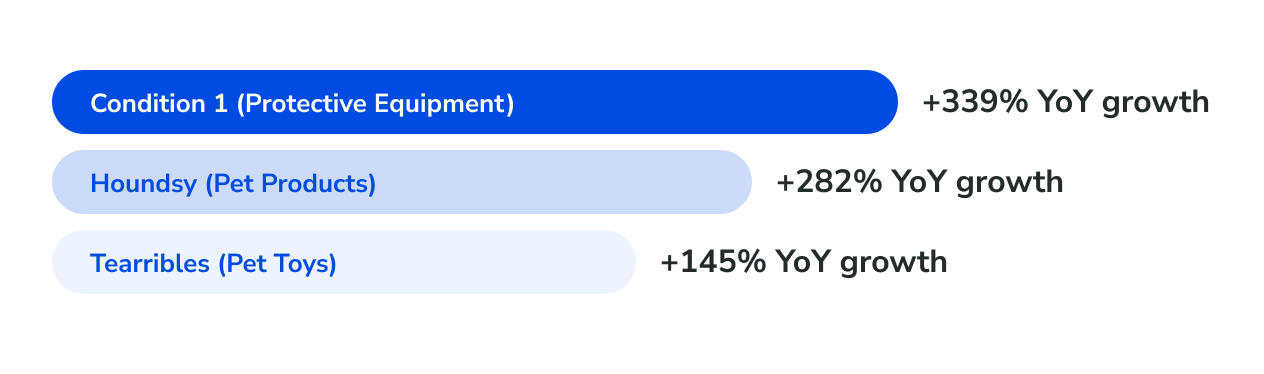
Additional standout brands: Hustle Butter (Tattoo Aftercare), Casamera (Bath Essentials), and The Tea Makers of London (Premium Tea).
The Real Challenge: Structure, Not Volume
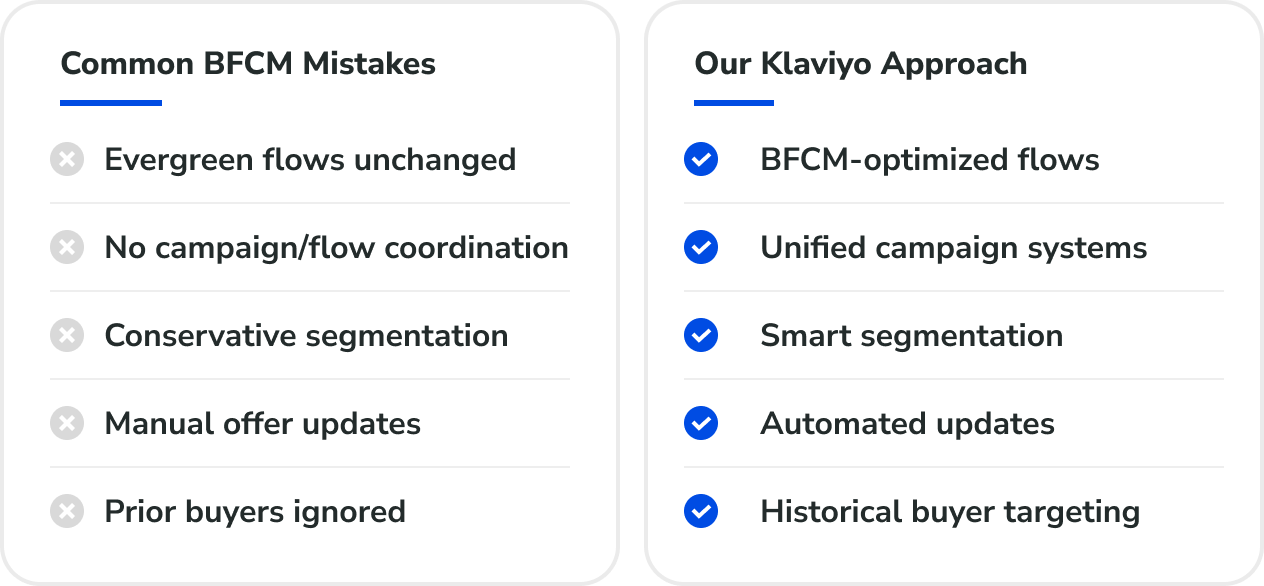
For most brands, BFCM problems don't start with demand, discounts, or list size. They start with structure. Across dozens of Klaviyo accounts, we consistently saw the same issues heading into promotional periods:
- Evergreen flows running unchanged during sales Standard welcome series and abandoned cart flows kept sending regular messaging while massive promotions were happening. High-intent subscribers saw generic content instead of BFCM offers.
- Campaigns and flows working against each other Promotional campaigns competed with flows rather than coordinating. No resends to non-openers, no behavior-based follow-ups, no strategic sequencing.
- Conservative segmentation limiting reach Tight targeting meant missing engaged subscribers and prior-year purchasers. Some sends were so narrowly segmented that reach collapsed during the biggest shopping days.
- Manual processes slowing execution Brands running multiple offers faced constant manual updates. Every offer change required editing dozens of emails and flows individually.
- Underutilized prior-year purchasers Historical Q4 buyers—people who had already demonstrated holiday purchase intent—were either excluded or treated the same as cold subscribers.
In short: brands were sending emails, but Klaviyo wasn't orchestrated to support a high-stakes launch window.
How We Solved It: Our Klaviyo Optimization Framework
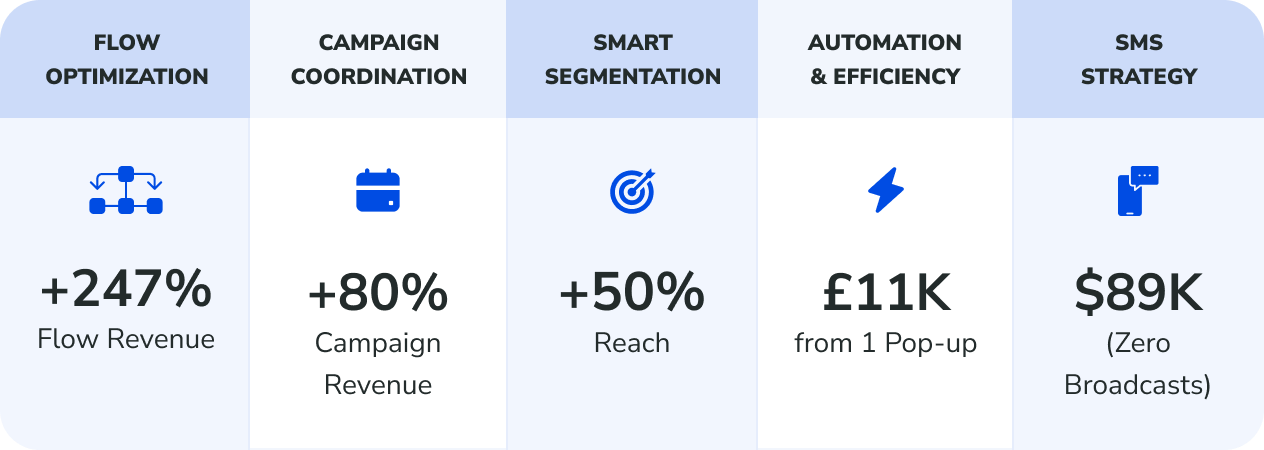
Rather than just sending more emails, we re-architected how our clients' Klaviyo accounts worked during BFCM.
1. Flow Optimization
We transformed evergreen flows into BFCM-specific revenue drivers. All core flows— welcome series, abandoned cart, post-purchase—received updated creative, dynamic content blocks with countdown timers, and behavior-based triggers. Using automatic flow scheduling, offers updated across all flows without manual work.
Result
Flow revenue increased 40-247% across brands. SMS flows alone generated $89,842 with zero broadcast sends.
2. Campaign Coordination
We built campaign systems, not just individual sends. Every email had a role: teasers built anticipation, launches drove traffic, resends captured non-openers, and follow-ups converted clickers. Plain-text founder emails cut through promotional noise at key moments. Morning and evening sends maximized reach.
Result
Campaign revenue increased 30-80% YoY . Evening resends generated 26% more revenue . One Black Friday launch became a brand's 3rd best-performing email of all time.
3. Smart Segmentation
We expanded reach intelligently using engagement-based logic instead of time-based filters. Prior-year Q4 purchasers got dedicated "welcome back" campaigns. Cold contacts were warmed before peak sends. B2B and B2C audiences received tailored messaging.
Result
50% more recipients reached without list fatigue. Engagement-based targeting unlocked scale while maintaining performance.
4. Automation & Efficiency
We leveraged Klaviyo's automation to handle complexity. Automatic flow scheduling swapped offers at predetermined times. Universal content blocks meant one update propagated instantly across all emails. Scheduled pop-ups appeared only during specific windows. Purchase-based flow filters personalized at scale.
Result
Manual updates eliminated. Teams moved fast without chaos. One pop-up generated £11K while live.
5. Behavior-Triggered SMS
The edge came from testing volume and narrative iteration speed. We found storytelling patterns that scaled, then refreshed continuously rather than relying on one winning narrative angle.
Result
MS generated $18-89K in incremental revenue per brand with minimal opt-outs
Why This Approach Worked Across Brands
These results weren't flukes. They were the outcome of systematic execution across five core principles:We didn't let underperformers linger hoping they'd improve. New creatives and audience tests were evaluated on early signals and either scaled or cut within days.
1. Strategy First, Volume With Purpose
High send volume wasn't avoided—it was orchestrated. Every email, SMS, and flow had a specific role in the buyer journey. Teased launches built anticipation. Coordinated flows caught high-intent moments. Behavior-based follow-ups ensured no opportunity was missed. SMS worked as a precision tool, not a blunt instrument.
2. Campaigns and Flows Worked Together
We didn't treat campaigns and flows as separate channels. They were choreographed as one unified system. Campaigns drove awareness, flows captured intent, SMS provided timely nudges. Everything worked together in coordinated sequences.
3. Automation Enabled Speed Without Chaos
Weekly offer changes and last-minute adjustments didn't slow teams down because we built systems that handled complexity automatically. Automatic flow scheduling, universal blocks, and scheduled pop-ups meant brands moved fast without breaking things.
4. Segmentation Unlocked Scale
We didn't choose between reach and performance—smart segmentation achieved both. Historical purchasers got tailored messaging. Engagement-based logic reached people by behavior, not arbitrary timeframes. Intent signals determined who got what message.
5. Small Optimizations Compounded
Banners added to flows. Resends to non-openers. Pop-ups at peak moments. Follow-up emails to clickers. Each improvement was modest individually, but when applied systematically across accounts, they multiplied into meaningful gains.
The Bottom Line
These results weren't about luck, bigger discounts, or list size. They were about building Klaviyo systems that hold up when it matters most—and continue driving revenue year-round. The infrastructure we built for BFCM 2025 didn't stop working on Cyber Monday. It became the foundation for ongoing performance. Flows optimized for peak periods kept performing during regular months. Segmentation logic refined under pressure improved everyday sends. Automation built for complexity made routine operations easier. This wasn't about a single weekend. It was about building systems that scale.