
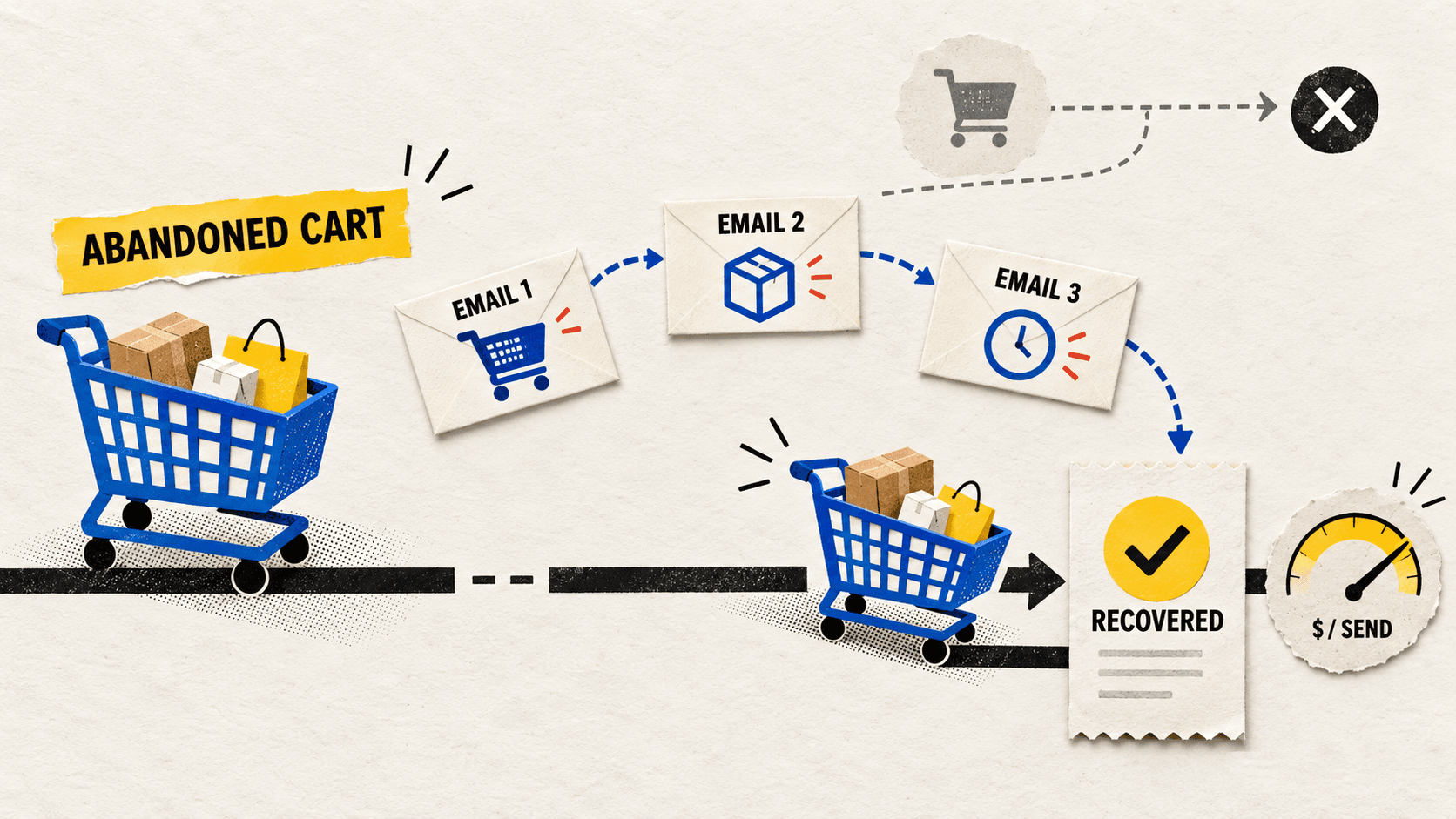
Almost every online store runs an abandoned cart email, and most run the same one: a single message, often with a discount, sent within the hour. It recovers some revenue, but leaves most of the flow's potential on the table.
Across the 14 brands in our flow benchmarks, cart abandonment earned more per send than any other flow, so how you build it matters more than whether you have one.
This post covers cart versus checkout, how many emails to send and when, what goes in each, the discount question, and how to measure the result.
TL;DR
- Cart abandonment earns more per send than any other flow in our data, $1.50 across 14 brands.
- Cart and checkout are different triggers for different shoppers. Run both, and set filters so no one gets both.
- Send two to three emails over a couple of days, with any offer saved for last.
- Update the flow during sales. A flow left on evergreen copy misses the promotion entirely.
What Is an Abandoned Cart Email?
An abandoned cart email is an automated message sent when a shopper adds items to their cart and leaves without buying, reminding them what they left and giving a direct path back to checkout. It belongs to a family of three abandonment emails, each triggered at a different point in the shopping journey.
| Triggered when | Intent | Revenue per send | |
|---|---|---|---|
| Browse abandonment | Viewed a product, did not add to cart | Lowest | $0.41 |
| Abandoned cart | Added to cart, did not check out | High | $1.50 |
| Abandoned checkout | Started checkout, did not finish | Highest | Grouped with cart |
The three fire at rising levels of intent. Someone who only browsed is a long shot, while someone who started checkout handed over their details and was moments from buying, which is why that moment earns the most.
Abandoned Cart vs Abandoned Checkout Emails: What's the Difference?
The difference is the trigger. An abandoned cart email fires when someone adds to cart, while an abandoned checkout email fires once they start checkout and enter contact details. Checkout is the higher-intent moment, and because it captures contact info, it can reach shoppers who were never on your list.
In Klaviyo these are two triggers. Added to Cart only reaches shoppers the platform can already identify. Started Checkout fires once someone enters their contact information, so it catches people who were not subscribers yet. Klaviyo recommends running them as separate flows, and Shopify has its own built-in abandoned checkout email.
Because a shopper often moves from cart to checkout, set filters so nobody gets both, and so anyone who buys drops out at once. In Klaviyo, add Started Checkout zero times since starting this flow to the cart flow, and Placed Order zero times since starting this flow to both.
Do Abandoned Cart Emails Work? What 14 Brands Show
Yes. In our flow benchmarks across 14 accounts, cart abandonment earned $1.50 per send, more than welcome at $1.01 or browse abandonment at $0.41. Every account we measured already runs it, so the flow is not a secret. The advantage is in how well it is built.
| Flow | Revenue per send | Total revenue | Adoption |
|---|---|---|---|
| Welcome | $1.01 | $298K | 100% |
| Cart abandonment | $1.50 | $127K | 100% |
| Browse abandonment | $0.41 | $76K | 100% |
That table looks like a contradiction until you break it down. Cart earns the most per send, but welcome brings in more total revenue, $298K against cart's $127K, simply because far more people sign up than abandon a full cart. Per send is the efficiency number; total revenue follows how many people enter the flow.
Klaviyo's own benchmarks point the same way. In Klaviyo's benchmark report across more than 110,000 customers, abandoned cart has the highest revenue per recipient of any flow, at $6.77 for email.
That counts revenue per person across the whole flow, so it is not comparable to our per-send figure, but it confirms the ranking: cart leads.
How Many Abandoned Cart Emails Should You Send?
Two to three. Klaviyo's guidance is that 2 to 3 messages perform best across the flow, yet over 60% of the accounts we audit still run a single email. That one email leaves money uncollected, because a second and third touch reach people who were busy, undecided, or waiting for a reason to come back.
A single reminder treats a multi-step decision as a one-shot. Spacing two or three emails over a couple of days gives the shopper room to return on their own before you add any incentive. For how the cart flow fits with the rest of your lifecycle, see the five core flows, and Klaviyo's own guidance lays out the same pattern.
When to Send Abandoned Cart Emails
Send the first email 2 to 4 hours after the cart is abandoned, the second 20 to 48 hours after that, and a third a day or two later if you include an offer. Klaviyo's pre-built flow waits 4 hours on the first send. Treat these as starting points to test, not fixed rules.
Higher-ticket products usually need longer gaps, because a $900 purchase gets more consideration than a $30 one, and a reminder that lands too fast can feel pushy. The right gap reaches people while they are still deciding, and that moment shifts with price and category.
What to Put in Each Abandoned Cart Email
Each email has a different job. The first is a simple reminder, the second handles the hesitation that stopped the sale, and the third is a last nudge. Keep every email focused on its one job, with a single clear button back to the cart.
| Job | Timing | What to include | Subject line | |
|---|---|---|---|---|
| 1 | Reminder | 2 to 4 hours | The items, an image, one button back to the cart | Direct: name the product |
| 2 | Handle the hesitation | 20 to 48 hours later | Reviews, shipping and returns, answers to likely objections | Direct, benefit-led |
| 3 | Last nudge | 1 to 2 days later | An offer only if you use one, or a true low-stock note | Direct; include the offer |
On subject lines, our subject line data across more than 4,000 campaigns shows a split. Soft, curious lines win opens, while direct lines win clicks and revenue. A cart email exists to recover revenue, so go direct: name the product in the first email, and lead with the benefit or the offer in the later ones.
Should Abandoned Cart Emails Include a Discount?
Not by default. Put a discount in the last email, if you use one at all, and test whether it actually lifts recovery. Leading with a discount trains shoppers to abandon on purpose, because they learn that leaving a full cart is the fastest route to a coupon.
Discounting every abandoned cart quietly builds a discounting habit into your customer base that is hard to unwind later. A better lever is to branch by cart value, the same principle as behavior-based segmentation.
A low-value cart may never justify an offer. A high-value cart might warrant free shipping or a small gift instead of a percentage off, which protects margin while clearing the final hesitation.
Should You Add SMS to the Abandoned Cart Flow?
SMS fits the abandonment moment well, because a text is read within minutes while an email can sit unopened for hours. Add it only for shoppers who opted in to texts, and keep it to one short message with a link back, timed close to the abandonment.
Used alongside email rather than as a second blast, it recovers the fastest-moving shoppers without adding noise.
What Most Brands Get Wrong About Abandoned Cart Emails
Three mistakes show up again and again: leaving the flow on evergreen copy during a sale, forgetting the purchase filter so buyers keep getting reminders, and running cart and checkout flows that double-send to the same person. Each one is quiet, and each one costs recovered revenue every week it runs.
The costliest is leaving the flow untouched during a promotion. In one five-brand BFCM program, the evergreen flows kept sending standard copy while major sales ran, so abandoners saw the wrong offer at the worst time.
After updating them with sale creative, countdown timers, and scheduled offer changes, flow revenue rose 40 to 247%, and the SMS flows alone earned $89,842 with zero broadcast sends.
The other two are simpler. Without a Placed Order filter, buyers keep getting “you left something behind” emails after they have paid, which erodes trust. And when cart and checkout run without exclusion filters, one shopper gets both flows at once. Both take minutes to fix.
“Winning brands treat their customers as ‘members’ rather than ‘transactions.’”
Devyn Pukteris, Head of Email & SMS, Sweat Pants Agency
Getting these details right across the whole flow is the kind of work that goes into the flows we build for the brands we manage.
How to Measure Abandoned Cart Email Performance
The core metric is recovery rate: orders placed from the flow divided by people who entered it. A healthy sequence recovers 10 to 15% of abandoned carts across all its emails. A rate below 8% usually points to a specific, fixable problem.
A rate under 8% almost always traces to one of three causes: a single email instead of a sequence, a first send that arrives too late, or an opening email that leads with a discount.
The second number to watch is revenue per send. Compare it with the benchmarks above, the same check we run in Klaviyo flow audits. If a flow earns well under $1.50 per send, there is room in the build.
Frequently Asked Questions
1. Are Abandoned Cart Emails Transactional or Marketing?
They are generally treated as marketing emails rather than transactional ones, because they are designed to drive a sale. Send them to people who have given the consent your local rules require, and check the regulations that apply to you. This is general guidance, not legal advice.
2. Should You Turn Off Shopify's Abandoned Checkout Email If You Use Klaviyo?
Yes, in most cases. Shopify's built-in abandoned checkout email runs separately from your Klaviyo flows, so leaving both on means the same shopper gets two reminders for one checkout. Turn off Shopify's version once your Klaviyo Started Checkout flow is live, and keep a single source for every abandonment message.