
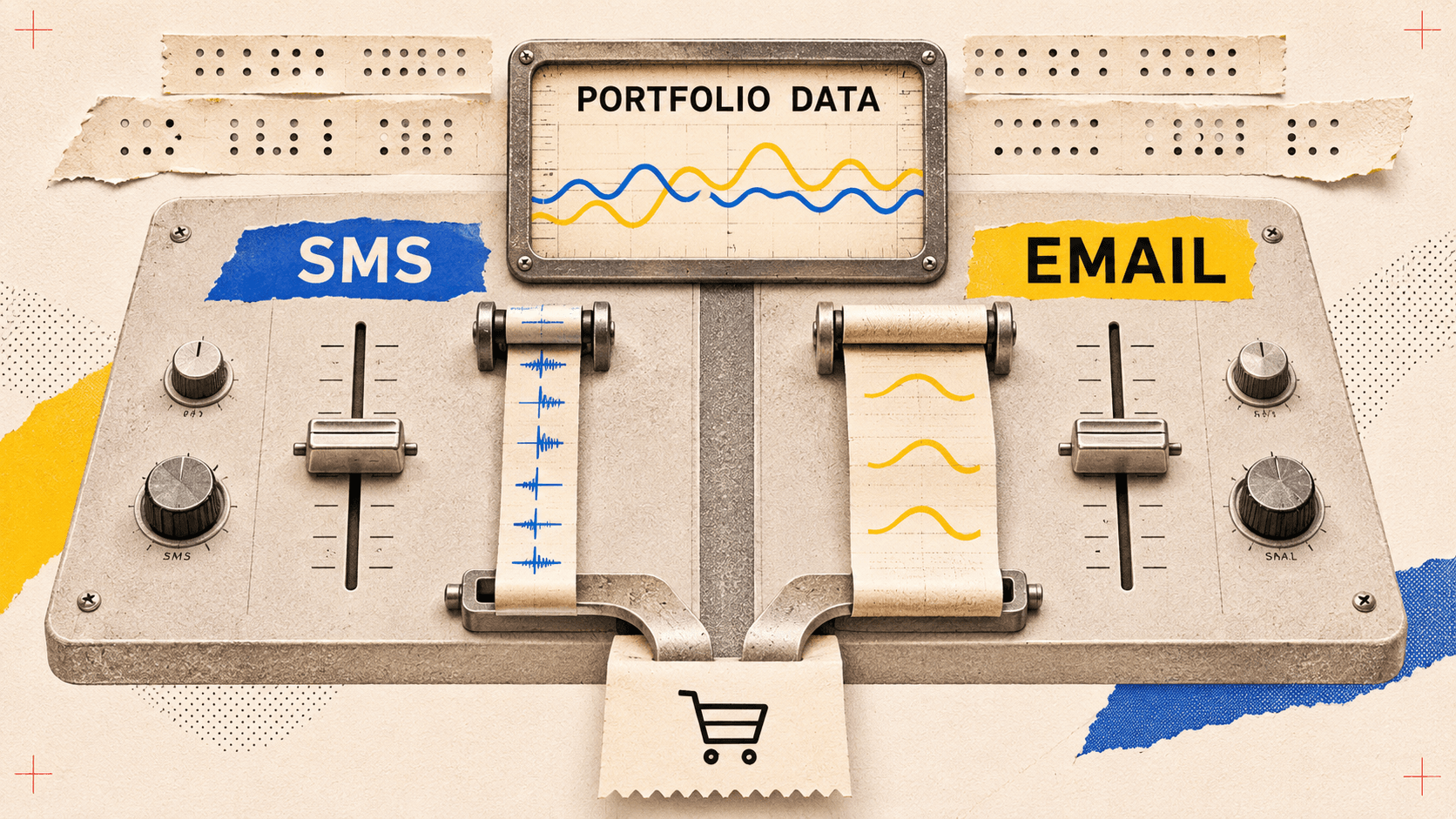
SMS gets about 12 times the median click rate of email across our portfolio, and that number is why so many DTC brands rush to add a texting program. The click is the easy part. Keeping the subscriber and turning that click into a sale is where the two channels pull apart.
Across the brands Sweat Pants Agency runs, SMS also costs about 4 times the unsubscribes of email per send, so every text spends down a list that is slow and costly to rebuild. That trade, more clicks for more churn, is the real decision behind SMS vs email marketing.
This post puts the two channels side by side on click rate, unsubscribe rate, and revenue, then sets out which job each one should actually do.
TL;DR
- SMS median click rate is 7.96% against email's 0.68%, but SMS unsubscribe rate is 1.28% against email's 0.32%.
- More clicks do not automatically mean more revenue. In Klaviyo's cart data, email earns more per recipient than SMS.
- Use SMS for time-sensitive moments and email for anything that needs explaining.
- Build email first, then add SMS where speed is the whole point.
SMS vs Email Marketing: The Key Differences
SMS and email marketing differ on four things that decide where each one belongs: how you get consent, how much you can say, how you pay for it, and how fast it gets read. For DTC brands weighing email marketing vs SMS, those differences explain every recommendation further down this page.
| SMS | ||
|---|---|---|
| Consent | Express written, before the first text | Varies by country, generally lighter |
| Message length | About 160 characters per segment | No practical limit |
| Billed by | Each message sent | Usually list size |
| How fast it's read | Within minutes, on the lock screen | When the inbox gets checked |
| Best at | Short, time-sensitive messages | Explaining, storytelling, depth |
The pattern underneath the table is that SMS is immediate but cramped and costly to send, while email is patient, roomy, and cheap per contact. That is why the honest answer is almost never one channel. It is knowing which message belongs in which place.
SMS vs Email Benchmarks: Click and Unsubscribe Rates
In our benchmarks report, the median SMS click rate is 7.96% against email's 0.68%, while the median SMS unsubscribe rate is 1.28% against email's 0.32%.
The email figures come from 31 senders and the SMS figures from 17 in the Sweat Pants Agency portfolio, so the ratios below are ratios of medians across the portfolio, not the same brands measured twice.
| Metric | Channel | P25 | Median | P75 |
|---|---|---|---|---|
| Click rate | SMS | 4.5% | 7.96% | 20.5% |
| Click rate | 0.35% | 0.68% | 1.00% | |
| Unsubscribe rate | SMS | 0.56% | 1.28% | 2.11% |
| Unsubscribe rate | 0.21% | 0.32% | 0.44% |
Read as medians, SMS gets roughly 12 times the click rate of email and costs roughly 4 times the unsubscribes per send. A cleaner way to hold both numbers at once is clicks per lost subscriber: SMS returns about 6 clicks for every opt-out it costs, while email returns about 2.
That is a rough ratio of medians rather than a precise rule, but it reframes the trade. SMS is not expensive per click, it is expensive in subscribers, and that distinction gets lost when SMS is simply called the higher-performing channel.
One number to ignore is the open rate. You will see a 98% SMS open rate quoted across vendor pages, and it is not something SMS platforms measure the way email opens are tracked. Click rate is the signal that holds up, which is why our SMS best practices lean on it.
Which Channel Earns More Per Recipient?
It depends on the moment. In cart flows, email earns more per recipient even though SMS wins the click. In Klaviyo's cart benchmarks, drawn from more than 110,000 of its customers, cart SMS earned a 10.3% click rate against 6% for email, yet email earned $6.77 per recipient against $4.48.
More taps did not mean more money there, likely because a shopper weighing a full cart wants room to read and decide, and the inbox gives it.
Our broadcast data shows the other side. In our send-time data, SMS at its best hour earned $0.489 per recipient against $0.250 for email at its best hour, over a 30-day window in April 2026. Treat those as each channel's peak rather than a typical send.
Read together, the two sources split cleanly. SMS can out-earn email when the buyer is ready to act in the moment, like a sale going live, and email earns more when the buyer still needs convincing, like a cart they are hesitating over. That is less a contest than a division of labor.
What Each Channel Really Costs
The real cost of SMS is not the per-message fee, it is the list. A median SMS send loses 1.28% of its recipients, and every opt-out closes the channel unless that person opts back in. Email carries a smaller version of that cost, which is why it can be sent more freely.
Email also has room to push harder. In our unsubscribe research, the highest-revenue quartile of email broadcasts runs at 0.4 to 0.7% unsubscribes, well above the 0.32% median, so email can accept a higher unsubscribe rate and still come out ahead on revenue.
SMS has less of that headroom, because its median unsubscribe rate already starts four times higher.
The billing models follow the same split. SMS is billed per message sent, so cost scales with how often you text, while email is usually billed by list size, so cost scales with how many contacts you keep. The right cadence for each comes from having a real reason to send, not from a fixed number.
When to Use SMS vs Email
The rule that holds across our accounts is simple: email leads anything that needs explaining, and SMS leads anything that is time-sensitive and short.
Email is the default channel because it is cheap to send, roomy enough to make a case, and forgiving on unsubscribes. SMS earns its place at the moments where speed is the entire value.
| Moment | Lead channel |
|---|---|
| Welcome and first purchase | Email, with an SMS nudge after a welcome flow click |
| Abandoned cart | Email first, one short text for opted-in shoppers in the cart flow |
| Flash sale, last call, restock | SMS |
| VIP early access | SMS |
| Product education, how-to, story | |
| Post-purchase and reorder | Email, with SMS for opted-in buyers |
| Win-back of lapsed customers |
The thread running through the table is consent and cost. SMS leads only where the moment is worth spending a slice of the list on, and everywhere else email does the work for a fraction of the churn.
SMS needs express written consent before the first text, and email consent rules vary by country, so collect each one separately. This is general guidance, not legal advice, so check the rules that apply to you.
How DTC Brands Split Revenue Between Email and SMS
In practice, SMS adds revenue on top of email rather than replacing it. In one three-day campaign for an organic food brand, email drove $19,700, SMS drove $10,500, and flows drove $1,800, for about $32,000 in total.
That put SMS at roughly a third of campaign revenue, earned alongside the email program rather than instead of it.
The lesson most email and SMS marketing comparisons miss is that the channels work best with separate jobs. Treat SMS as a second blast of the email calendar and you pay the unsubscribe cost without the upside. Give SMS the fast, urgent slice instead, and it adds revenue on top of what the inbox brings in.
Should You Add SMS Before Your Email Program Works?
No. Fix email flows and segmentation before adding SMS, because SMS magnifies whatever system is already in place, good or bad. A brand with leaky welcome and abandonment flows will simply pay to push more people through the same leaks, now with an unsubscribe cost attached.
A brand is ready for SMS when three things are true: the core email flows are live and converting, there is a steady reason to send time-sensitive messages like drops or restocks, and there is a clean way to collect SMS consent at checkout.
Without the first, SMS is premature. Without the second, it is a cost with no occasion. Getting that sequence right is the work that goes into the email and SMS programs we run for the brands we manage.
Frequently Asked Questions
1. Can You Use the Same Subscriber List for SMS and Email?
No. SMS and email require separate consent, so an email subscriber has not agreed to receive texts and cannot be added to an SMS list without opting in. Collecting a phone number at checkout is not the same as collecting SMS consent, so give each list its own clear opt-in.
2. Should SMS Subscribers Get a Different Offer Than Email Subscribers?
Often, yes. A subscriber who hands over a phone number has opted into a more personal channel, so a text should carry a sharper reason to act than the same week's email. Early access, genuine last calls, and restocks fit that bar better than a routine promotion repeated from the inbox.