
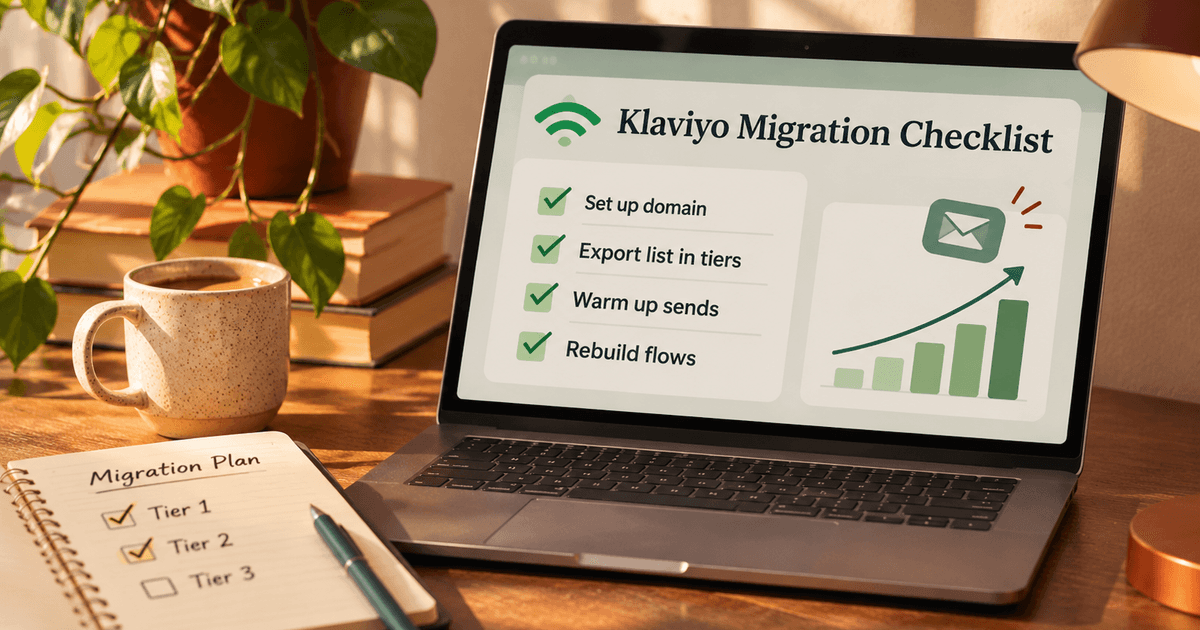
A Klaviyo migration checklist usually treats the switch as a data transfer: export contacts, import them, turn the flows back on. The transfer is the easy part. The real risk is a brand-new sending domain emailing your whole list on day one, before inbox providers have any reason to trust it.
When we moved an indie tabletop game brand's 14,300 contacts off Seguno, nine tiered warm-up sends over three weeks delivered 20,185 emails with a single spam complaint. Within seven weeks, email's share of store revenue went from about 14% to 29.3%.
This is the checklist we ran, in order: setup before export, the warm-up schedule, which flows to rebuild first, and what does not carry over.
What Should a Klaviyo Migration Checklist Include?
A Klaviyo migration runs in three phases: set up the domain and export your list in engagement tiers, warm up the new account by sending to the most engaged contacts first, then rebuild flows and campaigns once the domain is trusted. Budget about seven weeks from first send to a fully running program.
| Phase | When | Checklist | Done when |
|---|---|---|---|
| 1. Set up and export | 2 to 4 weeks before the first send | Branded sending domain, SPF, DKIM and DMARC; export engagement segments at 15, 30, 60, 90, 120 and 180 days; dedupe each tier; import unsubscribes and bounces as suppressions | Every tier is a clean CSV and nothing unsubscribed is in a send list |
| 2. Warm up | About 3 weeks | Seed list first, then the 15-day tier, then colder tiers in small batches; net-new contacts only on each send; re-export on send day | Open and spam rates hold as colder tiers go out |
| 3. Rebuild and launch | Weeks 2 to 5 | Welcome flow first, then cart, checkout and browse flows; campaign calendar to engaged segments | Flows live, campaigns sending, old ESP retired |
What Most Klaviyo Migration Checklists Get Wrong
The standard advice is to import everything and send a “we've moved” campaign. That is the fastest way to damage a new domain. Cold contacts open less, complain more, and bounce more, and inbox providers judge a new sender on its first sends.
In our migration, open rates fell to 10.4% for the 60-day tier and 8.7% for the 90-day tier. Sent first, those contacts would have set the new domain's reputation. Sent after the engaged tiers, they were absorbed. A blended send on Day 20 came back at a 58.1% open rate.
Importing everything also costs money. Klaviyo bills on every profile it can email, so a cold list you never mail still raises the bill. That is the most common surprise we see after a switch from Mailchimp. Suppress or leave out the 180-day-plus contacts before import, not after the first invoice.
How Do You Prepare Your List Before Migrating to Klaviyo?
Set up a branded sending domain with DMARC before anything else, then export your list from the old platform as separate engagement tiers rather than one file. Import unsubscribes and all-time bounces as suppressions so nobody who opted out moves over.
Our phase 1 checklist:
- Branded sending domain connected in Klaviyo, with SPF, DKIM and DMARC passing
- Engagement segments exported from the old ESP at 15, 30, 60, 90, 120 and 180 days
- Each tier deduplicated against the warmer tiers, so every contact sits in exactly one
- Unsubscribes and all-time bounces imported as suppressions
- Contacts with no engagement in 180+ days left out of the warm-up (see list cleaning for how to handle them later)
One step most guides skip: export again on every send day. Engagement changes daily during a migration, and a fresh export keeps each batch sized to the latest data. Klaviyo support recommends the same approach.
How Long Does It Take to Warm Up a New Klaviyo Account?
Plan on about three weeks. Start with a small seed list, send to your most engaged contacts next, then add colder tiers in small batches, sending only to contacts who have not had a warm-up email yet. Our nine-send warm-up ran from September 10 to 30.
| Send | Audience | Result |
|---|---|---|
| Seed | 98 contacts | Baseline check before real volume |
| Day 3 | 6,710 contacts engaged in the last 15 days | 69.7% open rate; 55% of the warm-up's revenue |
| Later sends | 30- to 180-day tiers, net-new only | Opens fell to 10.4% (60-day) and 8.7% (90-day) |
| Day 20 | 8,312 contacts, cold tiers blended with engaged | 58.1% open rate |
| All 9 sends | 20,185 emails | 51.7% open, 0.10% bounce, 0.005% spam (1 complaint) |
Source: one Seguno-to-Klaviyo migration, 14,300 contacts, September 2026.
The warm-up does not have to cost revenue. We used the founder's best-performing email, a back-in-stock announcement, as the warm-up send itself. It kept running through the switch and produced 77% of September's email revenue.
Which Klaviyo Flows Should You Build First After Migrating?
Build the welcome flow first, as soon as the domain is warm, then the cart, checkout and browse abandonment flows. In our migration, the welcome flow alone drove 80% of flow revenue and 8.9% of total store revenue in its first month.
| Flow | Live | Share of flow revenue (Sep 22 to Oct 22) |
|---|---|---|
| Welcome (site pop-up) | September 21 | 80% |
| Added to Cart | October 5 | 9% |
| Abandoned Checkout | By October 12 | 8% |
| Browse Abandonment | October 5 | 4% |
| Subscription Onboarding | October 12 | Too new to measure |
Flow revenue grew 47x against the prior 30 days, mostly because the old platform never ran browse or added-to-cart flows. Our flow benchmarks show the same order across a wider portfolio: cart and welcome flows earn the most per recipient, so they go first.
The abandoned cart guide covers how to build that sequence.
What Doesn't Transfer When You Migrate to Klaviyo?
Contacts, consent status and suppressions transfer by CSV, and Klaviyo backfills order history once Shopify is connected. Engagement history, templates and your old platform's revenue reporting do not. Plan to rebuild every email and keep your old reports as the baseline.
| Data | Transfers? | What to do |
|---|---|---|
| Contacts and consent status | Yes, by CSV | Import tier by tier, not as one list |
| Unsubscribes and bounces | Yes, by CSV | Import as suppressions before the first send |
| Order history (Shopify) | Yes, backfilled | Connect the store before building flows |
| Opens and clicks history | No | Rebuild engagement segments from Klaviyo data after the warm-up |
| Templates and flows | Usually no | Rebuild; our client's Seguno templates could not be exported |
| Old revenue attribution | No | Keep the old ESP's own reports as your baseline |
The last row trips up most post-migration reports. Klaviyo's dashboard compares against a “previous period” it cannot see. In our migration that window showed 4.4% email revenue share, because the old platform's revenue was invisible to Klaviyo. The real baseline, from Seguno's own reporting, was about 14%.
How Do You Know a Klaviyo Migration Worked?
Compare email's share of store revenue against the old platform's own reporting, and expect a dip during the warm-up month. Then check the deliverability metrics against Klaviyo's benchmarks. A healthy migration shows share back above baseline within four to six weeks of the first send.
| Metric | Old platform (May to Jul) | Warm-up month (Sep) | First full month (Oct 1 to 27) |
|---|---|---|---|
| Email share of store revenue | ~14% | 10.2% | 29.3% |
| Klaviyo deliverability score | n/a | 82 | 86 |
When we ran this migration for an indie tabletop game brand, email's share of revenue doubled to 29.3% while spam complaints held at 0.003%, and the founder's first Kickstarter funded on day one from the launch email.
The full timeline is in our Klaviyo migration case study.
If you would rather not run the tiers yourself, this is the process our Klaviyo agency team uses on every migration.
Frequently Asked Questions
1. Can You Migrate to Klaviyo Right Before Black Friday?
You can, but start early. A tiered warm-up takes about three weeks, and flows need a few more weeks to build and test, so the switch should begin by early September for a November peak. Our client started its warm-up on September 10 and had five flows live by October 12, with weeks to spare.
2. Should You Cancel Your Old Email Platform Right Away?
No. Keep it until every tier has been exported, imported and sent, and until you have downloaded its revenue reports. Those reports are the only record of your pre-migration baseline, since Klaviyo cannot see revenue that was attributed elsewhere. Cancel once the last warm-up send is out and the data is saved.
3. Do You Need a Dedicated IP to Migrate to Klaviyo?
Not for most DTC brands. Klaviyo sends from shared infrastructure by default, and a branded sending domain with SPF, DKIM and DMARC is what builds your reputation at this size. Dedicated IPs are for very high-volume senders, and they need their own warm-up on top of the domain warm-up.