
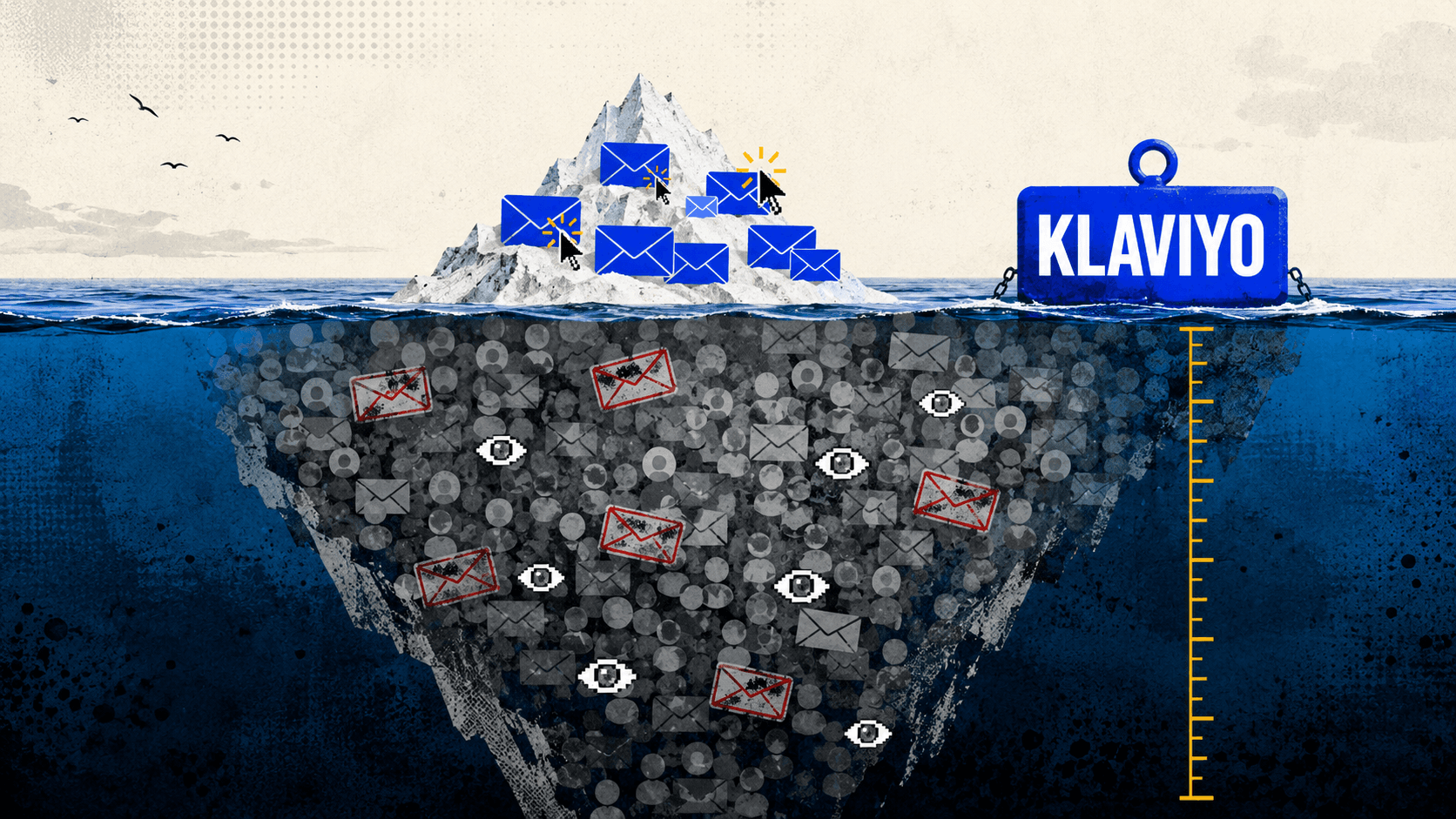
A bigger email list looks like growth right up until it isn't. Past a certain size, the dead weight works against you: inbox placement slips, the Klaviyo bill climbs, and the people who still want your email get buried under the ones who left months ago.
Cleaning fixes that, but only if you cut the right profiles. The signal almost everyone reaches for, open rate, went dark the day Apple Mail Privacy Protection started firing the pixel for subscribers who never opened a thing.
So this Klaviyo list-cleaning guide works off what MPP cannot fake, bounce rate and clicks, with the benchmark to show where your list stands.
TL;DR
- Bounce rate is the list-health signal Apple MPP cannot fake. The median DTC bounce rate is 0.46%, and a rate climbing past 0.6% is your signal to clean.
- Stop deciding who to cut by open rate. MPP inflates opens to a 53.7% median, so a high open rate no longer tells you who is actually reading.
- Suppress, do not delete. Suppressed profiles keep their full history, drop off your Klaviyo bill, and can re-subscribe on their own.
- Clean on a quarterly cadence, or sooner as bounce rises. Cutting so hard that your unsubscribe rate falls under 0.1% removes revenue, not risk.
What Klaviyo List Cleaning Is
Klaviyo list cleaning is the practice of removing or suppressing the profiles you should not be emailing: invalid and bounced addresses, likely spam traps, and subscribers who have gone quiet. The goal is not a smaller list for its own sake. It is a list where the people receiving your email are the people who might actually read it.
It matters for three reasons. Dead weight drags your sender reputation, which lowers inbox placement for everyone else. It raises your odds of hitting spam traps and the spam folder during high-volume sends. And because Klaviyo bills on active profiles, every unengaged subscriber you keep is a line item you pay for monthly.
The hard part was never the concept. It is knowing who actually counts as unengaged, and that is where most guides, and most accounts, go wrong.
What a Healthy Klaviyo List Looks Like
Before you clean anything, you need a number for what healthy looks like, and almost nobody publishes one. Here is the bounce-rate distribution from our portfolio, the single clearest measure of list health.
| Percentile | Email bounce rate |
|---|---|
| P10 | 0.16% |
| P25 | 0.18% |
| P50 (median) | 0.46% |
| P75 | 0.62% |
| P90 | 1.22% |
That comes from the bounce-rate distribution across our portfolio, across 31 active email senders over a trailing 12 months.
The bottom three quartiles pack between 0.16% and 0.62%, then P90 leaps to 1.22%, nearly three times the median. A clean list sits under about 0.6%. The brands up at 1.22% are the ones carrying a real hygiene problem, and that jump is your cleaning trigger.
Bounce earns this role because MPP cannot inflate it. Open rate can be pumped up by a pixel firing on nobody's behalf, which is why the median DTC open rate reads a misleading 53.7%. A bounce is a server rejecting a real send, so the number stays honest. Measure list health on bounce and clicks, not opens.
How to Decide Who to Clean (Without Trusting Opens)
So who makes the cut? Build your unengaged segment on behavior you can trust, and use opens only as a tiebreaker. Here is the segment logic we use in Klaviyo:
- Received at least one email in the window. If you never mailed someone, you cannot call them unengaged, you just never gave them the chance.
- Zero clicks and zero site activity in the window. These are the signals a real, interested human produces, and MPP cannot manufacture either one.
- No purchase in the last 12 months. A buyer who ignores your marketing email is still a customer, not a cleaning candidate.
- Created more than 90 days ago. New subscribers are still inside the welcome window and have not had a fair chance to engage.
Notice that clicks sit alongside site activity, never alone. Clicks are rare enough on any single send that a click-only rule would flag people who are reading and buying, which is why how we define an engaged subscriber pairs them with browsing and purchase signals.
Most accounts build this segment wrong, usually by leaning on opens or forgetting the purchase exclusion, which is one of the first things what we check in a Klaviyo flows audit surfaces.
Bounces: Soft vs Hard, and When to Remove
Bounces are where list cleaning gets concrete, and where the benchmark above turns into action. A hard bounce means the address is permanently undeliverable, usually because it is fake, mistyped, or the domain is gone. Klaviyo suppresses hard bounces automatically after the first one, so those mostly handle themselves.
Soft bounces are the ones that need judgment. A soft bounce is a temporary failure, a full inbox or a server that is briefly down, and Klaviyo only auto-suppresses an address after seven consecutive soft bounces. We do not wait for seven. If an address soft bounces four times running, we pull it, because a mailbox rejecting that many sends is rarely coming back and every attempt chips at your reputation.
Tie this back to the benchmark. If your overall bounce rate is drifting toward the 0.62% P75, a soft-bounce backlog is usually the cause, and it is time to clean rather than wait. Klaviyo's own list-cleaning documentation covers how to suppress these profiles in bulk, and it is worth reading next to your own bounce numbers.
Spam Traps and How to Find Them in Klaviyo
Spam traps are the part of list cleaning nobody can give you a clean number for, us included. A spam trap is an address created or repurposed by a mailbox provider to catch senders who are not managing their lists, and by design it never engages and never announces itself.
Because the addresses are hidden, you cannot target them directly. What you can do is build a proxy: a segment of profiles that have never opened, never clicked, never visited the site, and never purchased across their entire history. Recycled and pristine spam traps tend to live in exactly that never-active group.
For a large account, you can go further and test a small sample of that segment, a few hundred profiles, in an isolated send. If they stay silent, that is your confirmation, and you suppress the group. This is mechanics rather than data, but it is the difference between a list that reaches the inbox and one that quietly does not.
Suppress vs Delete in Klaviyo
When you clean, you have two options for each profile, and they are not interchangeable. Suppressing keeps the profile in Klaviyo with its full history, stops all marketing sends, and drops it out of your active-profile count, which is the number Klaviyo bills you on. Deleting erases the profile and everything attached to it.
Suppress by default. A suppressed profile can re-subscribe on its own later and return with its purchase history and engagement record intact, which means a returning customer is still a known customer. Delete only when you are legally required to, such as a GDPR erasure request, because deletion is permanent and unrecoverable.
This decision gets sharpest at the end of a sunset flow, where you choose whether a quiet subscriber is worth one more send. We wrote the full logic for that call in a separate piece on when to actually suppress subscribers.
Keep the Unengaged Out of Campaigns and Flows
Cleaning is not only suppression. For subscribers who are quiet but not yet dead, the move is to mail them less often, not to cut them.
In Klaviyo, exclude your unengaged segment from campaigns using the “Don't send to” field, and add a flow filter to high-volume flows so those profiles stop entering them. That protects your reputation while leaving the door open, since a quiet subscriber who clicks or buys drops back into your engaged segment on their own.
Do this on an ongoing basis, because an unengaged segment you exclude today refills every week as more subscribers go cold. Keeping that exclusion current as you scale is a standing part of what our Klaviyo team runs day to day.
What Over-Cleaning Costs You
Here is the counterweight, because cleaning too aggressively has a cost most guides never mention. In our unsubscribe calibration research across 126 broadcasts over a trailing 12 months, the brands mailing hardest tended to earn more revenue per recipient, and an unsubscribe rate below 0.1% usually signals under-mailing rather than a pristine list.
Read that against the cleaning decision. A subscriber just outside your engagement window may still be worth mailing, so remove the genuinely dead, not the merely quiet. Cut too deep and you are deleting revenue and calling it hygiene.
The upside of protecting an engaged base rather than trimming it shows up in a retention program that drove roughly 9x email and SMS revenue. A well-kept list is an asset you build on, not a cost you minimize.
The Deliverability Standards You Are Cleaning For
List cleaning is not busywork. It is how you meet the standards that decide whether your email reaches the inbox at all, and those standards got stricter in 2024.
Google and Yahoo now require bulk senders, anyone sending more than 5,000 messages a day, to authenticate with SPF, DKIM, and DMARC, to offer one-click unsubscribe, and to keep their spam-complaint rate below 0.3%, with under 0.1% as the real target. Cross the complaint threshold and your delivery degrades fast, and no subject line saves you. The full requirements live in Google's bulk sender guidelines.
The legal floor matters too. Under the CAN-SPAM Act, each violating email now carries a civil penalty of up to $53,088, per the FTC's current inflation adjustment. A dirty list that keeps mailing people who never consented is not only a deliverability risk, it is a compliance one.
How Often Should You Clean Your Klaviyo List?
Clean on a schedule and on a trigger, not on a hunch. As a default, run a full cleaning pass once a quarter, which keeps bounces and unengaged profiles from compounding between reviews.
The trigger matters more than the calendar. The moment your bounce rate climbs toward the 0.62% P75, clean immediately regardless of the quarter, because a rising bounce rate is your list telling you it has decayed.
Keeping that cadence honest across a growing account is real, ongoing work. The brands that stay clean treat it as maintenance, not a rescue mission run once deliverability has already dropped.
Common Klaviyo List-Cleaning Mistakes
Most of the damage we see traces back to a short list of repeatable errors.
- Cleaning on opens in the MPP era. An open no longer proves a human is there, so an opens-based rule keeps dead profiles and cuts live ones.
- Deleting instead of suppressing. Deletion is permanent and erases the history you would want back the day that customer returns.
- Suppressing purchasers who never open. A repeat buyer who ignores marketing email is still revenue, and cutting them is self-inflicted.
- Waiting for Klaviyo's seventh soft bounce. By then the reputation damage is done, so pull persistent soft bounces at four.
- Cleaning a huge chunk at once with no plan. Suppressing hundreds of thousands of profiles in a single day can disrupt your sending patterns, so stage it and monitor.
- Never cleaning until deliverability drops. Once inbox placement falls, you are recovering a reputation instead of protecting one.
Frequently Asked Questions
1. How Often Should I Clean My Klaviyo List?
Run a full pass quarterly as a baseline, and clean sooner the moment your bounce rate climbs toward the 0.62% P75. The calendar keeps you honest, but the bounce trend is the real trigger. A high-volume sender may need a monthly check, while a small, slow list can go longer between passes.
2. What Is a Good Email Bounce Rate in Klaviyo?
Across 31 active senders in our portfolio, the median DTC bounce rate is 0.46%, and the healthy range sits under about 0.6%. Push past 0.62% and you are in the worst decile, and it is time to clean. Consistently above 1% points to a list-acquisition problem, not just a hygiene one.
3. Should I Suppress or Delete Unengaged Subscribers?
Suppress by default. Suppression stops the sends, keeps the profile and its full history, and removes it from your billable active-profile count, and the person can re-subscribe later on their own. Delete only for compliance requests like a GDPR erasure, because deletion is permanent and takes the history with it.
4. Does Cleaning My List Lower My Klaviyo Bill?
Yes. Klaviyo bills on active profiles, so suppressing unengaged subscribers drops them out of that count while keeping their data in your account. You stop paying to hold people as active and stop mailing them, without losing the purchase and engagement history you may want later.
5. Will Cleaning My List Actually Improve Deliverability?
Usually, though not overnight. Removing profiles that never open, click, or buy raises your overall engagement signals, which is what Gmail and Yahoo watch when deciding inbox placement. The effect builds over a few send cycles as your sender reputation recovers, so treat cleaning as ongoing maintenance rather than a one-time fix.