
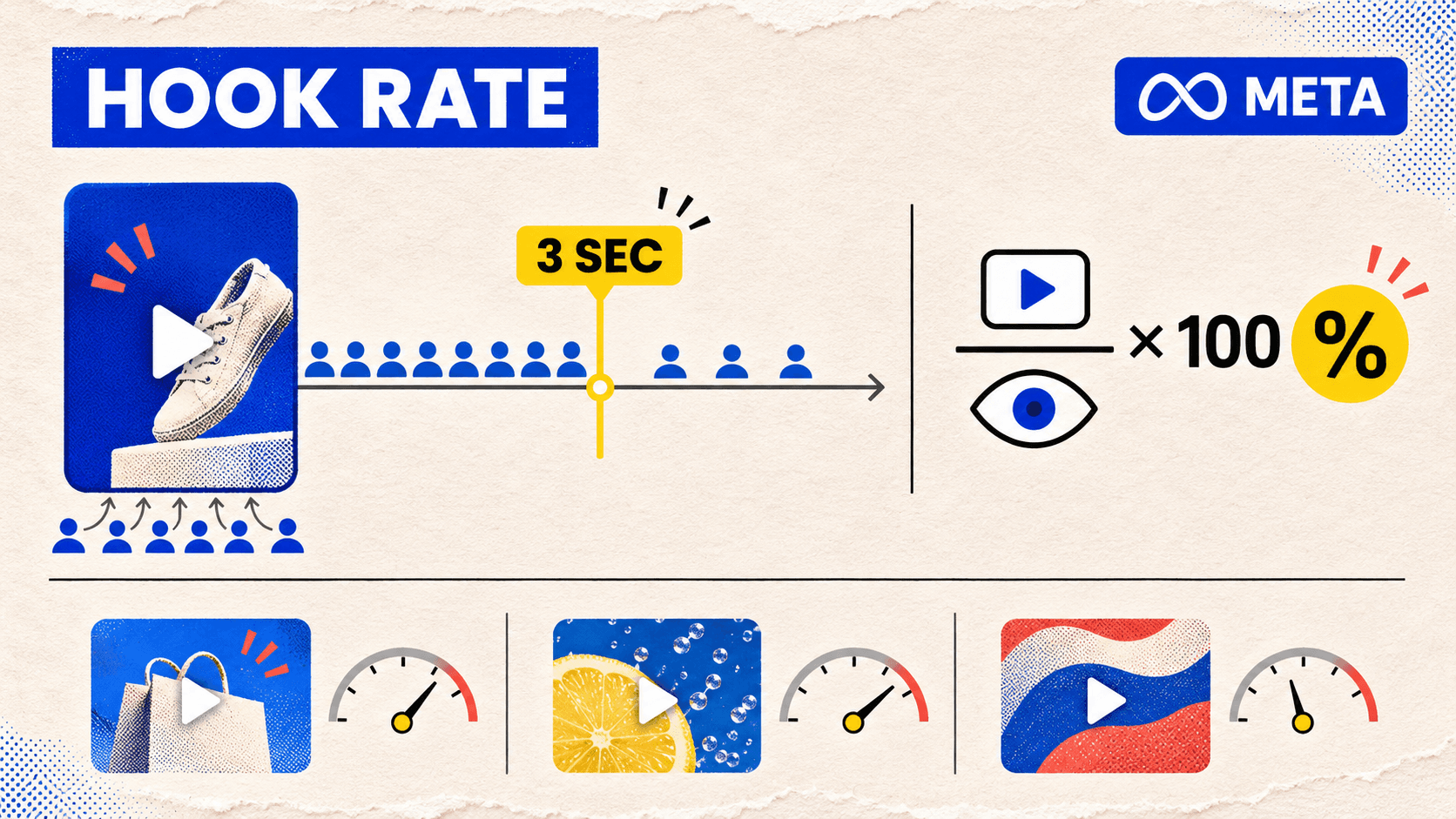
Hook rate is the share of ad impressions that turn into a 3-second video play, the people who stopped scrolling long enough to watch. Across the Meta video ads Sweat Pants Agency runs for DTC brands, the median hook rate is 24.5%, where 33% is good and 40% is great.
Hold rate is its partner, the share of those 3-second viewers who keep watching to a ThruPlay, with a median around 22%. These are the ranges our media buyers use to judge a new video ad before its budget scales.
This post covers how to calculate both, how to add them in Ads Manager, what a good rate is, why hold-rate benchmarks online disagree, and how to read both next to CPA.
TL;DR
- Hook rate is 3-second video plays divided by impressions. Our median is 24.5%, with 33% good and 40% great.
- Hold rate is ThruPlays divided by 3-second plays. Our median is 22%, with 28% good and 36% great.
- Online hold-rate benchmarks disagree because sites use different definitions, such as 15-second plays instead of ThruPlays.
- Read hook, hold, and CPA together. Attention without a sale is an offer or landing-page problem, not a creative one.
What Is Hook Rate on Meta Ads?
Hook rate on Meta is the percentage of impressions that become a 3-second video play, calculated as 3-second video plays divided by impressions, multiplied by 100. It measures one thing: how many people stopped scrolling when your ad hit the feed. Media buyers also call it thumb-stop rate.
Hook rate applies to video ads only, because the metric depends on a 3-second play that a static image cannot produce. For a static ad, the equivalent early signal is click-through rate, read alongside CPA.
How to Calculate Hook Rate in Meta Ads Manager
You calculate hook rate in Meta Ads Manager by building it as a custom metric, so it shows up as a column next to every video ad. Go to Columns, then Customize columns, then Create custom metric, and define it as 3-second video plays divided by impressions, formatted as a percentage.
Build hold rate the same way, as ThruPlays divided by 3-second video plays.
The math is simple once the column is live. An ad with 10,000 impressions and 2,450 3-second plays has a hook rate of 24.5%. From there you can sort your whole account by hook rate and see which openers are actually stopping the scroll.
What Is a Good Hook Rate for Meta Ads?
A good hook rate on Meta is 33% or higher, a great one is 40% or higher, and the median sits at 24.5%. In other words, a third of impressions becoming a 3-second play is a strong opener, and anything above 40% is rare. Hold rate follows the same tiers at lower numbers.
| Metric | Formula | Median | Good | Great |
|---|---|---|---|---|
| Hook rate | 3-second video plays ÷ impressions | 24.5% | 33%+ | 40%+ |
| Hold rate | ThruPlays ÷ 3-second video plays | 22% | 28%+ | 36%+ |
These ranges come from the Meta video ads we manage for DTC brands. They line up with the wider picture, too: a creative platform's public study of more than 88,000 Meta ads put the average hook rate near 25%, close to our median.
Compare any ad within one format and placement, because Reels and Feed do not share a baseline, and judging a Reels hook against a Feed number will mislead you.
What Is Hold Rate, and Why Do Benchmarks Disagree?
Hold rate is the share of 3-second viewers who keep watching, calculated as ThruPlays divided by 3-second video plays. The median in our accounts is 22%, with 28% counting as good and 36% as great.
Where hook rate measures whether the opener stops the scroll, hold rate measures whether the rest of the ad earns the attention it caught.
Online benchmarks disagree because they do not all measure the same thing. Some sites divide 15-second plays instead of ThruPlays, others use average watch time or a different base entirely, which is how “good” targets as high as 40 to 50% end up next to ours.
Pick one definition and keep it. We use ThruPlays, because Meta reports it on every video ad, which makes it consistent across an account.
The two metrics map to two jobs. For a children's vitamin brand we ran, the opener named the parent's problem, the mood swings and the picky eating, and the ingredient story came later. The rule our buyers work to is blunt: lead with the outcome, because the ingredient panel earns the click on the second scroll.
Hook rate measures that first job and hold rate the second. That account scaled prospecting from $3,000 to $5,000 a day up to $8,000 to $10,000 a day at about $30 CAC.
How to Read Hook Rate, Hold Rate and CPA Together (The Three-Gate Read)
No single metric tells you what to do next, so read hook rate, hold rate, and CPA as a set. Hook rate is the first gate, hold rate the second, and CPA the one that decides whether the ad is actually working. The combination points to the fix.
| Hook | Hold | CPA | What it means | Fix |
|---|---|---|---|---|
| Low | High | Good | The right people stay, too few stop | Test new openers on the same body |
| High | Low | Poor | The opener promises what the ad doesn't deliver | Rewrite the first line to match the offer |
| High | High | Poor | Attention isn't the problem | Look at the offer and the landing page |
| Low | Low | Poor | Wrong concept | Kill it, don't iterate |
| Any | Any | Good | It works | Scale, and watch for ad fatigue |
The row that catches the most brands is high hook, high hold, poor CPA. The attention is there, people stop and they watch, so the instinct is to keep tweaking the creative.
The real problem is downstream, in the offer or the landing page, and another opener will not fix a page that does not convert.
Hook rate and hold rate measure attention, not purchase intent, which is why neither predicted ROAS in our research. For the signals that actually track with return, see what predicts ROAS.
How to Improve Hook Rate on Meta Ads
The fastest way to improve hook rate is to change the first second, not the whole ad: put a fresh opener on a body that already converts. The opener is doing the stopping, so testing openers against a proven ad isolates the one variable that moves the metric.
Below are opener types that scaled in our accounts, described by what the first seconds showed.
| Opener | What the first seconds showed | Account result |
|---|---|---|
| Product sound | A golf driver's loud boom on impact, in a founder's backyard video | Became the account's first scaling ad, in an account that grew from $1M to nearly $8M a year at 7 to 13x ROAS |
| Payoff first | The finished dessert and the child's reaction, then the story, for a kids' cooking kit | Ran in an account that grew subscribers 220% during BFCM and hit Meta's $92K daily spend cap |
| Felt problem | A child's rough day, the mood swings and picky eating, for a vitamin brand | Scaled to $8,000 to $10,000 a day in prospecting at about $30 CAC |
| Problem, not novelty | Why the toy survives destructive play, not "look at this fun toy," for a dog toy brand | Linked case study below |
Treat the results as accounts where the opener scaled, not proof the opener did all the work, since each came from a full program of offer, funnel, and budget.
The specific hook lines and formulas live in our guide to ad hooks, and hooks that name the buyer's problem tend to win on cold traffic.
When we brief creators, our UGC ads test 7 to 8 openers on one core message so the winner surfaces fast.
Testing openers before the spend matters pays off. A date-night paint kit brand tested more than 15 variations through January, so by February it knew which hooks to fund and sold $1.28M in 14 days, with 8 consecutive $100K+ days.
When a dog toy brand's ads sold the product as a novelty, we rewrote the openers around the problem the toy solves. We launched new ads weekly and judged each on CTR, hook rate, and CPA together, cutting losers within days.
In three weeks revenue grew 52%, CPA fell 24%, and ROAS rose 31%, on higher spend. Read the full case study →
Reading these numbers across a full account, every week, is the work our Meta ads team does for the brands we manage.
Frequently Asked Questions
1. Is Hook Rate the Same as Thumb-Stop Ratio?
They measure the same idea, the share of impressions that stop the scroll, but the definition can differ by tool. Some platforms count a 2-second play instead of Meta's 3-second play, so a thumb-stop number from one tool will not always match a hook rate from another. Compare like with like before you judge an ad.
2. Does Hook Rate Work for Static Ads?
No. A static image has no 3-second video play, so there is nothing for hook rate to measure. For static ads, read click-through rate and CPA together as the early signals instead. Hook rate and hold rate are video-only metrics, and applying them to images gives you a number that means nothing.