
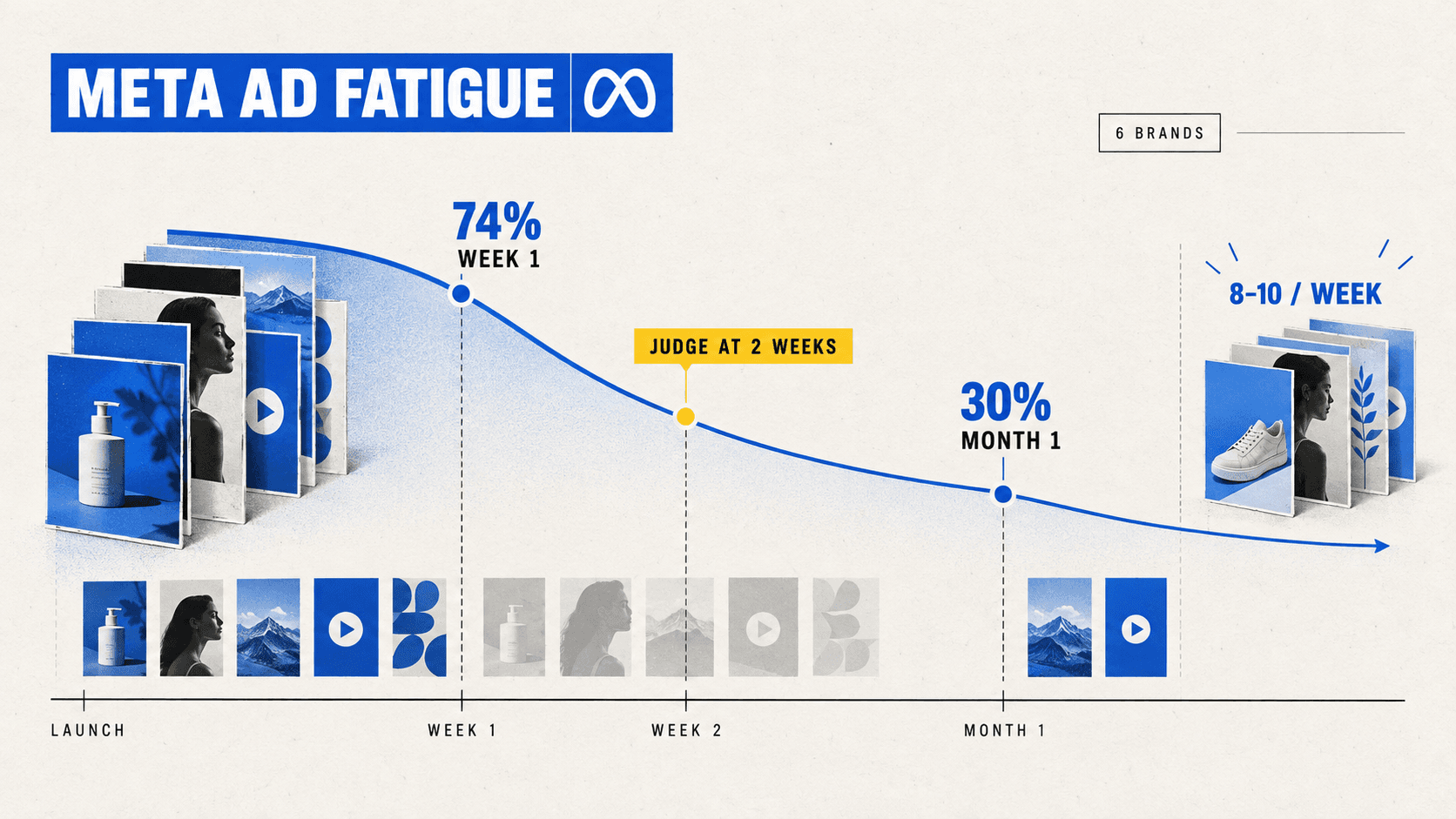
Every Meta ad wears out eventually, and the standard advice is to refresh your creative before it does. The problem is that nobody tells you how long an ad actually lasts, so brands either rotate winners out too early or ride losers too long.
We tracked six launch cohorts across six brands in our Meta portfolio to see how long ads keep delivering, and how many new ads a week keeps an account fresh.
This post covers what ad fatigue is, how to spot it, how long ads really last, how many to launch, and how to avoid it.
TL;DR
- About 74% of new ads are still delivering after a week and about 30% after a month, across 6 brands. The ones that survive week one run roughly three more weeks.
- Much of what looks like fatigue in week one is Meta sorting the batch, so do not judge ads on day-one numbers.
- The efficient cadence was around 8 to 10 new ads a week across 12 brands, and it did not grow with budget.
- Judge a launch batch about two weeks out, because the same-week numbers mislead.
What Is Ad Fatigue?
Ad fatigue is when an ad's results decline because the same people have seen it too many times. Cost per result climbs, click-through rate falls, and the ad that used to win stops winning. It is a real effect, but as the data below shows, it is only one of several reasons an ad stops delivering.
| Term | What's happening | Usual fix |
|---|---|---|
| Creative fatigue | This specific ad has worn out | A new hook or a fresh version of the ad |
| Ad fatigue | The umbrella term, often used for the same thing | Depends on the cause |
| Audience saturation | You have reached most of the people likely to buy | New angles or audiences |
The three get used interchangeably, but the right fix changes with the cause. A worn-out ad needs new creative. A saturated audience needs new angles or new people.
How to Spot Ad Fatigue on Meta
The clearest signals are a cost per result that climbs week over week, a rising frequency, and a click-through rate falling on an ad that used to perform. Any one can point to fatigue, though none proves it alone, so read them together instead of reacting to a single bad day.
A rising CPM on its own is not fatigue. In our Meta benchmarks, cost per acquisition stayed flat across low, mid, and high CPM tiers, so a pricier auction alone does not mean your ad is worn out.
Meta flags fatigue itself, too. It marks an ad with a Creative fatigue status in the Delivery column when its cost per result runs twice or more what your earlier ads cost, and “Creative limited” when the cost is higher but under double. Those labels are a prompt to act rather than a final verdict.
| Signal | What it suggests | What it doesn't prove |
|---|---|---|
| Cost per result rising week over week | Possible fatigue | A single bad week could be noise |
| Frequency climbing | The same people are seeing it more | No frequency number proves fatigue by itself |
| CTR falling on a proven ad | The hook may be wearing out | A weak first two days usually reflects the week-one sort |
| CPM rising | The auction got pricier | CPA held flat across CPM tiers in our data |
How Long Do Meta Ads Last? What 6 Brands Show
About three in four new ads are still delivering after a week, but only about three in ten make it to a month. That is the pattern across six launch cohorts from six brands over three months. Most of the drop happens early, and the ads that clear week one tend to keep running for weeks.
| Days since launch | Share of ads still delivering |
|---|---|
| 7 | ~74% |
| 14 | ~62% |
| 30 | ~30% |
The ads that survive week one run a median of roughly three more weeks, and a few evergreen winners keep going for months.
One caveat matters. This measures whether an ad was still delivering, not why it stopped. Plenty of the week-one drop-off is ads Meta never backed rather than ads that wore out. So read these as survival curves, and read on before calling every early death fatigue.
Is It Ad Fatigue or Just the First-Week Cull?
Much of what brands call fatigue is just the first week. Meta spends the opening days sorting a new batch, pushing budget toward a few ads and starving the rest, so most of the early drop-off is ads that never got a fair run rather than ads that burned out.
Meta's early ranking is a useful signal, but its first pick often changes as conversions come in. In Meta's early ranking of a launch batch, first-week spend predicted eventual spend closely, yet the week-one leader ended up on top in only one of six cohorts.
The algorithm keeps revising, so an ad that looks average on day three can still become a winner.
Two practical rules follow. Do not judge new ads on day-one or day-two numbers, because the batch has not settled. And do not rotate week-one survivors out on a fixed calendar, because an ad that cleared the cull often has weeks of profitable delivery left.
How Many New Ads Should You Launch Per Week?
In our data, around 8 to 10 new ads a week was the efficient cadence across 12 brands, and the payoff showed up about two weeks later rather than the same week. Medium-launch weeks had the best same-week CAC, while heavier weeks paid off later through better ROAS and lower CAC.
| Launch volume that week | Same-week CAC |
|---|---|
| Low | In between |
| Medium (about 8 to 10) | Best |
| High | Worst |
The real payoff lands later. Heavier launch weeks were followed by better ROAS and lower CAC about two weeks out, a pattern that held in 9 of 12 accounts. That lag is why same-week numbers mislead: a batch is judged fairly only after it has had time to find its audience.
The cadence did not scale with budget. Accounts under about $15K a week ran 8 to 16 launches per $10K of spend, while accounts over $50K ran under one per $10K, with about 28% of spend in testing at any size. Past roughly $40K to $50K a week, extra dollars did better in proven ads than more tests.
In concept terms, 8 to 10 new ads a week is about three to five concepts with a couple of variations each, which lines up with the cadence we recommend elsewhere. One account in our portfolio runs a much higher volume and sustains it, so treat 8 to 10 as a sweet spot rather than a ceiling.
You can feed persona-matched creative into the same rhythm.
Why Small Accounts Fatigue Faster
Smaller accounts reach a narrower pool of people, so the same ad gets in front of the same buyers sooner and wears out faster as a result. A large account with a broad, well-matched audience can run a winner far longer before the people who convert have all seen it.
The launch rhythm looks the same at both sizes, but it does different jobs. For a large account with a deep bank of winners, 8 to 10 new ads a week is a vitamin that keeps the account fresh. For a small account with a thinner audience, that same cadence is a painkiller that buys time until the next winner lands.
How to Avoid Ad Fatigue
Keep a steady flow of new ads, refresh the parts that wear out first, and protect the winners that are still profitable. Most fatigue is a supply problem: the account runs out of fresh creative before the next winner is ready, so the fix is a reliable pipeline rather than a frantic rebuild.
Start with the hook. The opening frame fatigues before the rest of the ad, so refreshing it with stronger ad hooks often revives a tiring ad without a full rebuild. From there, iterate on proven winners with new angles, formats, and lengths.
Protect the evergreen winners, too. An ad that is still profitable does not need retiring just because it is old, and pulling it to hit a rotation quota throws away margin.
This is mostly a testing-volume problem. One faith-based apparel brand we work with was not running enough simultaneous tests to find the next winner before the current one wore out.
By testing enough at once against a clean attribution read, we kept surfacing fresh winners ahead of the fade, and MER fell from 48% to the low 20s while the business doubled two years in a row.
“Iteration on existing winners, keeping angles simple and doubling down on what proved itself, drives more success than constantly trying to reinvent the wheel.”
Mateo Ramos-Jang, Paid Media Lead, Sweat Pants Agency
Ad Fatigue During Peak Season
The three-week survivor runway is a normal-conditions number. During BFCM, creative wears out in about a week instead, because every advertiser is spending into the same auction and the same shopper sees your ads far more often in a compressed window.
That is why peak season needs its own plan and a much faster refresh. How much peak-season creative to prepare is its own post.
What Most Brands Get Wrong About Ad Fatigue
The most common mistakes come from acting on the wrong signal. Brands rotate ads on a calendar instead of on performance, judge new batches on same-week numbers, scale test volume with budget, and blame fatigue when the real problem is the offer or the audience.
Rotating on a calendar retires winners that still had runway. Judging a batch on same-week CAC punishes ads that have not settled, and a CAC jump right after a big creative drop is usually the learning phase resetting rather than fatigue.
Scaling test volume with budget is another trap. Past roughly $40K to $50K a week, more dollars belong in proven ads rather than in more tests.
And when performance drops, fatigue often gets the blame while the real cause is the offer or the audience. If ads that aren't scaling are the symptom, check those first. Feeding the right creative cadence is a core part of what the Meta ads we run get right.
Frequently Asked Questions
1. What Is Ad Fatigue?
Ad fatigue is when an ad's results decline because the same audience has seen it too many times. Cost per result rises, CTR falls, and an ad that once converted stops delivering. It is one reason an ad fades, alongside audience saturation and Meta never favoring the ad in the first place.
2. How Do You Know If Your Facebook Ads Are Fatigued?
Watch for cost per result climbing week over week, frequency rising, and CTR dropping on an ad that used to work. Meta also flags "Creative limited" and "Creative fatigue" in the Delivery column. Read these together over a couple of weeks, since a single weak week is often just noise.
3. How Long Does a Facebook Ad Last?
In our data across six brands, about 74% of new ads were still delivering after a week and about 30% after a month. The ads that clear the first week run a median of roughly three more weeks, and a few winners run for months. At peak season that drops to about a week.
4. How Many New Ads Should You Launch Per Week?
Around 8 to 10 new ads a week was the efficient cadence across 12 brands, which works out to three to five concepts with a couple of variations each. The payoff tends to show up roughly two weeks later, so judge a batch then rather than on its first few days.
5. What's the Difference Between Ad Fatigue and Creative Fatigue?
The terms are mostly used interchangeably. Creative fatigue points at one ad wearing out, so the fix is a new hook or version. Ad fatigue is the broader umbrella and can also mean audience saturation, where you have reached most likely buyers and need new angles or audiences.