
The Challenge: Inconsistent Creative Performance Heading Into Q4
The situation was time-sensitive. Tearribles had been managing ads internally with some agency experience in the past, but creative performance was unpredictable and messaging lacked consistency.
The core problems:
- Creative fatigue from legacy formats: Existing ads leaned heavily on lifestyle imagery and novelty positioning—"look at this fun toy!" Rather than explaining why the product mattered, creatives assumed the concept would sell itself.
- Unclear value communication: For a product with a genuinely unique mechanism (detachable limbs designed to be ripped apart safely), ads weren't explaining how it actually worked. Dog owners didn't understand the problem-solution fit.
- Fragmented account structure: Campaign organization was inconsistent, making it difficult for Meta's algorithm to learn efficiently and limiting the agency's ability to optimize with precision.
- Q4 timing pressure: Taking over in early November meant we had just weeks to diagnose issues, implement changes, and see results before Black Friday. There was no runway for gradual testing.
The goal was clear but demanding: scale paid media profitably, improve creative consistency, and maintain strong ROI (above 3.5x) while increasing spend—all during the most competitive advertising period of the year.
The Strategy: Creative-Led Scaling in Three Weeks
With limited time before peak Q4, we focused on the highest-leverage variable: creative performance.
Week 1: Rapid Diagnosis + First Creative Batch
We immediately restructured prospecting around broad, algorithm-friendly audiences (open targeting US 18+) and launched the first batch of benefit-driven creatives. The breakthrough came on day one. The first new ads showed a significant CPA drop immediately—validating that the issue wasn't audience targeting or budget allocation. It was creative messaging. Over the next few days, performance leveled out as Meta's algorithm learned, but the efficiency gap between old and new creative approaches became increasingly clear.
Week 2-3: Aggressive Iteration + Simplification
With proof of concept established, we accelerated creative testing to 30 variations monthly, spanning: Static benefit breakdowns Motion graphics and animated statics Short-form explainer videos Structured narrative formats ("5 Reasons Why," "5 Myths," benefit teardowns) Testing wasn't volume for volume's sake. New creatives launched weekly, evaluated quickly on early performance signals (CTR, hook rate, CPA trajectory), and either scaled aggressively or cut decisively within days. We simultaneously simplified campaign structure to allow Meta's algorithm to optimize more efficiently, consolidating fragmented setups and shifting budgets aggressively toward ads proving efficiency early.
The Creative Breakthrough
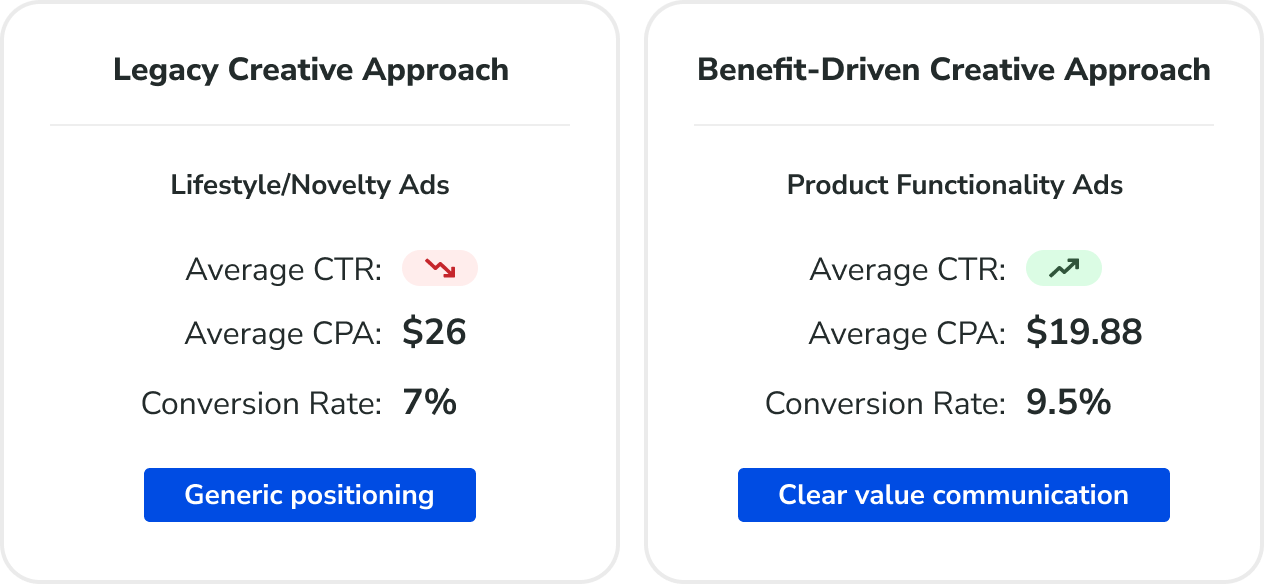
The major breakthrough was identifying that clear, visual benefit communication dramatically outperformed lifestyle or novelty content. Ads that explicitly showed how Tearribles works—detachable limbs, rip-ready design, anxiety relief for dogs, energy burn—consistently drove: Higher click-through rates Faster CPA stabilization Stronger ROAS at scale This reinforced a critical insight: Tearribles is a problem-solution product, not an impulse novelty toy. Creative needed to lead with education and functionality, not just "this is fun."
What Made This Work in Three Weeks
1. Speed and decisiveness:
We didn't wait weeks to evaluate creative performance. New ads were assessed on early signals and either scaled or cut within days. This aggressive iteration prevented wasted spend and kept budgets flowing toward proven winners.
2. Creative strategy, not targeting tricks:
Open targeting US 18+ was our entire audience strategy. All performance gains came from better creative, not complex audience layering or retargeting schemes.
3. Translating product mechanics into ad formats:
Understanding that the rip-and-reset system was the product's core differentiator allowed us to build creative frameworks specifically designed to communicate that mechanism visually and quickly.
4. Simplified structure for faster learning:
Consolidating campaign structure gave Meta's algorithm cleaner data to optimize against, accelerating the learning phase and improving delivery efficiency.
The Results
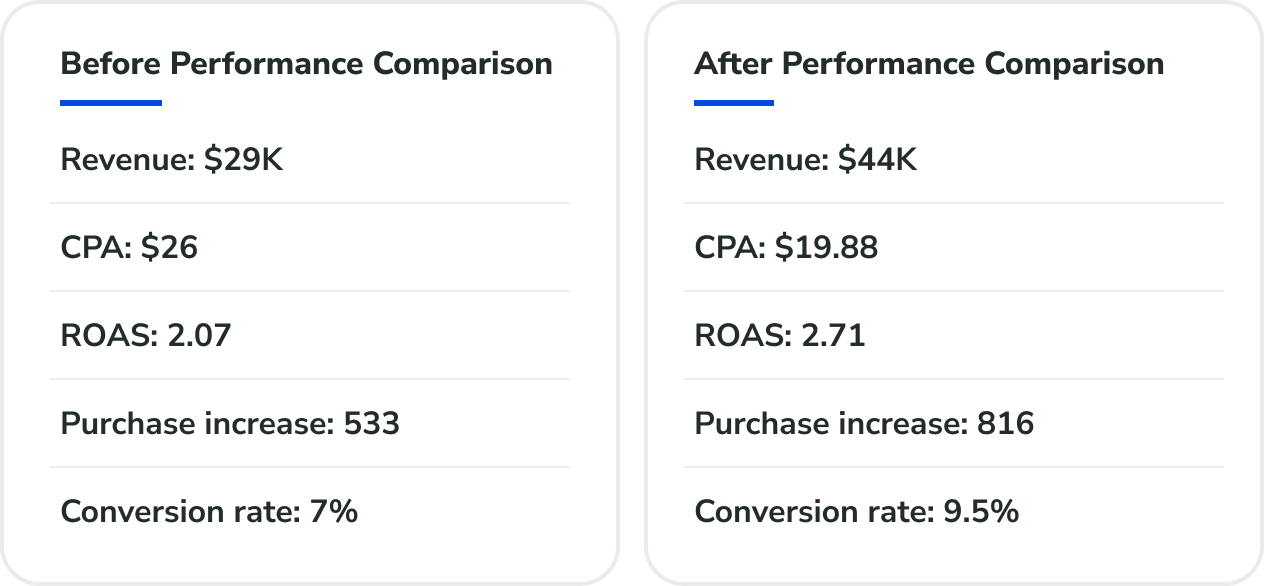
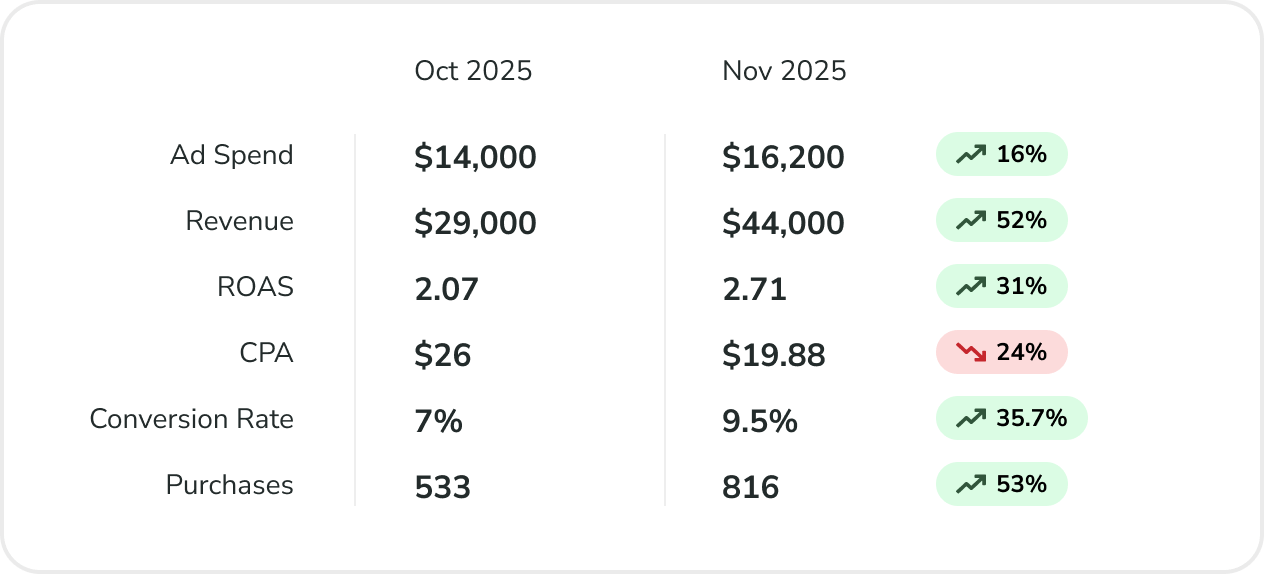
In just three weeks (November 1-30, 2025), we achieved: 52% revenue growth: Monthly revenue from paid ads increased from $29K to $44K 24% CPA decrease: Cost per acquisition dropped from $26 to $19.88—despite increasing spend during Q4's most competitive period 31% ROAS improvement: Return on ad spend climbed from 2.07 to 2.71, clearing the client's 3.5x profitability target 53% purchase increase: Orders grew from 533 to 816 monthly 35.7% conversion rate improvement: Site conversion rate jumped from 7% to 9.5%, proving we were driving higher-quality traffic, not just more traffic Ad spend increased modestly (16%) while efficiency improved dramatically— exactly the scaling dynamic needed during expensive Q4 traffic conditions.