
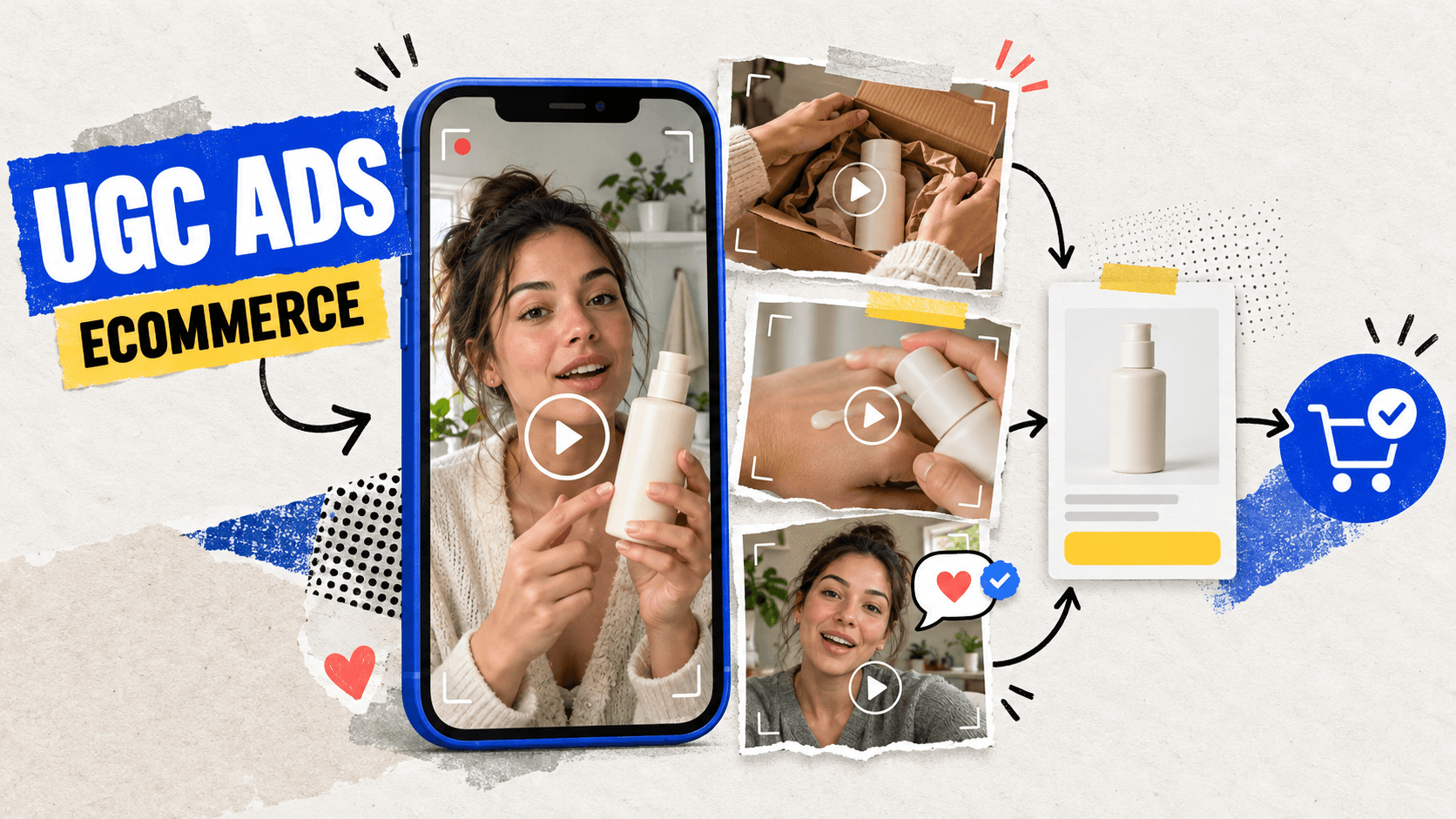
The hard part of UGC ads for ecommerce was never the idea that creator-filmed content builds trust. It is everything the guides skip: finding creators who can actually film, writing a brief they will follow, and knowing what you should get for the $200 you just spent.
Those three steps are where most brands lose time and money, long before the ad ever reaches an auction.
This post is the operator's version, drawn from how Sweat Pants Agency runs UGC across its ecommerce accounts: where we source creators, the three brief formats we use, the specs every brief carries, what we pay, what rights we hold, and what our spend data says about video against static.
One finding up front, because it reframes the rest: scripted “classic” UGC is no longer what wins in our accounts, founder-led and point-of-view formats are beating it, and plain statics still run cheaper on CPA in the median account.
TL;DR
- UGC ads are creator-filmed videos run as paid media, not organic reposts, and the work is in sourcing, briefing, and rights.
- Most creator videos cost about $200, with premium creators running $190 to $240.
- Across 16 accounts, video takes about 80% of spend, yet static ran about 10% cheaper on CPA in the median account.
- Founder-led and point-of-view formats are now beating standard scripted UGC, so test both rather than defaulting to video.
What UGC Ads for Ecommerce Actually Are
UGC ads for ecommerce are videos filmed by creators in an everyday, unpolished style, then run as paid ads rather than organic social posts. The “user-generated” look is the point: the footage reads like a real customer talking to a camera, not a studio spot, which is what earns attention in a feed built on personal video.
The distinction that matters for a brand is that these run as paid media, bought and optimized in the ad account, so they live or die by CPA like any other ad. A creator films the raw clips, and the performance comes from how the footage is briefed, edited, and tested, not from the creator alone.
Where We Source UGC Creators
Sourcing is the first step of UGC production, and we pull creators from five places, each suited to a different need, because no single source covers speed, quality, and specificity at once.
The choice usually comes down to how fast you need the footage, whether you need the raw files, and how specific the on-camera person has to be.
| Source type | Best for | Raws included | Rights |
|---|---|---|---|
| UGC platform (batches) | Premium creators, consistent quality | No | Often perpetual by default |
| Freelance marketplace | Fast turnaround | Yes | Often 90 days, we push for more |
| Casting site | A specific type of actor | Yes | Negotiated |
| Our own creator list | Proven performers we reuse | Yes | Negotiated |
| Pay-per-approved-submission platform | Volume of options, lower commitment | Varies | Varies |
Whatever the source, the vetting is the same, and it is stricter than most brands expect. We screen for lighting, microphone quality, and personality on camera, in that order, because a likable creator with bad audio still produces an ad nobody finishes.
A creator who clears all three is worth reusing, which is why our own list exists in the first place.
How to Brief UGC Creators
A UGC brief succeeds or fails on how much it leaves to chance, so we use three formats at three levels of control. The looser formats buy range and volume, while the tighter ones buy precision when a concept has to land a specific way. Picking the right one is the difference between usable raws and a reshoot.
| Brief type | When to use | What it contains |
|---|---|---|
| Talking-point batch | Volume of angles, evergreen use | 7 to 8 scripts, each on a different hook, one core message, no promos |
| Fixed-deliverable | A known edit you need filled | One 90-second upload: two 30-second scripts plus 30s of b-roll, 4 to 6 seconds per shot |
| Shot-by-shot storyboard | A concept that must land exactly | 6 timestamped frames with exact lines and filming notes |
The talking-point batch is the workhorse. A single brief carries seven or eight scripts that share one core message but each open on a different hook: the skeptic, the price objection, the multi-pet household, the emotional angle.
We keep promotions out of these on purpose, so the footage stays evergreen and a winning cut does not expire the moment a sale ends.
The fixed-deliverable and storyboard briefs trade that range for control. A fixed-deliverable brief leads with the single most common reason we reject footage, so the creator fixes it before filming, while a storyboard spells out all six frames when a concept has to land a precise way.
The tighter the brief, the fewer the surprises in the raws.
The Specs Every Brief Should Include
Every brief carries the same technical specs, regardless of type, because these are what make the raw footage editable into a Meta-ready ad:
- Shot vertical at 9:16, framed safe for a 4:5 crop
- 1080p or higher resolution
- No filters, captions, music, or AI-generated imagery
- A required clear product shot
- No single clip held longer than about 3 seconds
- Raw files sent to us, because we handle the edit
How Much UGC Videos Cost
Most UGC videos cost about $200 each, within a range of $150 to $300 depending on the creator and the ask. Premium creators sourced through a batch platform sit in a tighter band, around $190 to $240, for more consistent quality and, usually, broader usage rights built in.
Three things move the price inside that range: whether the creator sends the raw files, how fast you need the turnaround, and how specific the on-camera person has to be. A fast deadline with a particular age, look, or demographic costs more than an open brief on a standard timeline.
The creator fee is also only part of the cost of a finished ad, since the editing happens on our side after the raws come in.
UGC Usage Rights
Usage rights decide how long you can actually run a winning ad, and the default terms vary sharply by where you sourced the creator. Batch UGC platforms often grant perpetual rights by default, while freelance marketplaces commonly default to 90 days, and everything outside those defaults is negotiated case by case.
We push for perpetual rights wherever we can, for one practical reason: a UGC ad that becomes a top performer and then has to come down on day 90 is a scaling problem you created for yourself.
The best creative in an account should be an asset you own outright, not a lease with a clock on it. Check the rights terms before you brief, not after a video starts winning.
UGC Video Ads vs Static Ads on Meta
Video dominates spend but does not automatically win on efficiency, and that gap is the most useful thing in our data here. Across 16 accounts, video took about 80% of spend, yet static ran roughly 10% cheaper on CPA in the median account.
Video earns its budget on scale and storytelling, while a good static often quietly undercuts it on cost per acquisition.
Early in a pet brand launch we ran, video did beat statics on CAC by a wide margin, roughly $26 to $52 against $80 to $84, which is exactly why video deserves real budget at the top of the funnel.
The lesson is to run both formats and read the CPA, rather than crowning one on instinct or letting video eat the budget by default because it feels like the modern choice.
What counts as winning video is also shifting. Across our accounts right now, founder-led and point-of-view formats, along with short captioned cuts, are beating standard scripted UGC, which is part of why format variety matters more than ever under the Andromeda update.
The classic polished testimonial is losing ground to content that feels closer to a real person talking.
How to Test UGC Ads
Test UGC the same way you test any creative: isolate the variable, give each concept a fair budget, and judge it on CPA once it has had a fair run, not on the first day's numbers.
A strong ABO testing structure keeps each new UGC concept on its own footing so you can tell which hook and format actually earned the result.
The other half of testing is replacement. UGC fatigues like any ad, so the pipeline matters as much as the single winner, and keeping a steady flow of fresh concepts ready is how you stay ahead of creative fatigue instead of scrambling when a top performer fades.
Frequently Asked Questions
1. Should You Use AI-Generated UGC for Ecommerce Ads?
We keep AI-generated imagery out of our UGC briefs. The whole value of the format is that it reads as a real person, and audiences are quick to sense when a face or voice is synthetic, which costs the trust the ad was built to earn. AI has a place in editing and iteration, but not in faking the creator.
2. Do UGC Ads Work for High-AOV Products?
Yes, though the brief shifts. A higher-priced product usually needs more proof and more objection-handling, so the talking-point angles lean toward skepticism, risk, and value rather than quick impulse hooks. The format still works because it reads as a genuine account, which is exactly what a cautious, high-consideration buyer is looking for.