
Media buyers argue about ABO versus CBO endlessly, and nearly every guide online picks a side. The pages ranking for this question are confident and detailed and almost entirely opinion, because none of them has a dataset to check the claim against.
We pulled budget and campaign data from 16 DTC brands in our Meta portfolio to see whether the choice actually shows up in ROAS. It barely does, so this post covers what the data says instead, why campaign count matters more than budget type, and how to choose between ABO and CBO anyway.
TL;DR
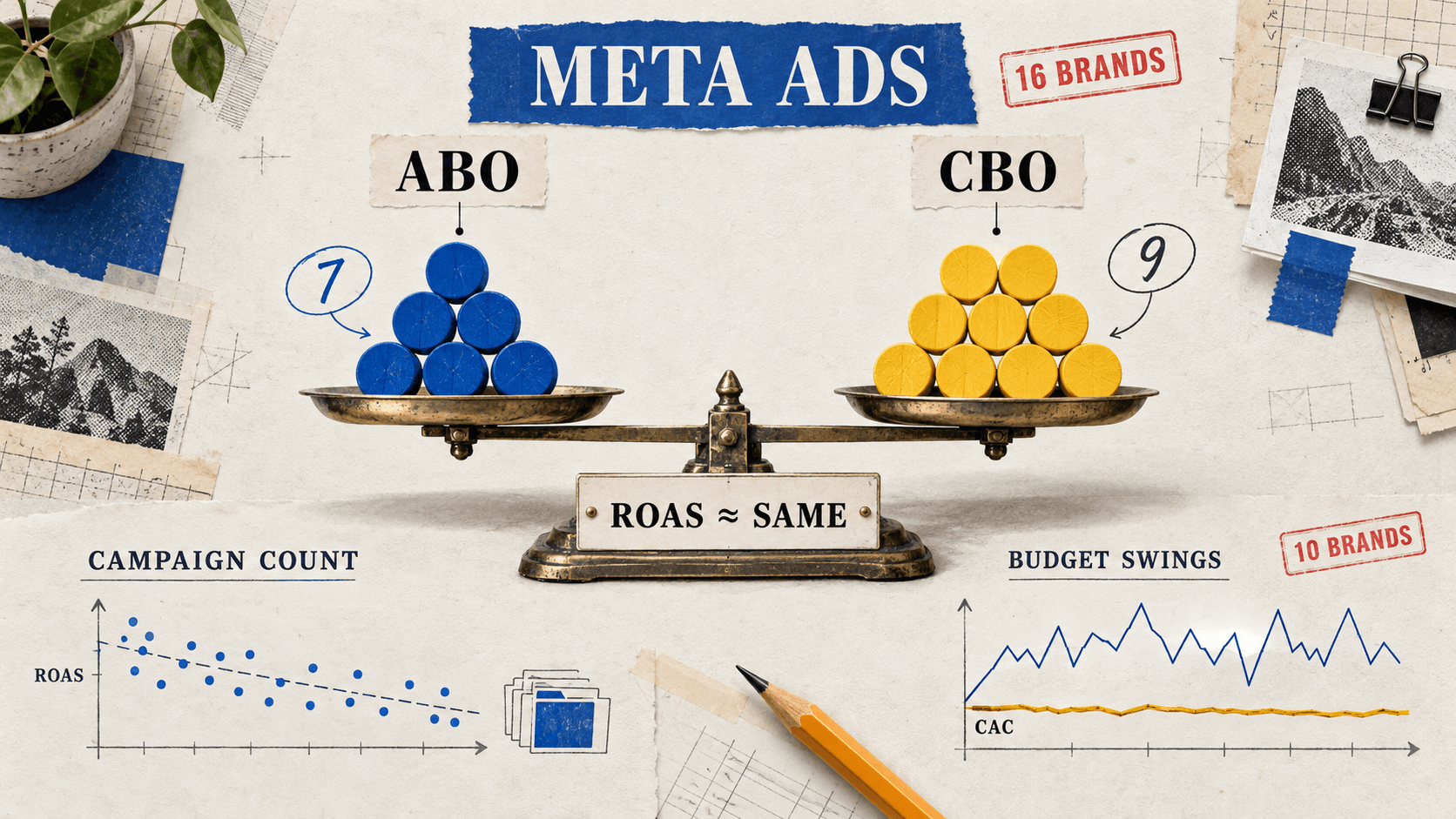
- Across 16 brands in our portfolio, ABO versus CBO was a wash: 7 ran mostly ABO, 9 mostly CBO, and both groups held high- and low-ROAS accounts.
- Campaign count mattered more. Across 17 brands, fewer campaigns tracked modestly higher ROAS, and the highest-ROAS accounts ran very few.
- Budget churn bought nothing. Weeks with more large budget swings showed no CAC benefit across 10 brands.
- Choose based on your workflow, since the data gives neither side a real performance edge.
What Is the Difference Between ABO and CBO?
ABO and CBO are the two ways to set a Meta ads budget. With ABO, Ad Set Budget Optimization, you set a budget on each individual ad set and control exactly where the money goes.
With CBO, you set one budget at the campaign level and Meta's delivery system distributes it across your ad sets in real time, shifting spend toward whatever is working.
| ABO | CBO | |
|---|---|---|
| Who controls spend | You, per ad set | Meta, across the campaign |
| Best for | Testing, guaranteed spend per test | Scaling proven winners |
| Main risk | Manual churn, uneven effort | Spend concentrates on one ad set |
| Management effort | High | Low |
| Budget sense | Needs enough behind each ad set | Needs enough to feed the campaign |
The practical difference is control versus automation. ABO hands you the steering wheel and the work that comes with it. CBO hands both to Meta's algorithm.
What Is Advantage Campaign Budget?
Advantage campaign budget is Meta's current name for CBO. The feature did not change, only the label did. As part of the wider Advantage and Advantage+ rebrand, Meta renamed Campaign Budget Optimization to Advantage campaign budget in Ads Manager, and some accounts now show it as Advantage+ campaign budget.
The mechanic underneath is identical: one campaign-level budget, allocated across ad sets by Meta's delivery system. When you see Advantage campaign budget in your account, you are looking at CBO.
Is CBO Better Than ABO? What 16 Brands Show
There is no clean winner. In our Meta benchmarks across 16 DTC brands, 7 ran mostly ABO and 9 ran mostly CBO, and both groups contained high-ROAS and low-ROAS accounts. Whichever way a brand set its budgets, it did not predict where the brand landed on performance.
| Budget approach | Brands | ROAS result |
|---|---|---|
| Mostly ABO | 7 | Spanned high and low |
| Mostly CBO | 9 | Spanned high and low |
If one approach were clearly better, the high-ROAS accounts would cluster on one side. They do not.
And ABO is not a small-budget-only tool: one kids' activity kit brand ran mostly ABO with broad targeting, graduated its winners into a separate campaign, and scaled to $28K a day at a 3.69x ROAS on $292K in spend. The budget setting was not the lever.
Why Campaign Count Matters More Than Budget Type
If the budget type barely moves ROAS, something else does, and in our data it is the number of campaigns. Across 17 brands, accounts with fewer campaigns tracked modestly higher ROAS, a Spearman correlation of -0.38, and the highest-ROAS accounts ran very few.
The sprawling accounts with 97 to 100 campaigns sat mid-pack, not at the top. The likely mechanism is signal dilution. Every campaign you add splits the account's conversions into a smaller pile, so Meta optimizes each one on sparser data and learns more slowly. Fewer campaigns concentrate the signal.
The pattern shows up in practice. For one seasonal pet product brand, we consolidated five campaigns split by geography into a single prospecting campaign, as one of three changes alongside cutting unprofitable markets and rebuilding the creative testing, and ROAS climbed from 3.6 to 6.1 with cost per purchase down 48%.
To be clear, the correlation is modest and account-specific. Some accounts genuinely do better with more separation, so treat consolidation as a tilt worth testing rather than a rule.
“Consolidating all ad sets only works in specific scenarios; testing requires more granular separation than ‘best practices’ often suggest.”
Eric Carlson, Founder, Sweat Pants Agency
When to Use ABO
Use ABO when you need guaranteed spend behind each thing you are testing. If you are running five new creatives or audiences and want each to get a fair, equal budget, ABO forces that, where CBO might starve three of them in favor of an early leader. ABO also suits anyone who wants hands-on, manual control of allocation.
The hidden cost of that control is the temptation to touch it constantly. In our data across 10 brands, weeks with more large budget swings showed no CAC benefit at all, a correlation of -0.05. Only rare 30 to 50% cuts moved CAC, and even then by just 4 to 7%, with the direction flipping from one account to the next.
And every time you raise a budget, expect CAC to run about 5 to 6% higher for roughly 10 days while delivery settles, whatever the size of the increase. So use ABO for guaranteed test spend, and resist the urge to rework budgets every morning.
When to Use CBO
Use CBO when you are scaling proven winners and want fewer manual decisions. It suits smaller teams and anyone who would rather spend their time on creative than on budget spreadsheets.
The most common complaint about CBO is that it dumps most of the budget into one ad set. Uneven spend is normal, though: in our benchmarks the top 10% of ads take roughly three-quarters of all spend, and about half never cross $100.
Meta's early ranking is a useful signal, but its first favorite often loses. Across six launch cohorts, an ad's first-week spend predicted its eventual total spend closely (a 0.79 average correlation), yet the week-one spend leader finished as the top spender in only one of six.
Meta keeps exploring and revising as conversions come in, so give a new batch a couple of weeks before judging it. One caveat: this is about how spend moves across individual ads, not ad sets, so treat it as suggestive about CBO rather than proof.
If one ad set is genuinely being starved of a real contender, an ad-set spend minimum is the fix, used sparingly.
Should You Use ABO for Testing and CBO for Scaling?
This is the workflow every competitor recommends, and it is a reasonable one. ABO gives new tests a fair shot, and CBO scales the winners with less manual work. Our data does not contradict it.
What our data adds is that the workflow helps but is not required: the same kids' activity kit brand above ran mostly ABO the whole way, graduating winners into a separate campaign instead of switching to CBO, and scaled fine.
The thing that matters more than the ABO-to-CBO handoff is keeping the number of campaigns low either way. You can run the test-then-scale workflow inside a tight account or a sprawling one, and the tight one tends to perform better.
ABO vs CBO for Small Budgets
On a small budget, consolidation matters even more. A limited budget split across many campaigns or ad sets gives each one too little conversion data to ever exit the learning phase, so nothing optimizes.
Whether you use ABO or CBO, the move on a small budget is to run very few campaigns and very few ad sets, so the spend concentrates enough for Meta to learn.
In practice that often means a single campaign with one or two broad ad sets, letting the algorithm find buyers rather than slicing a thin budget into audience segments it can never properly test. For a brand just ready for paid media, that discipline matters more than the ABO-or-CBO choice itself.
What Most Brands Get Wrong About Meta Account Structure
The biggest structural mistake is rebuilding the account when the real problem is the creative or the offer. ABO versus CBO, campaign counts, ad-set splits: these are the levers brands reach for when performance stalls, because they are easy to change in an afternoon.
But a well-structured account with weak creative still loses, and no budget setting fixes an offer nobody wants.
When ads that aren't scaling are the symptom, the cause is far more often the creative pipeline or the offer than the account structure. Spend the energy there first.
Getting the structure right is worth doing once. Past that, it's rarely where the next win hides, which is why the Meta ads we manage put most of the effort into creative and offer.
Frequently Asked Questions
1. Is CBO Better Than ABO for Facebook Ads?
Not in our data. Across 16 DTC brands, mostly-ABO and mostly-CBO accounts both included high and low performers, so budget type did not predict ROAS. CBO is easier to manage and ABO gives you more control, but neither delivers a reliable performance edge. The bigger lever is running fewer campaigns.
2. What Is Advantage Campaign Budget in Meta Ads?
Advantage campaign budget is Meta's current name for Campaign Budget Optimization (CBO). The rebrand changed the label, not the mechanic: you set one budget at the campaign level and Meta distributes it across ad sets in real time. Some accounts show it as Advantage+ campaign budget.
3. Can I Switch From ABO to CBO Mid-Campaign?
Yes, if the campaign qualifies. You can turn on Advantage campaign budget for an existing campaign as long as it has at least two ad sets, the same budget type across them, and a common bid strategy. Expect a short relearning period after the switch, so avoid doing it mid-sale.
4. Does CBO Spend More Money Than ABO?
No. CBO does not spend more than the budget you set; it just decides where that budget goes. What people notice is that CBO often concentrates spend in one or two ad sets, which is normal allocation. Across our portfolio, spend concentrates heavily in a few top ads, so some unevenness is expected.
5. How Many Campaigns Should a Meta Ad Account Have?
Fewer than most accounts run. In our data the highest-ROAS accounts used very few campaigns, while accounts with 97 to 100 sat mid-pack. There is no magic number, but a handful of campaigns concentrates the conversion signal better than dozens, so start lean and only add a campaign when it earns its place.