
The Challenge: Revenue Leaks in a Complex Healthcare Funnel
This GLP-1 subscription brand came to us with email already in place and generating revenue. The system wasn't broken—it was incomplete. Key moments in the patient journey had no automation support, creating revenue leaks at critical decision points.
Results: 9x Email and SMS Revenue in 30 Days
The Real Challenge
The brand already had email marketing . The problem wasn't execution—it was that their lifecycle system was built for eCommerce, not healthcare.
A multi-step patient journey with unsupported gaps:
A multi-step patient journey with unsupported gaps: The path to becoming an active patient required multiple steps: Complete eligibility quiz Purchase subscription Finish medical intake Receive provider approval Begin treatment Each step represented a potential drop-off point with no automation to guide users forward. Specific revenue leaks identified:
- Quiz started but not completed – No follow-up to recover interested prospects
- Pre-approved users who didn't purchase – Lost momentum after qualification
- Purchased but never completed intake – Revenue recognized but patients not activated
- Completed intake but needed different treatment path – No branching logic for qualified vs. disqualified users
Healthcare constraints most eCommerce brands don't face:
- HIPAA compliance considerations – Protected health data requiring specific ESP capabilities
- Pharmaceutical messaging restrictions – Required generic GLP-1 language, no brand names
- Patient status complexity – Different messaging needed based on medical approval status
- ESP limitations – Platform selection constrained by healthcare data requirements
The opportunity was clear: fixing these gaps wouldn't just improve performance—it would fundamentally change how lifecycle contributed to growth.
The Situation
The brand entered our engagement with functional email marketing but structural gaps in lifecycle automation.
What existed:
- Basic email campaigns generating revenue
- Some transactional messaging
- Standard eCommerce-style flows
What was missing:
- Quiz abandonment recovery
- Pre-approval nurture
- Intake completion reminders
- Branching logic for qualified vs. disqualified paths
- Active patient lifecycle management
- Compliance-first architecture
The constraint: Generic eCommerce lifecycle templates couldn't account for medical intake, provider approval, patient status, or compliance requirements.
The Strategy
Rather than apply standard eCommerce playbooks, we rebuilt lifecycle automation around how the healthcare business actually works.
Phase 1: Map the Patient Journey Before Writing a Single Email
The first step wasn't copywriting or design—it was understanding the complete patient journey. We mapped quiz behavior, purchase patterns, medical intake completion, approval paths, and cancellation opportunities. This revealed exactly where automation needed to intervene, what messaging was required, and how branching logic should work.
Phase 2: Build Healthcare-Specific Lifecycle Automation
We rebuilt the complete lifecycle system with 10 new flows: welcome, browse abandonment, checkout abandonment, quiz abandonment, intake abandonment, intake completion with branching, declined payment, post-purchase education, winback, and list hygiene. Each flow was designed to reduce friction at critical decision points, build trust during medical approval, and move users toward the next required step—all while respecting patient status and compliance requirements.
Phase 3: Layer SMS Intentionally at High-Intent Moments
SMS wasn't used as a broadcast channel. It was deployed strategically at abandonment recovery, step completion reminders, and time-sensitive approval updates. SMS paired with email at critical junctures drove meaningful incremental revenue without message fatigue.
Phase 4: Compliance-First Execution
Operating in the GLP-1 telehealth category requires precision . We selected an ESP aligned with HIPAA requirements, used only generic GLP-1 language (no pharmaceutical brand names), and built segmentation logic to prevent inappropriate messaging to active patients. Compliance wasn't a constraint—it was a requirement for sustainable scale.
Phase 5: Bilingual Flows for Incremental Revenue
The brand served English and Spanish-speaking audiences. We launched Spanish versions of all key flows and bilingual SMS messages, capturing meaningful incremental revenue without additional acquisition spend.
What Worked
Patient Journey Mapping Revealed Specific Gaps
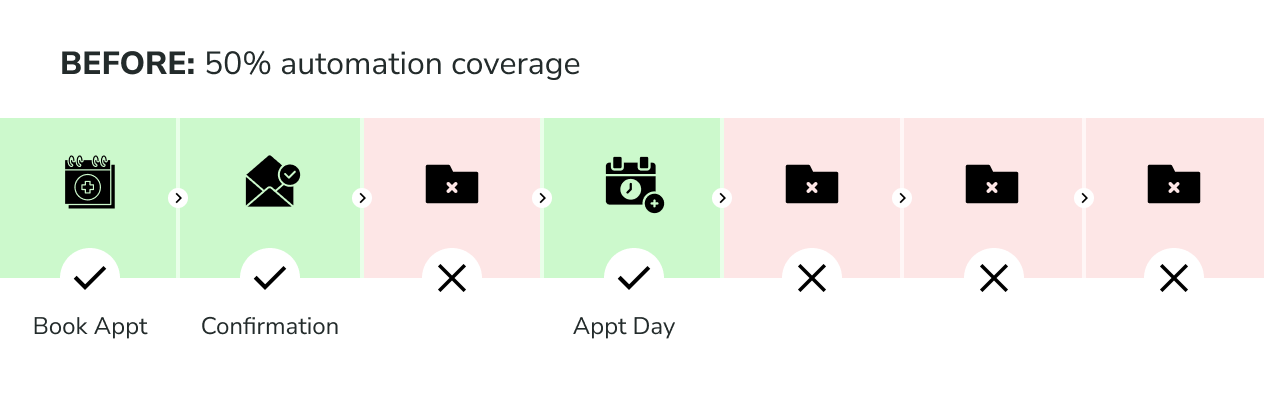
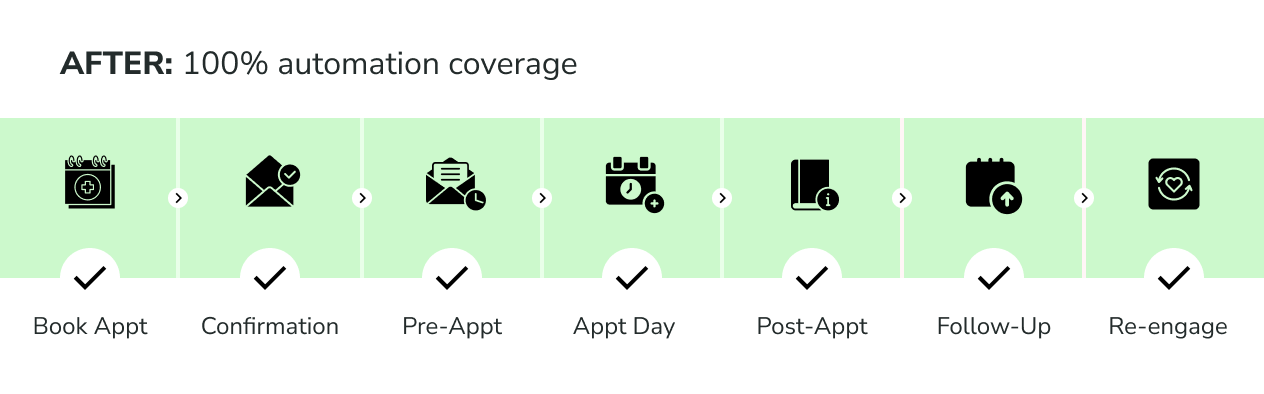
Result: 90% conversion rate improvement Rather than assume the entire system was broken, we identified specific revenue leaks and built automation to address each one.
Key gaps filled:
- Quiz abandonment (no recovery → automated nurture)
- Intake incomplete (no reminder → status-based follow-up)
- Disqualified users (generic messaging → branching paths)
- Pre-approval drop-off (no nurture → education sequence)
Result: Lifecycle system matched actual patient behavior, not generic eCommerce assumptions.
Healthcare-Specific Flows Drove Conversion
Standard eCommerce flows (browse abandonment, cart abandonment) performed well, but healthcare-specific flows were the breakthrough:
- Quiz abandonment flow – Recovered prospects who started eligibility assessment
- Intake completion flow – Moved purchased customers to active patient status
- Branching logic for medical approval – Different paths for qualified vs. disqualified users
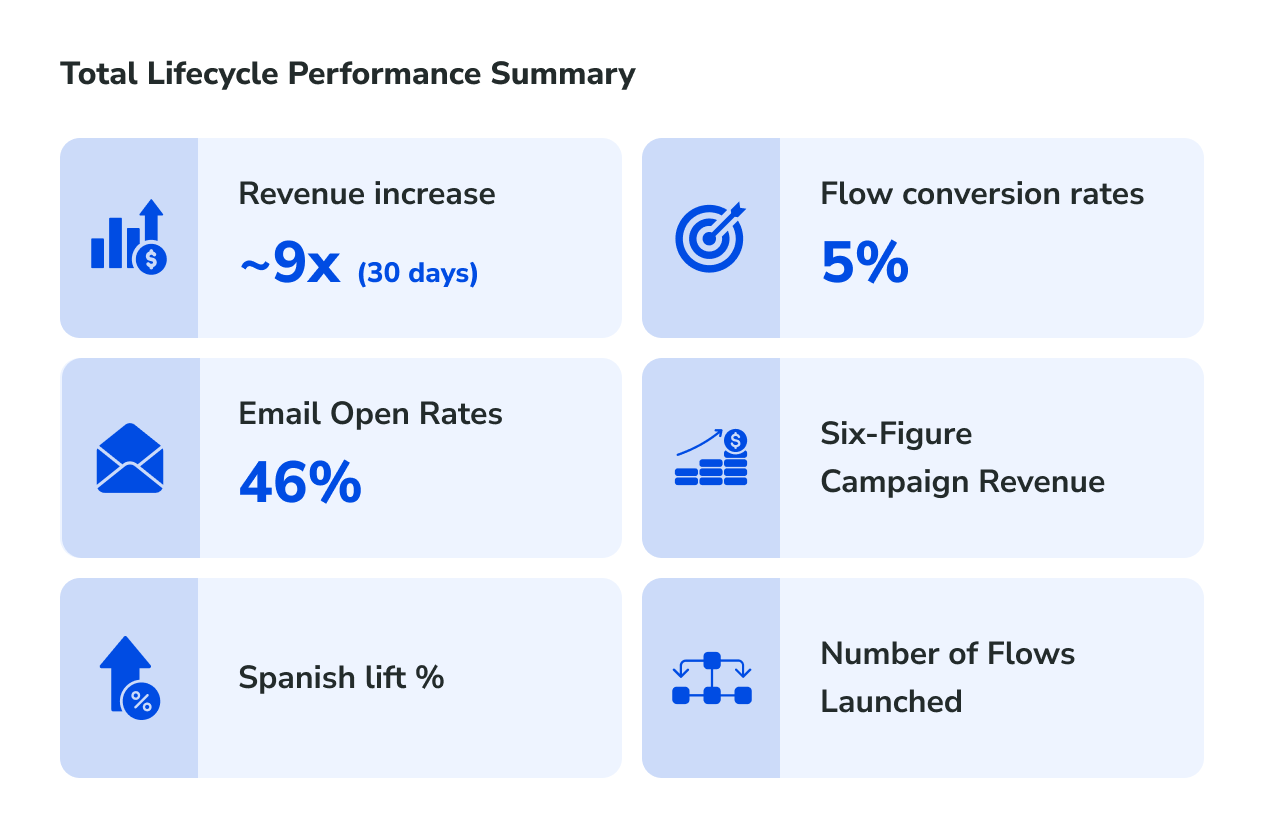
Result: ~5% conversion rates on welcome and abandonment flows, six-figure campaign revenue levels.
Intentional SMS Deployment Drove Incremental Revenue
SMS wasn't everywhere—it was at high-intent moments:
- Cart abandonment (immediate recovery opportunity)
- Intake reminders (medical completion urgency)
- Approval status updates (time-sensitive information)
Result: Meaningful incremental revenue lift when paired with email, without message fatigue.
Compliance-First Architecture Enabled Scale
Building for compliance from the start—not retrofitting later—allowed the system to scale confidently.
Key decisions:
- ESP platform with healthcare data capabilities
- Messaging templates vetted for pharmaceutical restrictions
- Segmentation rules preventing inappropriate sends
Result: Lifecycle could grow without deliverability risk or compliance exposure.
Bilingual Flows Captured Incremental Revenue
Spanish flows added meaningful revenue with minimal complexity. While English represented the majority of volume, Spanish captured prospects who would have otherwise dropped off due to language barriers. Result: Incremental revenue without increasing acquisition spend.
The Complete Picture
Why This Approach Worked
1. Journey Mapping Before Execution
We mapped the complete patient journey before writing a single email, revealing exactly where automation was needed.
2. Healthcare-Specific Flows
We built flows around medical intake, provider approval, and patient status—not generic eCommerce templates.
3. Strategic SMS Deployment
SMS was used at high-intent moments, not as a broadcast channel, driving incremental revenue without fatigue.
4. Compliance as Foundation
Building for HIPAA and pharmaceutical restrictions from the start enabled scale without risk.
5. Specific Gap Focus
We fixed specific revenue leaks rather than rebuilding everything, creating rapid impact.
The Real Win
The 9x revenue increase in 30 days proved a fundamental principle: lifecycle automation must match how your business actually works. Generic eCommerce playbooks will always underperform for telehealth, GLP-1, or regulated subscription brands. The leverage comes from designing around the real patient journey—not forcing healthcare into eCommerce templates. For brands with complex funnels, compliance constraints, or multi-step approval processes, the opportunity is in the gaps between standard automation.