
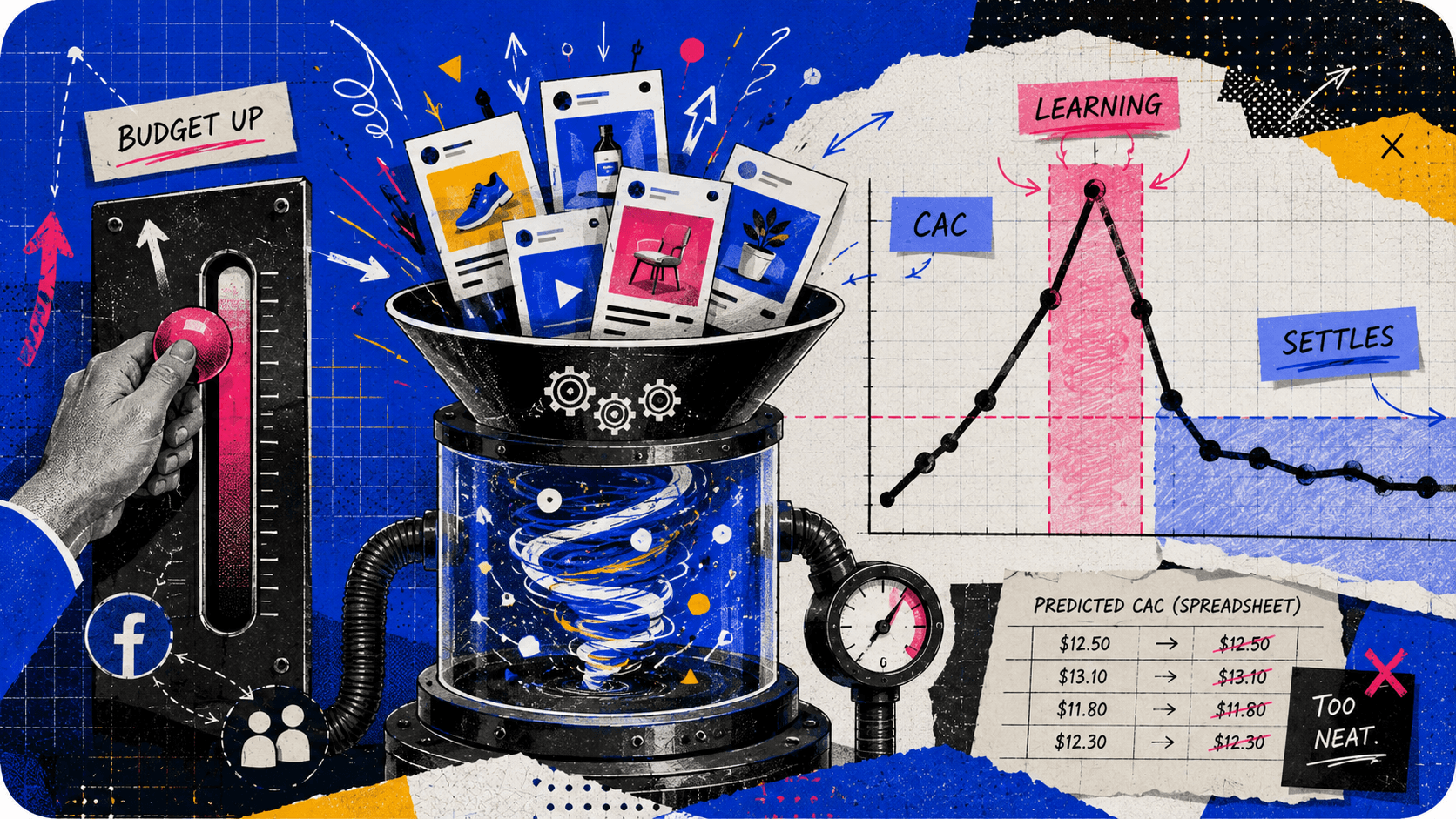
Scaling a Facebook ad account almost always costs more than the spreadsheet says. Push budgets up and CAC climbs for a week, then settles. Drop in a big batch of new ads and this week's numbers get worse before they get better.
Both are the learning phase doing its job, and both get misread as something breaking. Across 511 budget increases and dozens of launch weeks, spanning close to $400M in Meta spend, we measured the real cost of scaling.
This post breaks down what the learning phase does to your CAC, why “scale in small steps” does not help, and how to scale without paying the tax twice.
TL;DR
- The Facebook ads learning phase is Meta's exploratory delivery period for new or edited ad sets. Cost per result runs higher until the ad set exits, usually after about 50 conversions.
- Scaling carries a near-fixed CAC tax of about 5 to 6% for roughly a week after any budget increase. It peaks on days 6 to 9 and clears by days 10 to 14.
- Raising budgets in small steps does not shrink the tax. Small jumps were no cheaper than big ones, and constant small changes reset learning more often.
- There is a launch sweet spot of roughly 8 to 10 new ads a week. It is a fixed number, not a percentage of budget, and cramming in more hurts that week's CAC.
What Is the Facebook Ads Learning Phase?
The Facebook ads learning phase is the period when Meta is still working out who to show a new or recently edited ad set to. Delivery is exploratory, results swing, and cost per acquisition runs higher than it will once the system settles.
An ad set exits the learning phase after it collects roughly 50 optimization events, usually purchases, inside about a week.
Significant edits restart it. A budget change, a new audience, a swapped optimization event, or a fresh creative can all push an ad set back into exploration. During that window Meta is spending partly to gather signal, not purely to buy conversions, which is why efficiency dips.
The same delivery system deciding where those dollars go is the one we broke down in the Andromeda update. For scaling, the takeaway is simple: anything that resets learning has a price attached.
Why Does Scaling Spike Your CAC?
Because a budget increase nudges an ad set back toward the learning phase. When you raise spend, Meta has to find more of the right people at a faster clip, and delivery turns exploratory again. Across 511 budget increases in 10 accounts, raising spend lifted CAC by about 5 to 6% for the following week.
That penalty is temporary. It builds over the first several days, peaks around days 6 to 9, and clears by days 10 to 14. It is not a sign the scale failed. It is the cost of admission, and it stacks straight onto your acquisition cost, which is worth modeling honestly alongside the CAC math we covered here.
Does Scaling in Small Steps Avoid the CAC Tax?
No. Small budget increases do not carry a smaller CAC tax than large ones. Raising spend cost about 5 to 6% in CAC for the following week whether the jump was 10% or 50%. Tiptoeing does not buy a discount, and it triggers the learning reset more often.
Here is the CAC penalty by day, indexed to the three days before each increase, where 1.00 means fully recovered, split by jump size. It comes from 511 budget increases across 10 brands in our Meta ads benchmarks research.
| Days After Increase | Big Jumps (30%+) | Small Jumps (10 to 30%) |
|---|---|---|
| Day 0 | 1.038 | 1.065 |
| Days 1 to 2 | 1.047 | 1.025 |
| Days 3 to 5 | 1.037 | 1.072 |
| Days 6 to 9 | 1.065 | 1.050 |
| Days 10 to 14 | 1.026 | 1.035 |
Read the two columns side by side. The small-jump column is not lower than the big-jump column, and on several days it runs higher. Step size does not change the size of the tax. It only changes how often you pay it, because more frequent increases mean more frequent trips through the learning phase.
How Many New Ads Should You Launch at Once?
Roughly 8 to 10 new ads a week held the efficiency sweet spot in our data, and it did not rise with budget. A $10k-per-week account and a $150k-per-week account landed in the same range. Launch far more than that at once and several ad sets enter the learning phase together, which dragged that week's CAC.
Grouping each account's weeks by launch volume, the medium-launch weeks posted the best same-week CAC while the high-launch weeks were the worst. The sweet spot is a roughly fixed number of ads, not a fixed share of spend.
Small accounts launched many ads per $10k of budget, while the largest accounts launched under one per $10k and poured the extra money into proven winners instead.
The payoff from launching does not land the same week. It shows up about two weeks later, once the new ads clear learning and the winners earn delivery. React to the same-week dip and you will kill winners before they get going.
The effects here are modest and the 8-to-10 figure is a central cluster rather than a hard rule, so treat it as a cadence to aim for, not a law.
How Do You Scale Without Resetting Learning Every Week?
Stop tiptoeing on budget and stop flooding the account with launches. Make fewer, larger budget increases, price the 5 to 6% tax into the plan, and give each move about 10 days to settle before the next one. The penalty peaks on days 6 to 9, so judging a scale on day one will always look scarier than it is.
Hold new launches to a steady 8 to 10 a week rather than saving them up for a flood. Past roughly $40k to $50k a week, put incremental dollars into ads that are already working instead of more tests.
When we scaled Houndsy's Meta spend 6.7x, net profit grew 350% and ROAS improved as we did it, because the budget went into proven winners rather than a weekly reset of the whole account. The full breakdown is in our Facebook ads scaling case study.
This is the same discipline we bring to every account we run through our Meta advertising team.
Frequently Asked Questions
1. How Long Does the Facebook Learning Phase Last?
Usually until the ad set collects about 50 conversions, which can take a few days or up to two weeks depending on volume. After a budget increase specifically, the CAC penalty builds over the first several days, peaks around days 6 to 9, and clears by days 10 to 14.
2. Does Scaling Reset the Learning Phase?
A large budget or targeting change can push an ad set back into exploration, which is why every increase carries a CAC tax of about 5 to 6% for roughly a week. Small, frequent steps do not avoid the tax and reset learning more often than fewer, larger moves.
3. How Many Ads Should You Launch per Week?
Around 8 to 10 new ads a week held the efficiency sweet spot across accounts, and it did not scale with budget. Launching many more at once pushes several ad sets into the learning phase together and hurts same-week CAC, while the payoff from a bigger batch lands about two weeks later.
4. How Much Can You Increase Your Budget Without Resetting the Learning Phase?
There is no clean threshold that avoids it. The common advice to raise budget only 20% at a time did not hold in our data: small increases carried the same 5 to 6% CAC tax as large ones. Any meaningful increase nudges delivery back toward exploration, so size the move to your goal, not to the rule.