
A subscription pet food brand that had sold only three recipes was preparing its first launch ever: a new line of functional treat pouches for dogs, and a new cat line. We ran a one-week Klaviyo sequence: two teasers to leads and lapsed customers, then a launch email that also reached active subscribers.
Product Launch Challenge: A First Launch, a Bigger List and No Pet Data
Sweat Pants Agency started on the account in July 2026, three months before the launch. The brand had a loyal base on three subscription recipes but had never put a new line in front of that list, and the launch faced constraints on every side:
- First launch ever: no past launch emails to benchmark against or learn from
- Twice the usual audience: each send went to 2.1x the account's usual size, which normally drags engagement down
- Low baseline engagement: the account's campaigns averaged a 0.45% click rate
- No idea who had cats: the brand's data did not say which customers owned a cat, so the cat line could not be aimed
- Lapsed customers in the mix: much of the audience was one-time buyers and cancelled subscribers
They needed a sequence that built demand before launch day without over-mailing the subscribers who already paid.
Results: A 10x Click Rate on Twice the Usual List
2.2x the Launch-Day Revenue
Launch day earned 2.2x the revenue of a later launch the brand sent without teasers, with recurring subscription orders excluded. Because bigger sends normally earn less per recipient, that lift arrived despite the larger audience, not because of it.

Klaviyo campaign report for the launch sends, September 24 to October 12, as of October 15. Campaign names shortened and revenue blurred at the client's request.
Click Rates 3x to 10x the Account Average
Every dog-line send beat the account's 0.45% average click rate by at least 3x. The night-before teaser was the peak, and it was built around the word "tomorrow."
Teaser #1, a week out
1.726%
About 3.8x the average
Teaser #2, the evening before
4.656%
10.3x the average
Launch email, launch day
1.424%
About 3.2x the average
71 Orders From the Launch Email
The launch email converted 0.674% of recipients into orders: 71 orders from a single send. Lapsed customers started buying even earlier, during the teaser week, before the product had been revealed.
Performance
Why it worked
- Each email had one job: curiosity a week out, a reminder the night before, the reveal on launch day
- The day-before teaser named the day, "tomorrow," and it was the top-clicking send of the sequence
- Active subscribers got only the launch email, so the brand's best customers were never over-mailed
The Cat Line: A Smaller Win With No Targeting Data
The new cat line went out on October 12 in two versions, one for leads and one-time buyers and one for non-purchasers, and drove 25 orders at click rates around 0.4%. With no data on who owned a cat, neither version could be aimed at cat owners. We read it as a first signal of cat demand, not a miss.
Our Approach
Phase 1: Segment the Audience (September)
The first decision was who needed warming up and who just needed the news.
What we set up:
- Teaser audience: leads plus lapsed customers (one-time buyers and cancelled subscribers)
- Launch audience: the teaser audience plus the best active subscribers
- Separate versions for purchasers and non-purchasers
Key learning:
Lapsed customers are worth mailing before a launch. Some came back to order during the teaser week, before the product was even revealed.
Phase 2: The Week-Out, Night-Before Teaser Sequence (September 24 to 30)
The spine of the launch was two teasers. Teaser #1, a week ahead, sparked curiosity with a "Coming soon" badge, a blurred product shot and a "Be the first to know" button. Teaser #2, the evening before, was built around "tomorrow." The product stayed under wraps until launch morning.
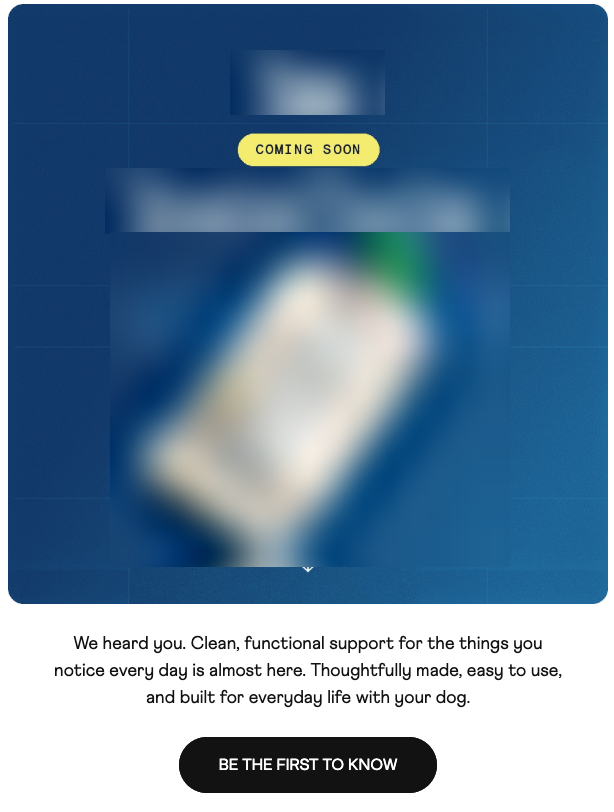
Teaser #1, sent a week before launch. Brand details blurred.
Phase 3: Launch and a Second Line (October)
- September 24, 8 PM: Teaser #1
- September 30, 7:30 PM: Teaser #2
- October 1, 11 AM: Launch email, with active subscribers included
- October 12: Cat line launch, in two segmented versions
Strategy, copy and design were split across three people on our side and run with the brand's team.
Overcoming Challenges
A Brand With No Launch History
Problem:
- There was no past launch to benchmark against.
Solution:
- We judged every send against the account's own campaign averages instead of an outside number.
Result:
- Every dog-line send cleared the account's average click rate by at least 3x.
Mailing Twice the Usual List
Problem:
- Bigger sends usually mean lower engagement per recipient.
Solution:
- Teasers went only to people who needed a reason to come back, and active subscribers got a single email.
Result:
- A 10.3x peak click rate on sends 2.1x the usual size.
Not Knowing Who Owned a Cat
Problem:
- The account had no pet-type data.
Solution:
- We split the cat send by purchase history instead.
Result:
- 25 orders and a first read on cat demand. Next time, the brand can collect pet type at sign-up.
The Complete Picture
Final Results
What Made This Successful
Strategic Partnership
Strategy, copy and design were owned by three people on our side and run as one sequence with the brand's team.
Creative Excellence
Each email had a single job, and the "tomorrow" teaser was the top-clicking send of the launch.
Data-Driven Flexibility
Every send was judged against the account's own averages, with separate versions for purchasers and non-purchasers.
Constraint Innovation
With no pet-type data, the cat send was split by purchase history instead.
Long-Term Commitment
We had been on the account since July, so the launch built on three months of list and flow work rather than a cold start.