
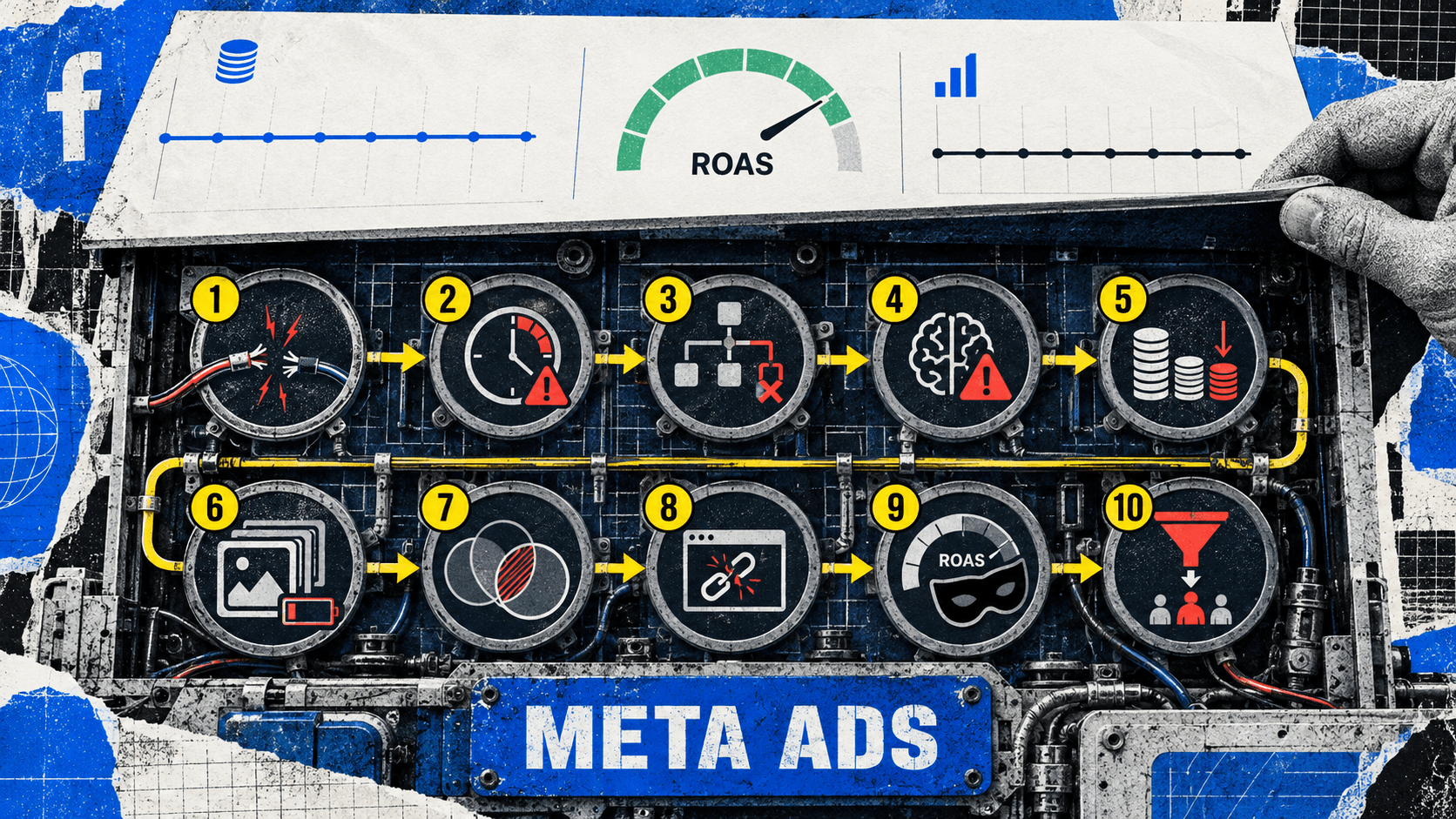
Spend is steady. The ROAS in your dashboard looks fine. Revenue has not moved in two months.
That gap, healthy-looking metrics sitting on top of flat growth, is the signal that something in the account is quietly broken. It is also the moment an audit earns its keep, because the dashboard number is the last place the problem actually shows up.
A Facebook ads audit is how you find where an account leaks, and in what order to fix it. This is the ten-point version we run on a stalled Meta account, from the data layer up to the creative.
The 10 checks, in order
- Tracking and data foundation: CAPI and event match quality
- Attribution window vs blended reality
- Account structure and consolidation
- Learning phase status
- Budget distribution: prospecting vs retargeting
- Creative volume and fatigue
- Audience setup and overlap
- Post-click destination
- Performance read: what ROAS hides
- Channel concentration risk
What Is a Facebook Ads Audit?
A Facebook ads audit is a structured inspection of an existing ad account, not a strategy rebuild. The goal is to find what is broken or leaking, rank it, and hand back a fix list. A Meta ads audit covers the same ground, since the platform is Meta and the account is still the Facebook and Instagram inventory you already run.
The distinction that matters is this: an audit diagnoses, it does not redesign. You are checking whether the foundation is sound, whether budget reaches the right places, and whether the creative and its destination hold up, before anyone proposes a new strategy. Skip the diagnosis and a “new strategy” is just a guess with a bigger budget behind it.
Why the Order of Checks Matters
Order is the difference between an audit that finds the real problem and one that lists cosmetic fixes. Start at the creative and work down, and you will polish ads that were never the bottleneck, while a tracking gap or budget fragmentation upstream quietly throttles everything beneath it.
So we audit from the foundation up: data first, then structure and budget, then creative and destination, then the performance read. Knowing why ads stop scaling in the first place is what makes this order matter. This post is the inspection itself, one layer at a time, with what healthy and broken look like at each.
The 10-Point Facebook Ads Audit
Here is the sequence, in the order we run it. Every check has the same three parts: what to look at, what healthy looks like, and what a failure means. It is also the first thing we do whenever a brand brings us on to manage their Meta ads: we run this full audit before recommending a single change, because diagnosing an account always comes before rebuilding it.
1. Tracking and Data Foundation
Start at the data layer, because every number downstream inherits its errors. Look at the Conversions API: is it live, is server-side firing alongside the pixel, and what is your event match quality in Events Manager? Then check deduplication, so one purchase is not counted by both the pixel and CAPI.
Healthy looks like CAPI active, event match quality in the good-to-great range on key events, and clean deduplication. A failure looks like pixel-only tracking, weak match quality, or events double-counting, which inflates in-platform ROAS and teaches the algorithm the wrong lessons. If the foundation is off, stop here and fix it, because nothing below this line can be trusted until you do.
Healthy: CAPI live, event match quality 6.0+, and platform purchases within roughly 10% of Shopify orders.
Failure: Pixel-only tracking, match quality below 6.0, or the same purchase counted twice.
2. Attribution Window vs Blended Reality
Reconcile what Meta claims with what the business actually banked. Check the attribution setting, usually 7-day click and 1-day view, then hold Meta's reported revenue up against your blended numbers in Shopify and your MER. Shopify's own marketing attribution reporting is the cleanest place to pull that comparison.
Healthy looks like Meta's claimed revenue tracking within a sane margin of blended reality. A failure looks like Meta reporting far more than the business saw, which means it is taking credit for sales it did not drive. The fix is to judge Meta on MER vs ROAS rather than the number inside the platform, and where the stakes justify it, to confirm the real lift with incrementality testing.
Healthy: Meta-reported revenue lands within roughly 20% of blended reality.
Failure: Meta claims materially more revenue than the business actually banked.
3. Account Structure and Consolidation
Now look at how the account is built. Count campaigns and ad sets, and see how fragmented the budget is across them. Since Meta's Andromeda shift, sprawling structures with dozens of tiny ad sets split the signal and starve each one of conversions.
Healthy looks like a consolidated structure where budget pools enough for the algorithm to learn. A failure looks like spend fragmented across too many ad sets, none getting the volume to stabilize. Consolidation matters more since Meta's Andromeda update reshaped how delivery works, and it is one of the most common fixes we make on a stalled account.
Healthy: Budget pooled into few enough ad sets that each can clear its weekly conversion threshold.
Failure: Dozens of tiny ad sets, none of them reaching stable volume.
4. Learning Phase Status
Check how many ad sets are stuck learning and never stabilizing. In Ads Manager, read the delivery column for ad sets marked “Learning Limited,” which means they are not getting enough conversions to exit.
Healthy looks like most ad sets exiting learning and running stable. A failure looks like a large share stuck in “Learning Limited,” usually a symptom of the fragmentation from the check above. The conversion volume needed to exit the learning phase, and whether scaling resets it, decides whether your ad sets ever stabilize. If most never do, your structure is fighting the algorithm.
Healthy: Under 20% of active ad sets sitting in Learning Limited.
Failure: A large share of ad sets never exit learning at all.
5. Budget Distribution
Look at where the money actually goes. Map spend concentration across campaigns and the split between prospecting and retargeting. Stalled accounts often have most of the budget trapped in retargeting, which harvests demand it never created.
Healthy looks like the majority of spend in prospecting, with retargeting sized to the audience it can realistically reach. A failure looks like a retargeting-heavy split that reads efficient on ROAS while it caps new-customer growth. How you split the ecommerce ad budget between prospecting and retargeting is often where a good-ROAS, flat-revenue account is quietly bleeding.
Healthy: Prospecting to retargeting sits at roughly 4:1 or wider.
Failure: A retargeting-heavy split that reads efficient while new-customer growth caps.
6. Creative Volume and Fatigue
Creative is the lever that moves a modern Meta account, so check the supply. Look at how many net-new creatives launch each week, the frequency on your top ad sets, and whether hold rate is decaying on the winners.
Healthy looks like a steady stream of fresh concepts and hooks entering testing every week, with fatigue caught early, before frequency climbs. A failure looks like the same three winners running for months while performance slowly bleeds out. The best ad hooks are worth studying before you brief the next round. As a Meta Premium Partner managing $350M+ across roughly 57 DTC brands, the most common gap we audit is simply not enough creative in the water.
Healthy: 15–20 net-new concepts per month entering testing, with fatigue caught before frequency climbs.
Failure: The same three winners running for months while performance bleeds out.
7. Audience Setup and Overlap
Now the targeting, which matters less than it once did but still breaks accounts. Look at whether the account leans broad or on stacked narrow audiences, how much those audiences overlap, and whether exclusions keep prospecting and retargeting from bidding against each other.
Healthy looks like mostly broad targeting letting the algorithm find buyers, with clean exclusions and little overlap. A failure looks like a maze of narrow interest audiences competing with one another, pushing costs up while the algorithm sits boxed in. On most accounts we audit, simplifying the audience setup frees the budget to do more with less.
Healthy: Mostly broad targeting, clean exclusions, and overlap under roughly 30% between active ad sets.
Failure: Narrow interest stacks overlapping and bidding against each other.
8. Post-Click Destination
Follow the click. Where does paid traffic actually land, a product page, a collection, or a dedicated landing page, and does that destination keep the ad's promise? A strong ad pointed at a weak page wastes every dollar upstream of it. On speed, Google's Largest Contentful Paint threshold is the number to hold the page to.
Healthy looks like a fast, on-message destination whose offer matches the ad that earned the click. A failure looks like traffic dumped on a generic homepage or a slow product page that never repeats the hook. Which destination to use is its own decision. Whether paid traffic lands on a landing vs product page changes the math, and either way, high-converting product pages share the same fundamentals.
Healthy: An on-message page loading with LCP under 2.5 seconds.
Failure: A homepage dump, or a slow product page that never repeats the hook.
9. Performance Read
Only now do you read performance, and carefully. Look at what the ROAS number is made of: in-platform or blended, whether it is inflated by the retargeting and attribution issues from earlier checks, and whether it moves with real revenue.
Healthy looks like a ROAS you can tie to banked revenue and contribution margin. A failure looks like a proud in-platform ROAS sitting on flat sales, the exact symptom this audit opened with. What a good Meta ROAS actually is, and why the number can lie, is worth settling before you celebrate a high one. Read the number last, because everything above it decides whether it means anything.
Healthy: ROAS moves with banked revenue and contribution margin.
Failure: A high in-platform ROAS sitting on flat sales.
10. Channel Concentration Risk
Last, step back to the portfolio level. If Meta is the only meaningful acquisition channel, every audit finding doubles as a single point of failure, and rising CPMs hit the whole business at once.
Healthy looks like Meta as the largest channel but not the only one, with a tested path to at least one more. A failure looks like total dependence, where one algorithm change or cost spike stalls growth with no fallback. For many brands the hedge is a second channel, and the AppLovin vs Meta comparison is where that starts. A stalled account is sometimes a concentration problem wearing a performance costume.
Healthy: Meta under three-quarters of paid acquisition, with a tested second channel.
Failure: Total dependence on one platform, with no fallback when costs move.
The Audit at a Glance
| # | Check | Healthy | Failure Signal |
|---|---|---|---|
| 1 | Tracking and data | CAPI live, event match quality 6.0+, purchases within ~10% of Shopify orders | Pixel-only, match quality below 6.0, or events double-counting |
| 2 | Attribution | Meta-reported revenue within ~20% of blended reality | Meta claims far more revenue than the business banked |
| 3 | Structure | Budget pooled into few enough ad sets to clear their weekly conversion threshold | Dozens of tiny ad sets, none reaching stable volume |
| 4 | Learning phase | Under 20% of active ad sets sitting in Learning Limited | A large share never exits learning |
| 5 | Budget split | Prospecting to retargeting at roughly 4:1 or wider | Retargeting-heavy split that reads efficient while growth caps |
| 6 | Creative supply | 15–20 net-new concepts per month entering testing | The same three winners running for months |
| 7 | Audience | Mostly broad, overlap under ~30% between active ad sets | Narrow interest stacks overlapping and bidding against each other |
| 8 | Destination | On-message page loading with LCP under 2.5 seconds | Homepage dump, or a product page that never repeats the hook |
| 9 | Performance read | ROAS moves with banked revenue and contribution margin | High in-platform ROAS sitting on flat sales |
| 10 | Concentration | Meta under three-quarters of paid acquisition, with a tested second channel | Total dependence on one platform |
Which Findings to Fix First
Not every finding carries equal weight, so fix in impact order, not checklist order. Tracking and attribution come first, because they corrupt every other number in the account. Structure and budget come next, since they decide whether the algorithm can learn at all. Creative and destination follow, then diversification.
The rule we use: repair anything that makes your data lie before you touch anything cosmetic. That order is exactly how we scaled a stalled account that had over-invested in retargeting, growing spend 6.7x while ROAS improved 10.8% as we did it. If you also run Google, our Google Ads audit follows the same order.
How Often Should You Audit a Meta Account?
Audit on a cadence and on a trigger. As a baseline, run a full audit quarterly, which catches structural drift and creative fatigue before they compound into a stall.
The trigger matters more than the calendar, though. Audit immediately when spend is flat while ROAS looks fine, when you are about to scale budget, or when you have just inherited an account from another team. A fast, creative-led fix can turn a stalled account around in weeks, the way a dog-toy brand's revenue grew 52% in three weeks after a creative turnaround.
Frequently Asked Questions
1. Can You Audit a Facebook Ads Account With No Historical Data?
Yes, though the audit shifts from performance to setup. With little history, you focus on the foundation: tracking, CAPI and match quality, account structure, audience and exclusion logic, and where traffic lands. You cannot judge trends yet, but you can confirm the account is built to generate clean data once spend starts.
2. What Can a Facebook Ads Audit Not Tell You?
An audit shows what is broken, not guaranteed outcomes. It cannot predict exact future ROAS, prove causation without an incrementality test, or fix a weak product or offer. It also cannot see demand you never captured. Treat it as a diagnosis of the current account, not a forecast of what growth is possible.
3. How Do You Audit an Account Another Agency Is Running?
Request read access in Business Manager rather than admin, which is enough to inspect everything that matters. Work through the same ten checks, and note where the current setup reflects a deliberate strategy versus neglect. The goal is an honest read of the account's health, not a hunt for reasons to criticize the incumbent.
4. Which Checks Change When Spend Is Under $10k a Month?
At smaller budgets, structure and learning phase dominate, because there is not enough volume to support many ad sets. Consolidate hard, keep prospecting simple, and expect noisier data. Attribution and channel concentration still apply, but the biggest fixes are almost always structure, creative supply, and the destination page.
5. What if the Audit Finds Nothing Wrong?
Then the problem is usually above the account, in the offer, the pricing, or the market, not in the settings. A clean account with flat results points you upstream, which is useful information. It tells you to stop optimizing ad sets and start testing offers, positioning, or a new channel instead.