
The Challenge: Breaking Through a Retargeting Ceiling
The situation was frustrating but familiar. Here was a well-positioned brand with a strong product—a modern kibble dispensary solving real feeding problems for pet owners—yet their paid media strategy had hit a wall.
The core problems:
- Budget allocation trap: The previous agency had over-indexed on retargeting, creating a situation where the majority of spend chased the same small audience repeatedly. New customer acquisition had stalled.
- High-ticket constraints: Premium pet products face natural scaling limits. The buyer pool is smaller, purchase consideration is longer, and acquisition costs are higher. The brand needed a strategy designed for these realities, not generic DTC playbooks.
- Creative stagnation: Available assets consisted mainly of product shots and demo b-roll. Without fresh creative variety, audience fatigue was inevitable at higher spend levels.
- Trust deficit: After previous agency disappointments, the client was understandably cautious about aggressive scaling recommendations.
The mandate was clear: prove we could scale efficiently in the first month, then take full control to execute a systematic growth strategy.
The Strategy: Budget Surfing + Creative Discipline
We rebuilt the account around a principle we call "budget surfing"—actively reallocating spend based on real-time performance signals rather than setting static budgets and hoping for the best.
1. Budget Surfing for Maximum Efficiency
Data Points:
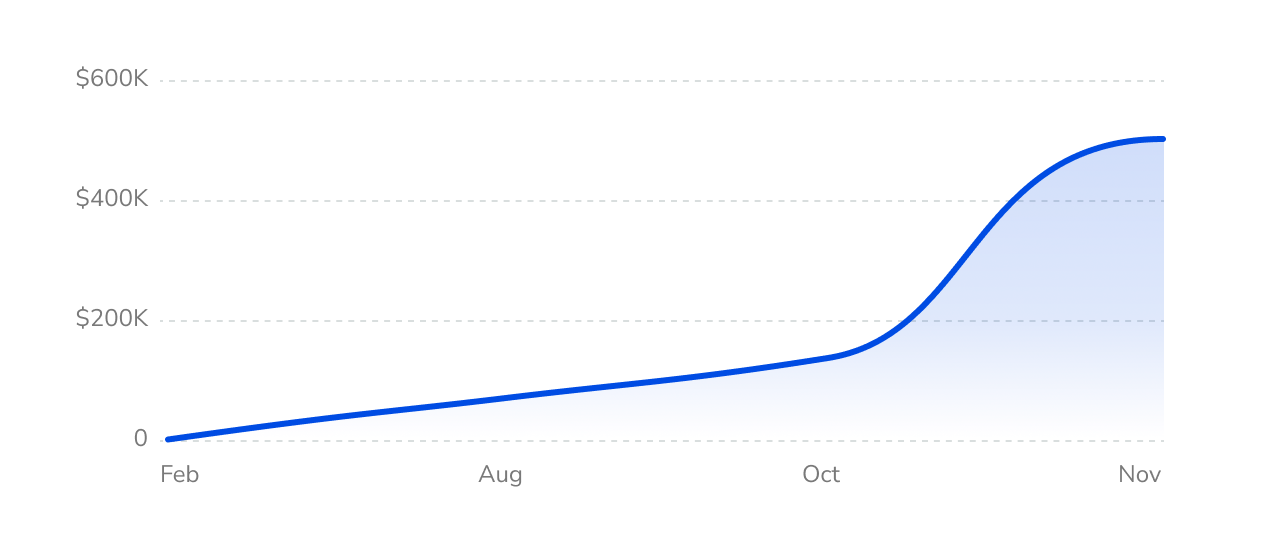
February 2025: Partnership begins August 2025: $71K contribution margin October 2025: $105K contribution margin (goal achieved) November 2025: $563K net profit (peak)
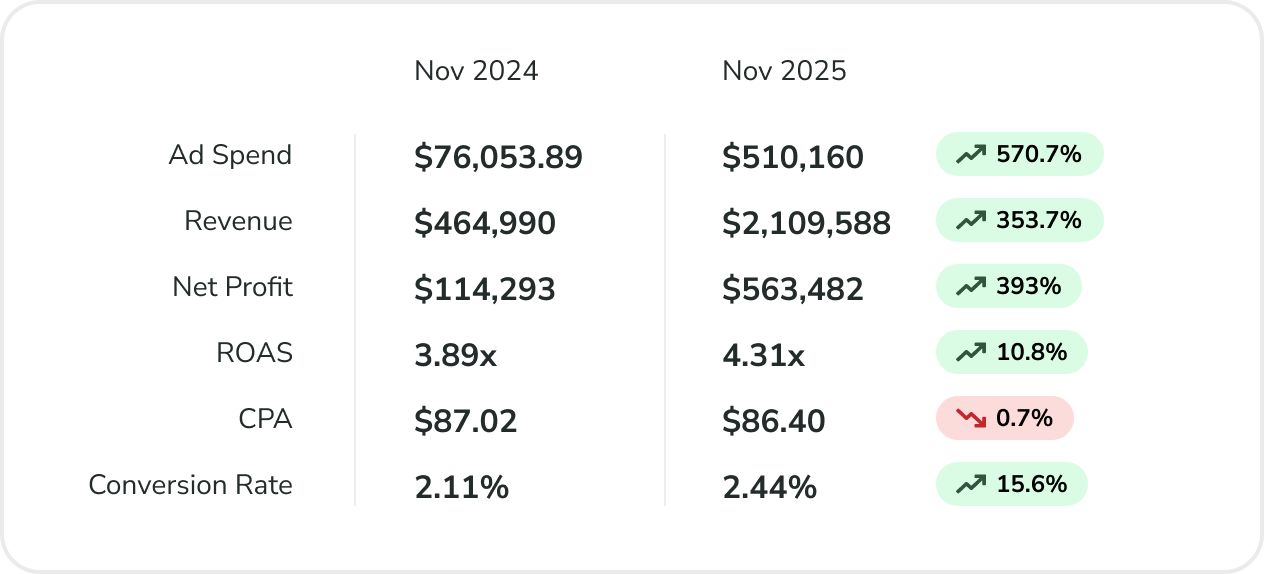
Traditional agencies set campaign budgets weekly or monthly. We reallocate daily—sometimes multiple times per day—based on what's actually working in the moment. When a creative or audience segment shows strong early signals (low CPA, high conversion rate, stable performance at higher spend), we shift budget aggressively toward it. When performance dips, we pull back immediately. This dynamic approach prevents wasted spend and keeps dollars flowing only toward proven winners. The results speak for themselves: we went from $71K contribution margin in August to $105K in October (goal achieved), then peaked at $563K net profit in November. Budget surfing was the primary driver behind this trajectory.
2. Consolidated Testing Structure
Rather than spreading testing, retargeting, and evergreen campaigns across fragmented structures, we consolidated them to improve Meta's learning efficiency and give us tighter budget control.
This consolidation allowed us to: Test multiple variations using customer lists and pixel data Identify top-performing lookalike audiences faster Merge winners into a single control audience Scale with confidence rather than guesswork
3. High-Velocity Creative Testing
With 40+ new creatives launching monthly across images and videos, we maintained constant creative refresh to prevent fatigue at higher spend levels. The winning combination that sustained performance: native-style demonstration ads + scripted UGC videos + feature/problem-focused static images. Whenever we broke this format mix, performance trended down—proving that creative discipline matters as much as creative volume.
Creative sourcing evolution: Month 1: Limited to existing product shots and b-roll Months 2-3: Used AI to generate new product images Months 4+: Added variety with dogs and humans using the product in real environments
Testing wasn't random. We informed every creative with customer reviews, ad comment feedback, and hypothesized personas—ensuring volume had direction.
4. Funnel Optimization Beyond the Product Page
One surprising discovery: the advertorial landing page and even the homepage converted at a higher AOV than the standard product page. We got intentional about funnel routing: new creatives tested on the product page first to establish baseline performance, then promoted to the advertorial only after proving efficiency. This let us manage CPA increases strategically—accepting slightly higher acquisition costs only when supported by meaningfully higher order values. This same approach now guides holiday sale execution, where we route traffic based on offer type and customer intent rather than defaulting everything to product pages.
5. Audience Simplification
Complex targeting wasn't the answer. We tested multiple lookalike variations, identified top performers, then consolidated them into a single control audience. Simpler structure, better learning, more efficient delivery.
What Made This Successful
1. Speed and decisiveness prevented waste.
We didn't let underperformers linger hoping they'd improve. New creatives and audience tests were evaluated on early signals and either scaled or cut within days.
2. Format discipline sustained performance.
The combination of organic-style videos, scripted UGC, and feature-focused statics created a resilient creative ecosystem. Breaking this balance caused immediate performance drops.
3. Trust enabled execution.
After proving efficiency in month one, we took full ownership of strategy and execution. From there, performance improved through fast pivots, tight budget control, and constant reallocation toward what was working.
4. The approach is repeatable.
This wasn't luck or a one-time win. It was a system built around budget surfing, batch creative testing, audience consolidation, and funnel optimization—scalable across other accounts facing similar challenges.
The Results