
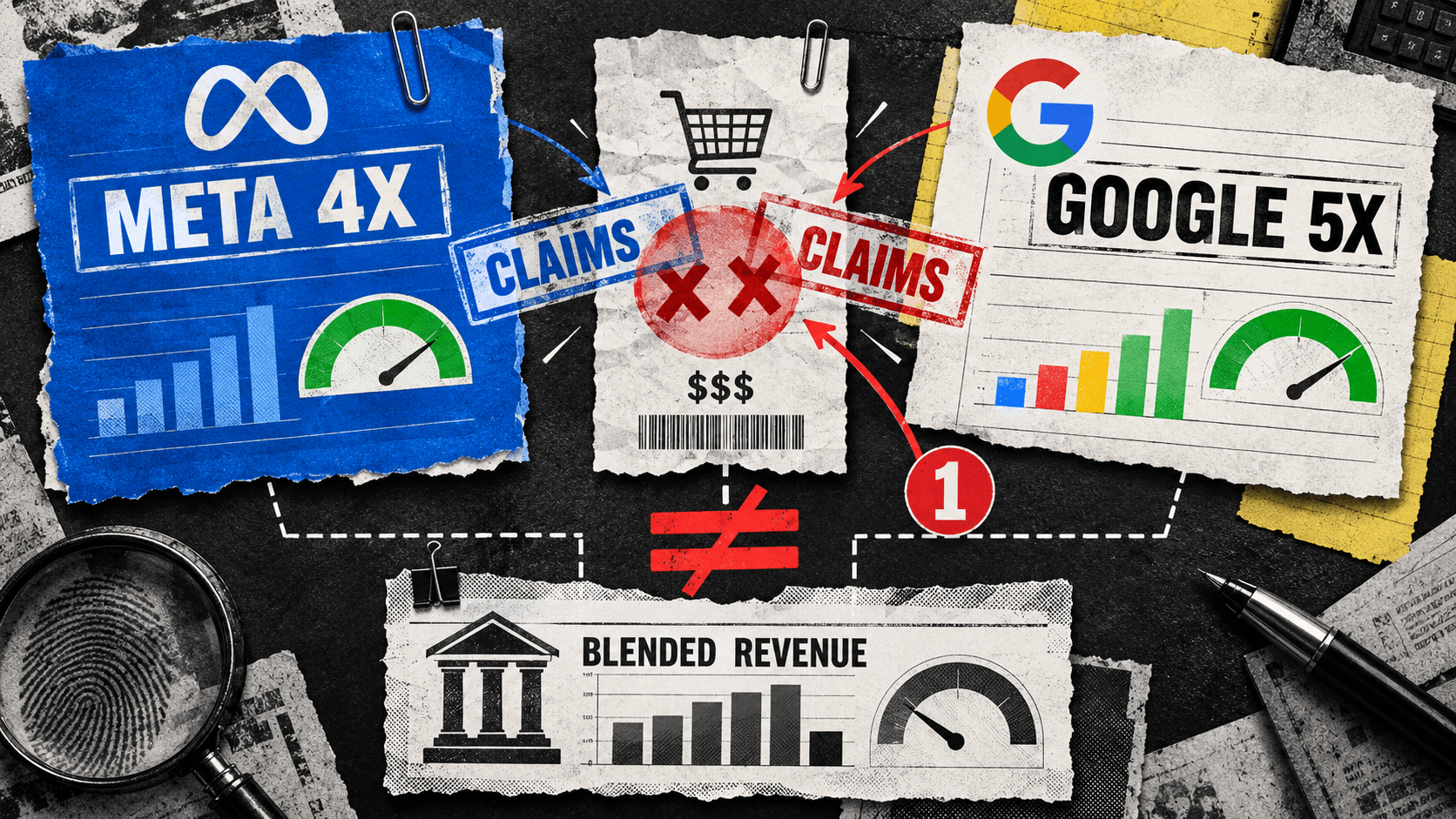
Meta says it drove a 4x return last month. Google says 5x. Add both to what the business actually banked and the math does not close, because together they claim more revenue than the company made.
That is the problem a single-channel audit can never catch. Audit Google alone and it looks healthy. Audit Meta alone and it looks healthy too. The leak only shows up when you put them side by side against one blended number.
A paid media audit is the portfolio-level version. It checks each channel, then checks the channels against each other and against reality.
This is how we run one across Google and Meta, and how to tell which one to fix first.
TL;DR
- A paid media audit is portfolio-level. Auditing one channel at a time hides the cross-channel problems.
- Two platforms claiming the same conversion is the most common finding, and it inflates both at once.
- Reconcile every channel against blended revenue before you judge any channel on its own number.
- Fix the channel corrupting the measurement first, not the one with the worst reported ROAS.
What Is a Paid Media Audit?
A paid media audit is a portfolio-level inspection of every channel you pay to run, Google, Meta, and any others, judged together rather than one at a time. A single-channel audit asks whether Google Ads is set up well. A paid media audit asks whether Google and Meta are still telling you the truth once you combine them.
That distinction is the whole point. Each platform reports on itself, in its own favor, using its own attribution window. Left alone, they double-count, overclaim, and quietly compete for the same budget. The audit's job is to inspect each account, then reconcile all of them against the one number that cannot flatter itself: what the business actually banked.
It spans everything you pay to place, Google Ads and Meta at the core for most brands, plus any secondary channel like AppLovin, TikTok, or a paid search partner. The more channels you run, the more the value shifts away from tuning each one and toward reconciling all of them, because that is where the money actually goes missing.
Why Single-Channel Audits Miss the Problem
The reason to zoom out is that the most expensive problems live between the channels, not inside them. A channel audit tunes each account in isolation, which is necessary but not sufficient, because it cannot see the overlap where two platforms fight over the same sale.
The channel-level mechanics still matter, and we keep them in their own posts on purpose. The account-by-account checks live in the Google Ads audit and the Facebook ads audit. This post sits above both: it assumes each channel has been inspected on its own, then asks the harder question of how they behave together.
The Cross-Channel Checks
These are the checks that only make sense with every channel on the table at once.
The Same Conversion, Counted Twice
Start with the finding that shows up on nearly every account: one sale claimed by two platforms. A shopper clicks a Meta ad, searches your brand a day later, clicks a Google ad, and both platforms record the purchase as theirs. Neither is lying, but added together they invent revenue that never existed.
To measure it directly, pull each platform's reported conversions for the same date range, add them together, and compare that total to the real order count in your store for the window. If the platforms sum to more orders than you actually received, you have just measured the double-count, and the size of the gap tells you how bad it is.
Healthy: Platform-claimed revenue sums to roughly what you banked.
Failure: Google and Meta together claim 130% of actual sales, which means every ROAS in front of you is inflated.
Attribution Windows That Disagree
Check the windows next, because they decide who gets to claim what. Meta usually runs 7-day click and 1-day view, Google's default is often set differently, and view-through settings widen the overlap further. When the windows disagree, the same conversion falls inside both. The neutral referee is a third source, and a consistent model in Google Analytics is the usual one.
The fix starts with writing the click and view window for every channel in one place, then setting them as close to identical as each platform allows. You will not erase the overlap, but you will know its size, which is the difference between a number you can adjust for and one that quietly misleads you.
Healthy: Aligned, documented windows across every channel.
Failure: Nobody can say which window each platform is using.
Budget Split Across Channels
Once both accounts are inspected, look at how budget is divided between them and whether that split still fits the business. Prospecting share should track budget by revenue stage rather than last quarter's habit. A quick test: if you cannot say what the last incremental thousand dollars earned on each channel, the split is running on habit, not evidence.
Healthy: Money flows to the channel with the best incremental return.
Failure: Spend anchored to whichever platform had one good month and was never revisited.
Per-Channel Performance, Read Honestly
Now read each channel's performance, and only now, because the checks above decide whether the number means anything. What counts as a good Meta ROAS depends entirely on how much of it is real versus double-counted.
Healthy: A per-channel ROAS you can defend against the blended figure.
Failure: A proud in-platform number that evaporates the moment you reconcile it.
Concentration Risk
Last, step back to the portfolio. If one platform carries almost all of your spend, every finding above becomes a single point of failure. Weighing AppLovin against Meta, or any second channel, is how you test whether a fallback exists.
Healthy: A dominant channel plus at least one proven alternative.
Failure: Total dependence, where a single CPM spike stalls the whole business.
The Cross-Channel Audit at a Glance
| Check | Healthy | Failure Signal |
|---|---|---|
| Double-counting | Platform-claimed revenue sums to about 100% of banked | Google and Meta together claim more than you banked |
| Attribution windows | Windows aligned and documented across channels | The same conversion falls inside two windows |
| Budget split | Spend follows each channel's incremental return | Spend anchored to last quarter's habit |
| Per-channel ROAS | Survives reconciliation against the blended figure | Evaporates the moment the double-count is removed |
| Concentration | One dominant channel plus a tested second | Total dependence on a single platform |
Reconciling the Channels Against Blended
This is the step single-channel audits skip entirely, and it is where the audit earns its fee. Add up what every platform claims, then hold that total against what the business actually banked. The gap between them is your double-count, and closing it changes every decision underneath it.
The reconciliation itself is simple to build and uncomfortable to read. Put three columns side by side for the same period: what you spent per channel, what each channel claims it earned, and what the business actually banked in total. Sum the platform-claimed revenue and divide it by the banked figure. Anything over 100% is the overclaim, spread across the channels in roughly the proportion each one over-reports. That single percentage quietly reframes every ROAS on the page.
Judge the channels on MER and ROAS together rather than on either alone, because blended efficiency is the one number no platform can inflate. Where a channel's contribution is genuinely in doubt, incrementality testing settles whether it caused sales or only took credit for them. And because acquisition cost is where the double-count bites hardest, reconcile CAC and CPA against real new-customer revenue instead of platform math.
Your blended source of truth usually lives outside every ad platform, in Shopify's marketing reports or their equivalent. The payoff is rarely a new tactic. On one pet brand's Google account, nothing was wrong with the bids or the copy, and attribution alignment was what let spend scale 140% with acquisition cost holding flat.
Which Channel to Fix First
When both accounts look bad, resist the urge to start with the worst reported ROAS. Fix the channel corrupting the measurement first, because until the data is clean the ranking itself cannot be trusted. In practice that means resolving the attribution overlap before you touch either budget.
After measurement, fix the channel that is throttling the system, not the one with the ugliest number. A Meta account where ads stop scaling often drags down the blended figure that makes Google look worse than it really is. The practical test is to ask which fix makes the other numbers more trustworthy: a tracking or attribution repair does that for the whole account, while a creative tweak does not, so it waits its turn.
This ordering, measurement first, then the bottleneck, then optimization, is exactly what we work through whenever a brand brings us on to manage paid media across both platforms.
How Often Should You Audit Paid Media?
Audit the full portfolio quarterly, and reconcile against blended monthly, since the double-count creeps back the moment budgets shift. The quarterly pass catches structural drift, while the monthly reconciliation catches the overlap before it distorts a whole quarter of decisions.
Trigger an audit immediately when blended CAC climbs while every platform still reports a healthy ROAS, when you add a channel, or when you first start spending. Knowing the right moment for starting paid media is its own decision, but once you run more than one channel, the cross-channel audit stops being optional.
Frequently Asked Questions
1. Which Channel Should You Audit First?
Audit the one corrupting your measurement first, usually whichever is claiming the most inflated attribution, not the one with the worst reported ROAS. Until the double-counting is resolved, you cannot trust the numbers well enough to rank the channels, so cleaning the data always comes before optimizing any single account.
2. How Do You Tell if Google and Meta Are Double-Counting the Same Sale?
Add each platform's claimed revenue together and compare it to what the business actually banked. If the platforms together claim more than 100% of real sales, they are double-counting. A neutral third source with one consistent attribution model, sitting outside both ad platforms, confirms where the overlap is happening.
3. Can You Audit Paid Media Without a Blended Reporting Setup?
Partly. You can still inspect each account's structure, tracking, and creative, but you cannot do the reconciliation that makes a paid media audit worth running. Building even a basic blended view, platform spend against total banked revenue, should be the first fix the audit recommends, because everything else depends on it.
4. Should You Pause a Channel During an Audit?
Rarely. Pausing distorts the very data you are trying to read and can reset learning on the paused channel, which costs you more than the audit saves. Audit while everything runs, and only pause a channel after the reconciliation proves it is genuinely unprofitable rather than just badly attributed.
5. How Is a Paid Media Audit Different From a Channel Audit?
A channel audit inspects one account in isolation and asks whether it is set up well. A paid media audit inspects every paid channel together and asks whether they are telling the truth once combined. The cross-channel version catches double-counting, attribution overlap, and budget misallocation that no single-channel audit can see.