
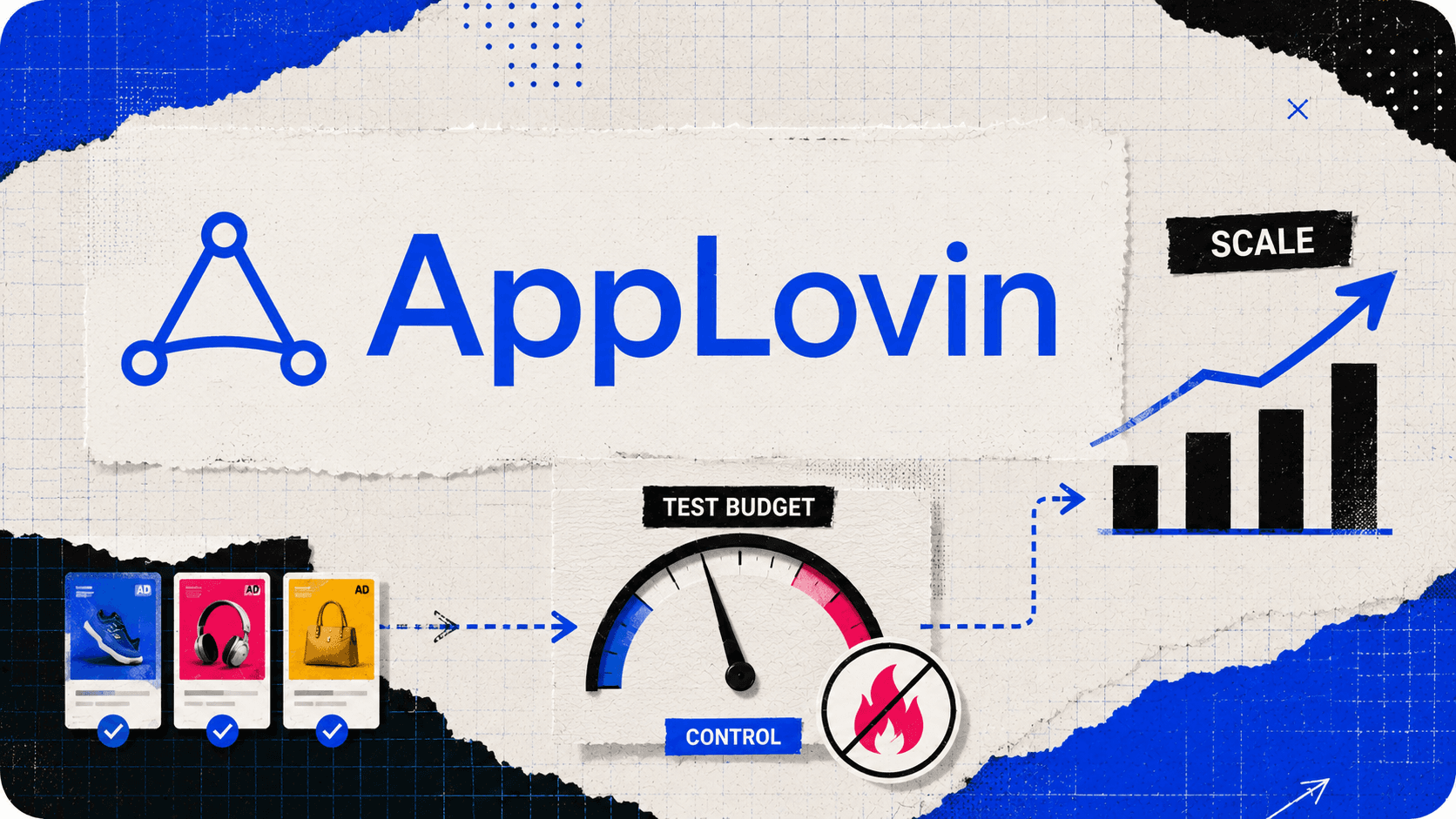
AppLovin has become the first acquisition channel outside Meta and Google that many DTC brands can scale profitably, which is why testing it well matters. Since its Axon Ads platform opened to public self-serve in June 2026, the referral requirement is gone and the channel is open to any Shopify brand willing to run a real test.
The brands that make it work treat the test as an experiment with a set budget and a clear exit criterion. The ones that burn through the budget underfund the test, judge it in three days, and react to AppLovin's dashboard instead of what the channel adds to the business.
This guide covers how much to spend, how long to wait, which numbers to trust, and how to scale once the test proves out.
TL;DR
- Fund the test at the spend level you actually intend to run, not a token amount. AppLovin's incrementality changes with spend, so a starved test answers the wrong question.
- Give it two to four weeks. Axon has a learning phase like Meta, and an inconclusive early read usually means more time or spend, not a dead channel.
- Know which attribution mode your dashboard is reporting on, clicks-only or clicks-and-views. Either way it is platform self-attribution, so judge the channel on incremental lift in blended MER and new customers.
- Feed Axon accurate purchase value on every order. A missing or zero value pushes it toward the cheapest, worst delivery.
How Much Should You Spend to Test AppLovin?
Fund the test at the budget you actually intend to operate at, not a cautious fraction of it. AppLovin's incrementality is tied to spend level, so a $500-a-day test can read as non-incremental when a $5,000-a-day campaign would have worked. Testing small to “be safe” is the fastest way to get a false negative and walk away from a channel that would have scaled.
Commit a real test budget for a defined window, and ask your AppLovin rep whether any onboarding credit is available for your account, which can offset a meaningful share of the first test. If you are new to the platform, our explainer on how AppLovin works for ecommerce covers the setup and the audience before you commit spend.
How Long Should You Run a Test Before Scaling?
Plan for two to four weeks before you judge anything. Axon runs a learning phase much like Meta's learning phase, where delivery is exploratory and early performance swings are noise rather than signal.
The trap is calling the test in week one. An inconclusive result is not a negative one. In practice it usually means the test needed more days or more spend to resolve, not that the channel failed. Set the window and the budget up front, and hold to both before you decide.
What Metrics Should You Watch During an AppLovin Test?
Start by understanding what AppLovin's numbers are. Its attribution documentation gives web campaigns two reporting modes: clicks only, which counts conversions attributed to a click through to your site, and clicks and views, which also counts a purchase within one day of viewing an ad. Conversion windows run from D0, the 24 hours after the ad engagement, and D7, the 192 hours after a click, out to D14 and D28.
Which mode you are reading changes the number more than most teams realize. Clicks only is the conservative setting and tends to undercount the revenue AppLovin influences through exposure. Clicks and views credits that exposure and carries the same optimism as the default reporting on other major platforms. Neither one is causal.
The only reliable read is incremental: did blended MER and new-customer volume rise when AppLovin turned on, and fall when it turned off?
That is a business-level question, and it is the same discipline behind tracking MER alongside platform ROAS on every channel. Pick one attribution mode, keep it consistent so your week-over-week reads stay comparable, and watch the blended number rather than the platform's slice of it.
How to Set Bidding Strategies Without Overspending
The single most important input is not the bid, it is the value you feed the model. Pass accurate purchase value on every order, after discounts and shipping, in your store currency. Send a zero or a missing value and Axon falls back to optimizing for the cheapest clicks it can find, which is the worst path the model can take.
With clean value flowing in, set a target near your break-even and give the algorithm room before you touch it. Frequent target changes restart learning and waste the spend that was funding it.
“When platforms learn from revenue instead of leads, scale stops being fragile. High-growth brands move from lead-level guessing to revenue-driven certainty.”
When Should You Increase Spend on AppLovin?
Increase spend once the test clears its learning phase and shows a real lift in blended MER and new customers, not just a healthy-looking dashboard ROAS. Stable incremental performance is the signal. A good platform-reported number on its own is not.
Scale in steps rather than one large jump. The same gradual-scaling discipline that keeps a Meta account from spiking its CAC applies here, and if you have scaled on Meta the rhythm will feel familiar, though the two channels differ in ways worth knowing before you move budget between them. Top AppLovin spenders tend to grow their total budget rather than pulling dollars out of Meta, because the point of the channel is net-new reach.
How Do You Scale AppLovin Without Tanking ROAS?
Raise budget gradually, keep feeding accurate value, and keep fresh creative in rotation so the model always has new signal to work with. Protect your target ROAS as you go rather than loosening it to chase more volume, which usually buys cheaper, weaker traffic.
The step most brands skip is re-checking incrementality at each new spend level. Because AppLovin's incremental contribution shifts as you scale, a channel that was clearly additive at $3,000 a day can quietly stop being additive at $15,000, and only the blended read will show it. Scaling this way, with measurement built in, is how we run AppLovin for DTC brands.
Frequently Asked Questions
1. How Do You Know If AppLovin Is Actually Working?
Not from the dashboard alone. Run an incrementality read: compare blended MER and new-customer volume with AppLovin on versus off, using a holdout or a clean on/off period. Whichever attribution mode you report on, clicks-only or clicks-and-views, the dashboard is still self-attributed, so business-level lift is the signal that matters, not the platform's reported ROAS.
2. What Is the Biggest Mistake DTC Brands Make When Testing AppLovin?
Testing at too low a spend, killing it early, then judging it on dashboard ROAS. An underfunded, short test reads as “AppLovin does not work” when it was never set up to answer the real question. Fund it at operating spend, hold the window, and measure incremental lift.
3. Is AppLovin Worth It for DTC Brands?
It depends on how saturated your Meta prospecting already is. AppLovin's value is incremental reach among mobile-app users that social-first platforms are not serving well. For brands hitting a ceiling on Meta, it is often the strongest net-new channel available. For brands with plenty of Meta headroom, it is less urgent.
4. How Does AppLovin Compare to Meta for DTC?
They reach overlapping buyers through different mechanisms: Axon uses contextual AI across a mobile-app network, while Meta uses social-graph and interest signals. Reporting is closer than it used to be, since AppLovin now offers a clicks-and-views mode alongside clicks-only, though its view window is a single day. Most eight- and nine-figure brands end up running both as complementary channels rather than treating one as a replacement.