
Case Study · Luxury E-Scooter · Meta Rescue
How We Cut Meta CAC 89% on a $2,500 Luxury E-Scooter in 60 Days
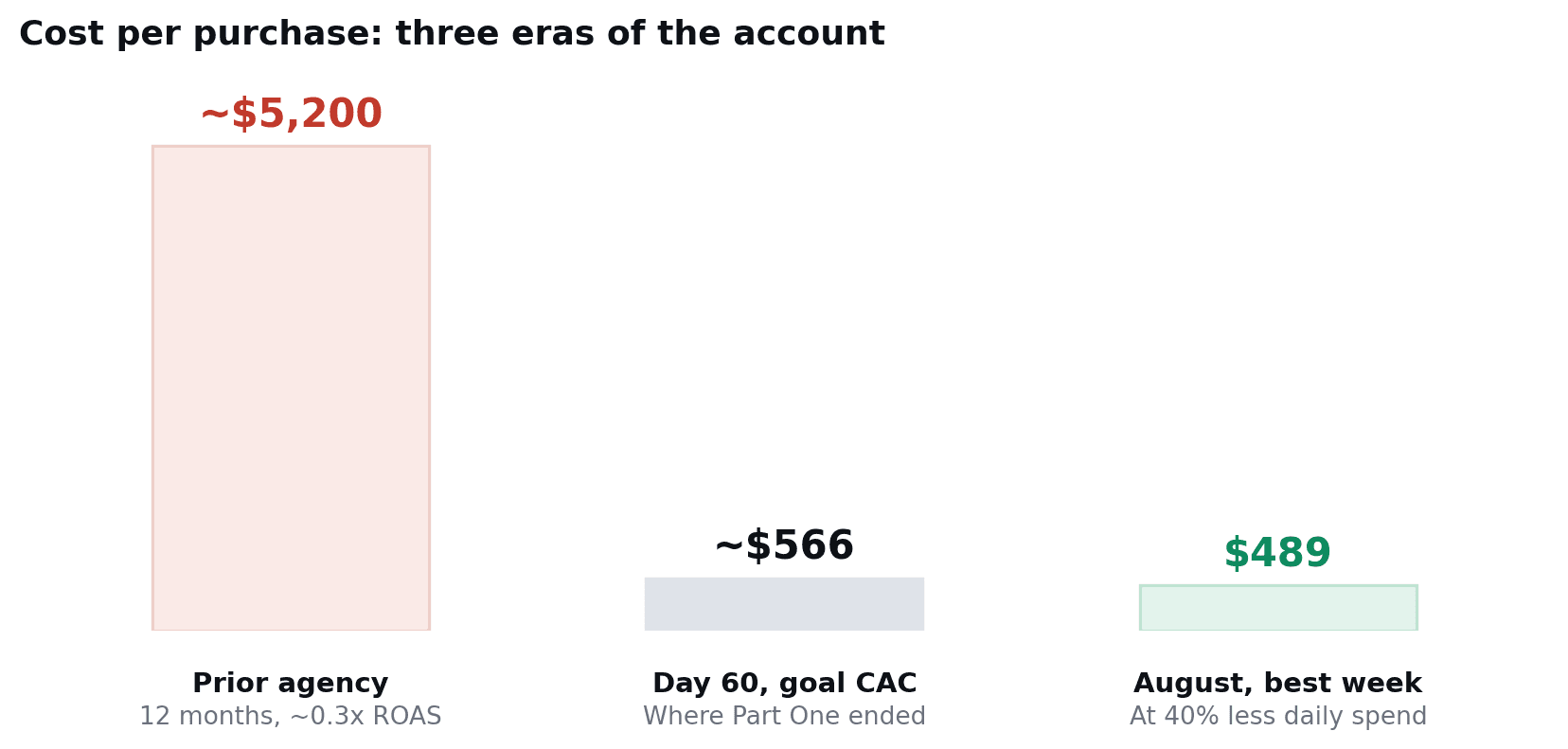
This luxury e-scooter brand's lineup starts at $990 and lands above $2,000 AOV. A considered, high-ticket purchase that's brutal to sell cold on Meta. A previous agency spent a year and $20,800 proving exactly that. We took over the account, and within 60 days cut CAC by ~89% and turned it into a scaling machine on Meta.
89%
Meta CAC Reduction
From ~$5,200 down to ~$566 per sale
60 Days
Cold Start to Goal CAC
Takeover to a scaling machine on Meta
−42%
Daily Spend, Cut on Purpose
And cost per sale fell with it
$489
Best-Week Cost Per Sale
At 3.65x ROAS, the account's best yet
A Year of Spend Without Sales
This brand never had a problem with its product. In fact, it had one of the best products on the market. But it was completely different than the other category leaders. It was more expensive than most scooters on the market. It wasn't foldable. It was built out of one piece of aerospace-grade aluminum and was engineered by Formula One engineers.
In the twelve months before we took over, the account spent roughly $20,800 at around a 0.3x return.
Activity was sporadic: a trickle of spend through 2025, dark from October to February, then a heavy $7.5k–9k-a-month push in March and April 2026 that still converted almost nothing.
What We Changed
Five Moves, Made Together in the First Weeks.
Purchase Optimization From Day One
Previously, the account was optimized on a mix of clicks and purchases. We went all in on purchase optimization. It cost more per click, but it aimed the account at the metric that mattered: purchases.
Product as the Hero
In previous creative, the product was rarely the star. It was a mix of unboxings, showing off the hanger feature, and other tangents. This is a scooter built by F1 engineers. We showed it in motion and demonstrated its smooth ride.
The Range as a Pricing Ladder
Launching the full M1 / M2 / M3 range let the funnel handle sticker shock. The M1 ($990, from $44/month) reframes the category; most buyers move up, landing above $2,000 for the average order value.
Financing and Section 179 to the Front
“From $44/month,” 0% financing, and the Section 179 deduction (roughly half of its US buyers can claim it) reframed the pricing and made it more approachable. We made both impossible to miss.
Conversion-Rate Work on the Site
Traffic was never the constraint. A rebuilt buy-box, product page, and range-map widget roughly 2x'd the site conversion rate through mid-June. That single change let spend scale without CAC running away.
The Creative Engine
The account wins on a system, not one hero ad: some creatives fill the funnel, some close it, and a fast loop turns audience reactions into the next round of ads.
A Film That Feeds the Funnel
The hero film (long and short cuts) drives ~42% of impressions and ~30% of spend. The short cut is a reach machine (1.34M impressions at a $4.90 CPM); the long cut is the top consideration piece (13,080 clicks, 4.55% CTR). Its job is to fill the room; other ads close it.
The Closer: Social Proof, Not Spec
The single best-converting asset in the account is our own edit of the founder video, built around pure desirability (“people stop them in the street to ask what it is”) and it drove nearly a third of purchases on its own.
Objection-handling statics (financing, “worth-expensing / 100-day trial”) hit gold-CAC territory by removing the money objection at the moment it bites.
Creative From the Comment Section
We leverage ad comments as a way to find objections fast. Using that feedback loop, we update creative to eliminate objections before they happen, reframe objections into benefits, and address the hardest ones head on.
The “They Deleted It” advertorial (built from skeptics' own objections about removing the fold) returned 4.95x ROAS. The comment section is a free, continuous creative brief.
The First 60 Days: ROAS Climbed From Zero to 2.2–2.7x
From the first live campaigns on ~13 May, the account moved from a standing start to a steady, scaling machine.
Weekly ROAS climbed from break-even to a sustained 2.2–2.7x on Meta's own reporting as spend more than doubled. The account is now holding above 2x on conservative reporting, week after week.
The Creative Hierarchy
Rather than optimise ad by ad, we built the budget around a deliberate structure, with each tier of the funnel getting a different job and a different creative format:
Founder videos with our best b-roll, engaging AI-voiceover scripts and edits, longer-format video.
Statics displaying benefits, and videos directly responding to the objections buyers raise most.
Financing-plan and offer-based creative: static or short-form video.
A high-ticket item like this runs a very different creative funnel than a low-ticket one: the video doing the reach work up top is also doing real closing work further down, which isn't how a $50 impulse-buy account behaves.
Who Is Buying
The buyer profile locked in fast and gave us a targeting edge. Purchases skew strongly male and 45+, with the majority of early buyers landing in that band.
We bid down audiences that click but don't convert (25–34 and 65+ throttled ~80%, under-25 off) and let budget concentrate on real buyers. The Section 179 and financing angles resonate hardest with this group. Demand clustered in Miami and San Francisco alongside the coasts.
August 2026 · The Update
Then the Client Asked Us to Slow Down
Most agencies talk about scaling. Almost none ever get the opposite brief.
The Ads Outran the Supply Chain
Through July the account kept compounding: CAC fell another 28% week over week while ROAS climbed 43%, on CTRs above 9% and clicks under $0.30. Then, in August, the answer to “how fast can we scale” arrived from an unexpected direction. Four constraints landed at once:
The mandate: sell through the final units at maximum efficiency, on minimum spend, without killing the account's momentum. Anyone can buy sales with budget. Holding efficiency while cutting it is the harder test, and it separates a structure that works from one being carried by spend.
Consolidation and Creative Discipline
On a reduced budget, every pound of manual allocation costs twice as much. The proving phase was over. The efficiency phase needed one clean structure, only proven creative, and an algorithm left alone to do its job.
Consolidate the Winners Into One CBO
Proving creative needs ad-set budgets forcing spend into every test. Efficiency needs the opposite. On August 4 we collapsed everything into a single prospecting campaign on campaign budget optimization at ~$680/day, highest-volume bidding, no bid caps, no audience micromanagement.
Only Proven Creative Earns a Seat
The CBO launched exclusively with ads that had already produced purchases: the spoken founder-story video, the objection-handling statics, and the Section 179 business-expensing family. Everything unproven was retired. Testing budgets are for proving phases.
Let the Algorithm Allocate
No caps hands budget allocation to Meta's delivery system, which reads auction signal no buyer can see. Our job shifted from steering spend to curating inputs: which creative was in the pool, and where the traffic landed.
Route Demand Up-Range
With inventory finite, every sale had to carry maximum value. We retired the entry model from the store, concentrating demand on the mid and flagship tiers. Order values held near $1,700 with the M3 at over 60% of sales.
Judge Weeks, Not Days
Every decision is graded on relative CPA against a rolling weekly benchmark, never a single day. That discipline is how you avoid killing winners on a slow Tuesday or scaling noise on a lucky Friday.
Spend Went Down, Efficiency Went Up
Daily spend was cut 42%, from roughly $1,180 a day to $680. Cost per sale fell 55% against the old structure's final stretch, and the account posted its most efficient week since takeover: a $489 CAC at 3.65x ROAS, under goal. Two individual days closed sales at $250 and $295.
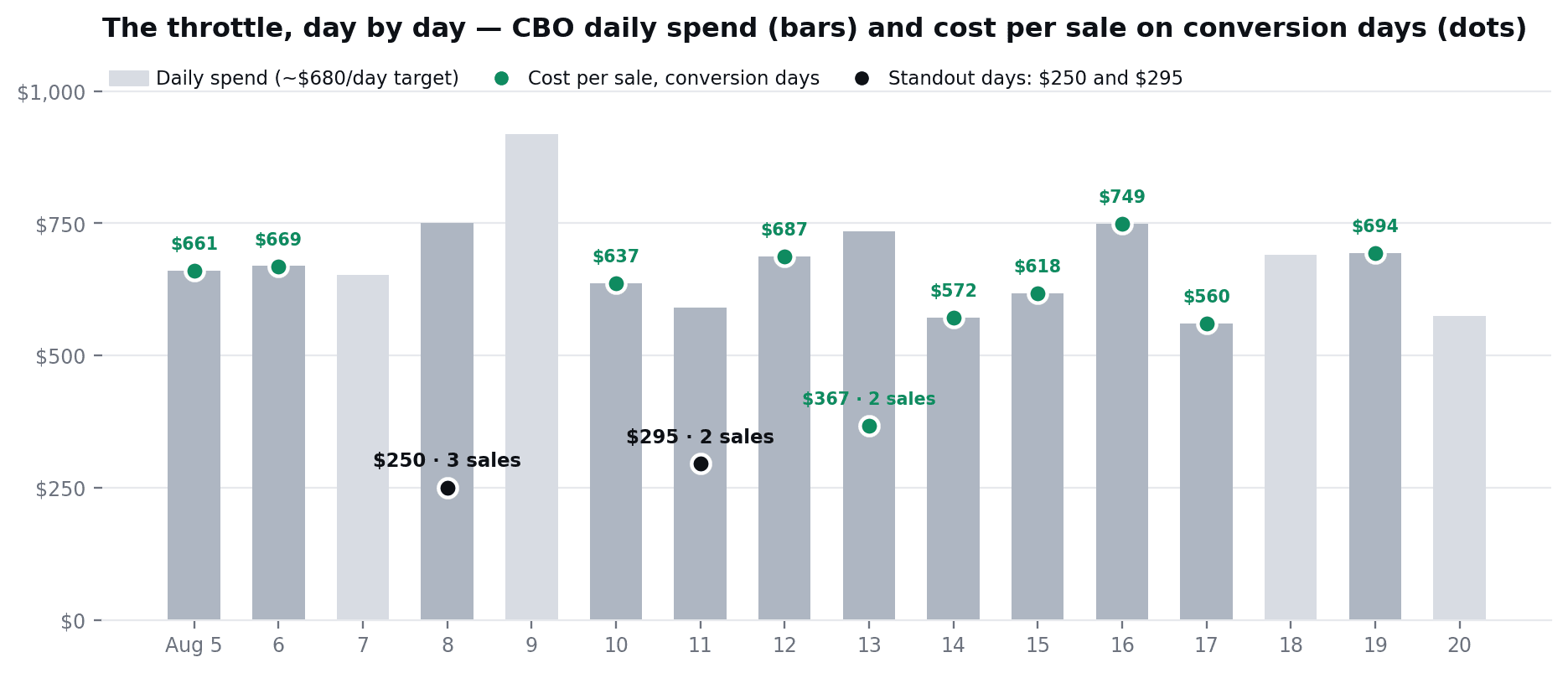
The throttle was meant to stretch the final units into the fall. Instead, unit velocity held so well at the reduced budget that the run kept selling ahead of schedule. The account is now pacing toward a full sell-through, with the spend saved going straight into the war chest for the next launch.
“Before we started working with you, we genuinely weren't sure this was possible. You've proven what everybody said was impossible.”
Where This Goes Next
This is the rare case study that ends with the spend turned down on purpose, and that is the point. The account found goal CAC from a cold start, held it while scaling, and held it again while throttling. Cutting daily spend 42% while cost per sale fell 55% showed the economics stand on structure and creative rather than budget. That makes the next scaling phase a decision instead of a gamble.
None of it was a lucky week. It was a deliberate sequence we can rebuild on any high-ticket account facing the same constraints: prove creative under ad-set budgets, consolidate the winners under one CBO, hand allocation to the algorithm, and grade everything on rolling weekly CAC.
Every dollar not spent selling the outgoing run is a dollar available for the next-generation launch, where the playbook is already built: a pre-order engine with a waitlist and pre-launch email series, a launch offer with genuine scarcity, a loyalty deal for existing owners, and lookalike seeds from a purchaser base that has finally crossed the volume threshold where lookalikes get sharp.
Data notes: all figures are Meta in-platform reporting for May 11 to August 20, 2026. The account bills in GBP; figures are converted at approximately £1 = $1.36 and rounded. Consolidated CBO figures cover August 4 to August 20. Best-week figures reflect the rolling seven-day window of August 8 to 14. Client identity and product roadmap details are withheld at the brand's request ahead of an upcoming launch.
Ready to Build Results Like These for Your Brand?
We turn down brands we don't think we can move the numbers for. Tell us about yours and we'll be honest about whether we're a fit.