
By the time a founder-operator starts shopping for an email marketing agency, email is usually already "set up" by a generalist agency or a freelancer, and nobody can say whether it is working.
The accounts we audit in this revenue range almost always arrive with the same profile: Klaviyo flows that have not been touched in a year, campaigns and automations competing instead of coordinating, and a revenue dashboard nobody trusts.
This article covers how to evaluate an ecommerce email marketing agency, what to ask before you sign, what it should cost, and when hiring one actually makes sense.
How Do You Choose an Email Marketing Agency for Ecommerce?
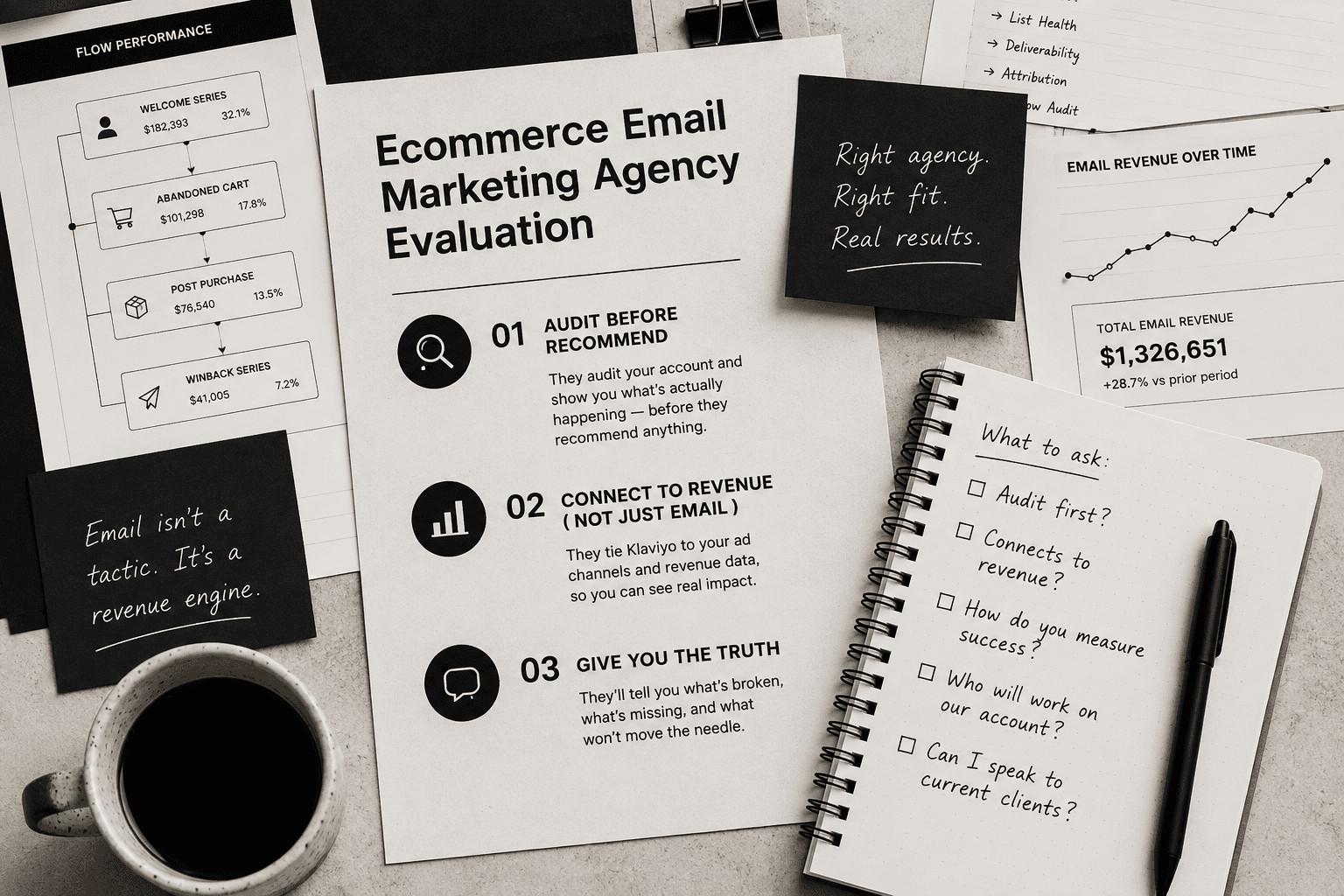
Choose an ecommerce email marketing agency by evaluating three things in order:
- whether they audit before they recommend
- whether they connect email to your paid media and revenue data
- whether they will give you an uncomfortable answer
Deliverable counts (campaigns per month, number of flows) matter far less than diagnostic ability.
An agency that recommends a plan before seeing your account is selling a template. The first deliverable from any ecommerce email marketing agency worth hiring is an audit: flow-by-flow review, deliverability, list health, and how much of total revenue your owned channels actually drive.
The second filter is integration.
Email segmentation data should feed your Meta targeting, and paid performance should inform how flows get prioritized. When those run as two vendors who never talk, you get a fragmented strategy and two different interpretations of your brand.
We sequence before we scale, which means we do not scale paid media until email is healthy.
Because we manage brands at $1M, $5M, and $10M, we can tell you what healthy email contribution looks like at your specific stage, not a generic number borrowed from a blog. We have pulled PMax for 40% of clients and told founders their ROAS number was lying to them.
That willingness to give the answer you did not want is rare, and it is the thing that actually protects your budget.
What Most Founders Get Wrong When Choosing an Email Agency
Campaign volume is the metric founders fixate on. It is also the least predictive of revenue. The common move is to compare agencies on how many campaigns they send, how many flows they build, and how polished the designs look.
High send frequency without lifecycle timing trains your list to wait for a discount. More emails to the same unsegmented list just lifts your unsubscribe rate. The agencies worth hiring optimize for when and to whom, not how often.
"Most brands still miss the fact that email marketing is about lifecycle timing, not just blast frequency."
Devyn Pukteris, Head of Email & SMS, Sweat Pants Agency
If you want to see what under-built timing looks like in practice, the structural problems behind underperforming Klaviyo flows are usually the first thing an audit surfaces.
What Results Should an Email Marketing Agency Produce?
An email marketing agency should move metrics that predict revenue, not vanity opens. Expect a rising share of total revenue from owned channels, healthier flow revenue, and list growth that converts.
A credible agency commits to a process and to leading indicators, not to a guaranteed revenue number, because anyone guaranteeing a specific figure before auditing your account is guessing.
Across three engagements in our portfolio, fixing the email infrastructure produced this:
| Brand | What Was Broken | Result After Rebuild |
|---|---|---|
| Condition 1 (protective cases) | Flows, pop-ups, and campaigns worked against each other during BFCM | 679.9% BFCM revenue growth YoY; email list 135K → 240K |
| 5-brand Klaviyo portfolio | Evergreen flows ran unchanged during sales periods | $6.5M+ BFCM email revenue; flow revenue up 40–247% |
| GLP-1 telehealth brand | No automation at patient-journey drop-off points | Email and SMS revenue up ~9x within 30 days |
The results from one of our clients came from coordination, not more sending. When we rebuilt the BFCM system so campaigns and flows stopped cannibalizing each other, revenue grew 679.9% year over year against a goal of 100%. Read the full case study →
What Questions Should You Ask Before Hiring an Email Marketing Company?
Ask questions that reveal judgment, not just capability. The strongest signal is whether an agency will commit to a point of view about your account, and whether they will name what they would not do. Five questions separate a diagnostic partner from a campaign vendor:
- Will you audit our Klaviyo account before recommending anything, and what does that audit cover?
- How do you connect email performance to your paid media and overall revenue (MER, contribution margin), not just email-attributed revenue?
- What would make you tell us to wait, or not to hire you at all?
- How do you decide what to fix first?
- Who owns the account day to day, and how often do flows get revisited after launch?
The answers to questions two and three matter most. An agency that only reports email-attributed revenue is hiding inside a metric that ignores how the rest of your spend performs.
Freelancer vs In-House vs Email Marketing Agency: Which Is Right for Your Brand?
A freelancer is the cheapest option and works best when your strategy is already set and you need execution.
An in-house hire gives you daily ownership and brand depth, but you are capped by one person's experience. An ecommerce email marketing agency costs more than a freelancer but brings pattern recognition across many brands and can connect email to paid.
The right choice depends on whether your bottleneck is hands or judgment.
| Freelancer | In-House Hire | Email Marketing Agency | |
|---|---|---|---|
| Best for | Execution when strategy is set | Daily ownership, brand depth | Strategy plus execution, multi-channel |
| Cost | $ | $$ (salary plus benefits) | $$–$$$ retainer |
| Pattern recognition | One brand's experience | One brand's experience | Many brands across revenue stages |
| Email plus paid coordination | Rare | Depends on the team | Built in when the agency runs both |
| Main risk | Capacity ceiling, single point of failure | One person's ceiling | Onboarding and fit |
When Is the Right Time to Hire an Email Agency?
Hire an email marketing agency when email is materially under-contributing to revenue and you cannot diagnose why, when you are about to scale paid media on top of a weak owned-channel foundation, or when BFCM is approaching and your flows have not been rebuilt for it.
The wrong time is before you have product-market fit or enough list volume to work with.
The sequencing matters here. Scaling paid spend while your email foundation leaks is how brands burn budget acquiring customers they never reactivate. Get the owned channel healthy first, then pour traffic into a system that converts it.
FAQs
1. What should an email marketing agency cost?
Most ecommerce email marketing agencies charge a monthly retainer. Execution-only work tends to sit in the low-to-mid four figures, and pricing rises when strategy, SMS, and paid-media coordination are included. Price is less useful than what you are buying. An agency selling output is cheaper than one selling judgment and integration, and usually costs more in the end.
2. Should an email marketing agency also manage SMS?
Ideally, yes. Lifecycle email and SMS share the same customer data and timing logic, so splitting them across two vendors usually produces conflicting sends and a worse experience. Across our portfolio, SMS flows generated meaningful incremental revenue with minimal opt-outs when built alongside email, not separately from it.
3. Do email marketing agencies need to use Klaviyo?
Klaviyo is the dominant lifecycle platform for Shopify DTC brands, so most specialist agencies work in it natively. A good agency should be deep in your existing stack rather than pushing a migration without a clear revenue reason. Forcing a platform switch on day one is a flag, not a feature.
4. How long before an email marketing agency shows results?
Leading indicators such as flow revenue and deliverability can move within the first 30 to 60 days. One GLP-1 telehealth brand we rebuilt saw email and SMS revenue rise roughly 9x within 30 days. Timelines vary with list health, list size, and how much was broken when work began.