
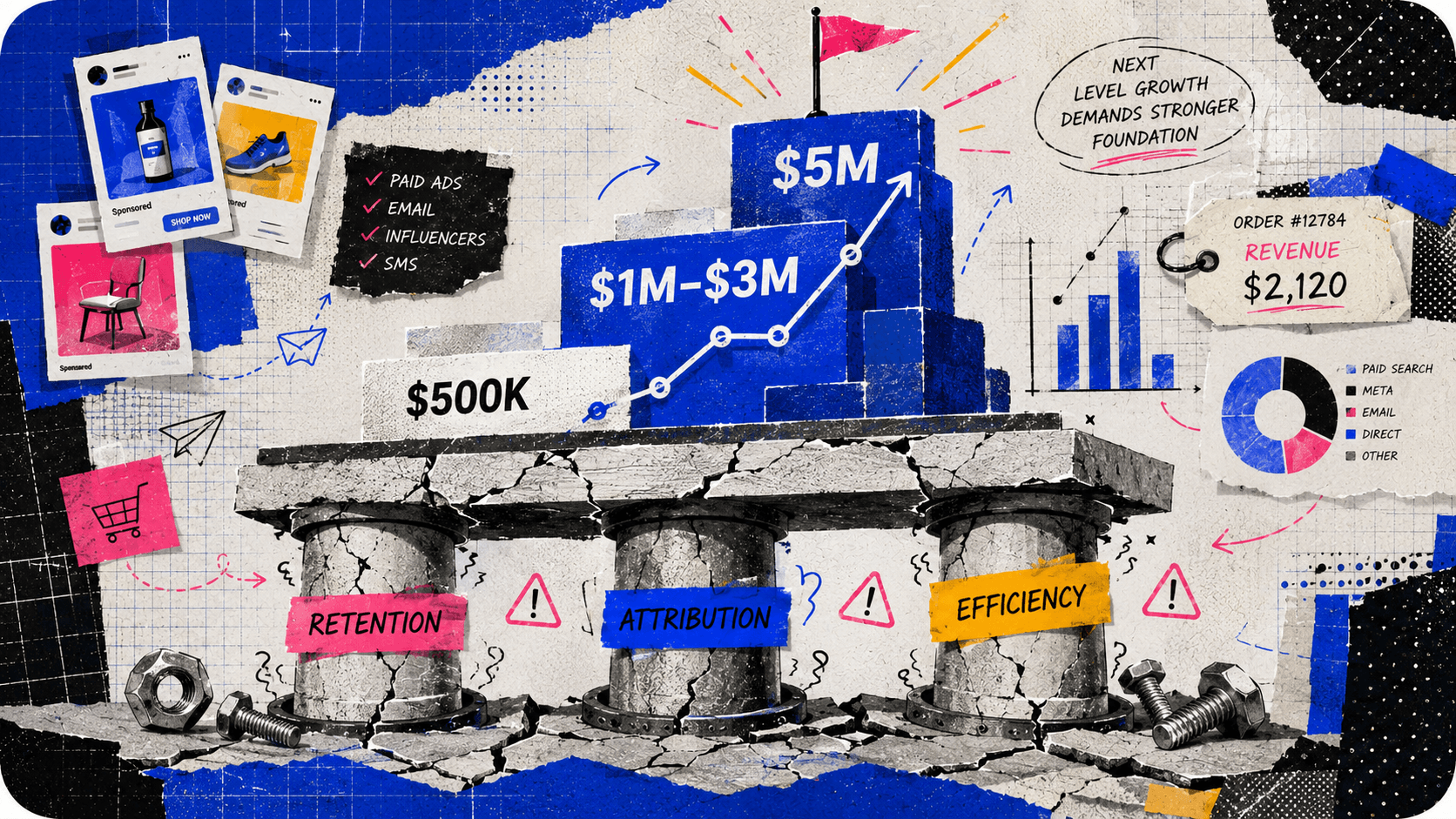
The moves that got a brand to $500K stop working somewhere between $1M and $3M. The product is proven and the team knows how to execute. What slips is the foundation underneath the growth. Retention, attribution, and channel efficiency have not kept pace with revenue, and the gap starts showing up in the numbers.
These mistakes are not random. After inheriting dozens of accounts in this revenue range, our team at Sweat Pants Agency keeps seeing the same handful of patterns. The brands that reach $5M efficiently catch them early. The ones that stall usually find them the expensive way, after spending real money to prove the lesson.
TL;DR
- The $500K to $5M stage is where structural mistakes compound fastest. Revenue is real enough to fund them at scale but not large enough to absorb them.
- The most expensive mistake is scaling spend before the conversion and retention foundation can support it. Repeat purchase rate is the clearest signal of whether that foundation is ready.
- Attribution breaks quietly in this range. Brands that have not built clean measurement by $2M make budget decisions on data that no longer reflects reality.
- The brands that clear this stage cleanly made one deliberate choice: fix before scale, rather than scale and fix later.
What Marketing Mistakes Do DTC Brands Make at $1M Revenue?
The most common one is treating paid media as the main growth lever while underbuilding everything that makes paid efficient. Email is a single flow. The product page has never been tested against cold traffic. Attribution is one blended ROAS number from a platform that claims credit for everything it can.
Early paid efficiency at low spend reflects platforms finding high-intent buyers fast, people who were close to purchasing anyway. As spend scales and the audience widens, efficiency drops. By then the brand has months of spend history and a retention problem it has not noticed, because top-line revenue is still climbing. The metric that surfaces this first is repeat purchase rate, which is why it leads the list below.
The Seven Most Expensive Mistakes
Here they are in the order they tend to bite, starting with the one that quietly drains paid efficiency long before anyone traces it back to the source.
1. Scaling Paid Before Retention Is Ready
The trap is scaling paid spend while email sits below 15% of total revenue, so every new customer lands in a system that does not keep them. Repeat purchase rate, the share of customers who buy more than once in a 90-day window, is the fastest way to see it. Most consumable brands (skincare, supplements, coffee, pet food) land at 25 to 35%, and big-ticket categories run lower because the repurchase cycle is longer, so compare against your own baseline rather than an industry average. If yours sits at 15% against a category norm of 30%, paid is buying customers who churn at twice the expected rate, and no amount of creative testing fixes that. When spend climbs while LTV stays flat, retention is where the budget is leaking.
To turn it around before scaling further:
- Fix the post-purchase flow first, since the first 30 days after an order is when a repeat habit forms or gets lost.
- Time replenishment and win-back messaging to the product's real usage cycle, not a fixed calendar.
- Build a distinct first-30-day segment instead of dropping new buyers into the general list.
- Track repeat rate for paid-acquired customers specifically, since a blended number hides a weaker paid cohort.
2. Treating ROAS as the Primary Success Metric
At $500K, ROAS is a reasonable proxy. By $2M it is dangerous, because it measures what a channel claims credit for, not what the marketing investment actually produces. The failure looks like this: paid ROAS holds strong, spend increases, and MER declines because the incremental spend is cannibalizing organic and direct revenue instead of generating new demand. By $2M, MER belongs alongside platform ROAS on every budget decision.
3. Broken Attribution Foundation
The most common structural problem is one Performance Max campaign mixing branded and non-branded spend with no visibility into which is driving what. Branded terms convert cheaply and pollute the blended numbers, which makes non-branded campaigns look less efficient than they are.
When we rebuilt a pet brand's Google Ads account with clean branded and non-branded separation, non-branded revenue grew 105% while CAC held flat at $45.
4. Belief-Based Channel Spending
“Don't fall into the trap of ‘belief-based’ marketing. Just because a channel is a ‘staple’ doesn't mean it's performing downstream. You must pull back spend on lagging channels regardless of their historical reputation.”
Brands at $1M to $3M run channels because DTC brands are supposed to run them. Budget gets allocated by convention instead of evidence. The question worth asking: if this channel went dark for 30 days, what would actually happen to revenue?
5. Hiring a Generalist Agency at the Wrong Stage
The $1M to $3M stage is when most brands first hire outside help, and when the wrong hire costs the most. A generalist covering email, paid, SEO, and social across every vertical has no portfolio-level pattern recognition for DTC at this specific stage. You get six months of fees and output that could have come from a blog post.
6. Adding Channels Before Optimizing Existing Ones
Every hour spent standing up a new channel is an hour not spent improving a channel that already makes money. A Meta account running at 60% of its potential efficiency is a bigger opportunity than a TikTok account that might work. Before adding anything, ask what 90 days of improving your existing channels by 20% is worth against what the new channel would return in the same period.
7. Discounting as the Default Revenue Lever
Once a meaningful share of the list has bought at a discount, full-price emails convert at a fraction of the rate. Each round then needs a deeper discount for the same response, margin compresses, and the dependency deepens. The fix is not to stop promoting. It is to run promotions with defined windows, a clear reason, and suppression logic that keeps recent full-price buyers from seeing offers they never needed.
The Seven Mistakes at a Glance
| Mistake | When It Starts | What It Costs |
|---|---|---|
| Scaling paid before retention is ready | $500K to $1M | Unsustainable CAC, high churn |
| ROAS as the primary metric | $1M to $2M | Overspend on acquisition |
| Broken attribution | $1M to $2M | Optimization on bad data |
| Belief-based channel spending | $1M to $3M | Budget stuck in underperforming channels |
| Generalist agency at wrong stage | $1M to $3M | Six months of generic output |
| Adding channels before optimizing | $2M to $4M | Diluted focus across all channels |
| Discounting as default lever | Any stage | Margin compression, offer dependency |
How to Know If Your Brand Is Already in One of These Patterns?
Five questions we run when auditing a new account in this range:
- What share of total revenue comes from email flows versus campaigns? Below 20% from flows means retention is not working.
- Is MER this month lower than it was six months ago while platform ROAS holds steady? If so, paid is cannibalizing organic demand.
- Can you see CAC separately for branded and non-branded paid search? If not, attribution needs work before any budget decision is reliable.
- What is the 90-day repeat purchase rate for paid-acquired customers specifically? More than 30% below your overall repeat rate means paid is buying a lower-quality cohort.
- When did you last run a creative test that challenged a core assumption? More than 90 days means the account is optimizing inside a frame that may no longer hold.
Frequently Asked Questions
1. What Is Repeat Purchase Rate?
Repeat purchase rate is the percentage of customers who buy more than once within a defined window. Calculate it as customers with 2 or more orders in the period divided by total customers in the period, times 100. Most DTC brands track it on a 90-day basis to isolate how a specific acquisition cohort behaves, rather than blending in older customers.
2. What's a Good Repeat Purchase Rate for a DTC Brand?
It depends on category. Consumable and replenishable products like skincare, supplements, coffee, and pet food typically see 25 to 35% repeat purchase within 90 days. Considered or big-ticket purchases run lower, because the natural repurchase cycle is longer. The most useful comparison is against your own historical baseline, not a flat industry number.
3. How Do You Calculate Repeat Purchase Rate?
Divide the number of customers who placed 2 or more orders in a period by the total number of customers in that period, then multiply by 100. Run it separately for paid-acquired customers and for your full list, because a blended number can hide a retention gap in your newest cohort.
4. What Are the Biggest Errors Scaling From $500K to $5M?
Seven consistent patterns: scaling paid before retention, using ROAS instead of MER, broken attribution, belief-based channel spending, generalist agencies at the wrong stage, adding channels before optimizing existing ones, and defaulting to discounts when growth slows. Most brands in this range have at least three running at once.
5. How Do I Avoid Mid-Stage Marketing Traps?
Run the five diagnostic questions above honestly. The answers tell you which trap you are in. The fix is almost always the same: do the structural work before increasing spend, not after.
6. When Should a DTC Brand Hire a Marketing Agency?
After validating product-market fit and having enough internal clarity to judge the output. At the $1M to $5M stage, a specialist agency for a specific channel almost always outperforms a generalist trying to cover everything.
7. How Does the Right Approach Change Between $500K and $5M?
At $500K the job is validation. At $1M it is foundation: retention, attribution, and making paid efficient. At $3M it is compounding: optimize what already works, build better measurement, and resist adding complexity before existing systems perform.